- LOGIN
- MemberShip
- 2026-08-27 13:43:48
- Pharmaceutical services market expands as industry evolves
- by Son, Hyung Min | translator Alice Kang | 2026-08-27 09:43:29

The era of agents has arrived. As multinational pharmaceutical companies reorganize their operations around changing business priorities, the service industry supporting them from the outside is gaining an increasingly prominent presence.
It has long been common for pharmaceutical companies to outsource key functions such as legal advice, public relations and pharmacoeconomic evaluations to specialized firms. What has changed recently is the breadth and depth of the work performed by these external providers. Professional services are becoming increasingly specialized, covering reimbursement and pricing, pharmacoeconomic evaluation, policy response and market access strategy for new drugs, as well as product communications.
The changes at major law firms are a prime example. Former officials who handled pharmaceutical pricing and reimbursement at MOHW’s Pharmaceutical Benefits Division, HIRA’s Pharmaceutical Benefits Department and New Drug Listing Division, and the NHIS’s Insurance Benefits Department have joined leading law firms. Once largely limited to working-level officials, recruitment has recently expanded to former heads of the Pharmaceutical Benefits Division and HIRA’s Pharmaceutical Benefits Department, as well as former health ministers and vice ministers.
The role of consulting firms is also expanding. External advisers are now used not only to prepare pharmacoeconomic evaluation data submissions but also to determine which reimbursement pathway a new drug should pursue and to analyze how changes in drug pricing policy may affect a company’s portfolio and develop corresponding strategies.
A similar trend is emerging in the PR industry. The continued introduction of new drugs and indications is increasing the need for product communications. Rather than expanding their in-house PR teams accordingly, however, pharmaceutical companies are increasingly dividing responsibilities with external agencies.
Drug pricing officials move to law firms…from working-level staff to former ministers and vice ministers
One development illustrating the expansion of pharmaceutical and healthcare practices at major law firms is the movement of former public-sector officials with experience in healthcare policy and drug pricing and reimbursement.
Particularly notable is the succession of former heads of the Pharmaceutical Benefits Division joining law firms. The division is a core unit of the MOHW responsible for the full spectrum of pharmaceutical benefits policy, including new drug listings, pricing systems, post-listing drug price management and reassessments of reimbursement eligibility. Because these policies directly affect the market entry of new drugs and the prices of existing products, the division has extensive points of contact with the industry.
Former heads of the Pharmaceutical Benefits Division, Yang-ji Ryu, joined Yulchon; another, Myung-seop Kwak, joined Kim & Chang, and Chang-hyun Oh joined Bae, Kim & Lee. Sung-tae Kim, a former deputy director who worked on reimbursement listings and post-listing management at the division, also moved to Kim & Chang before joining Shin & Kim.
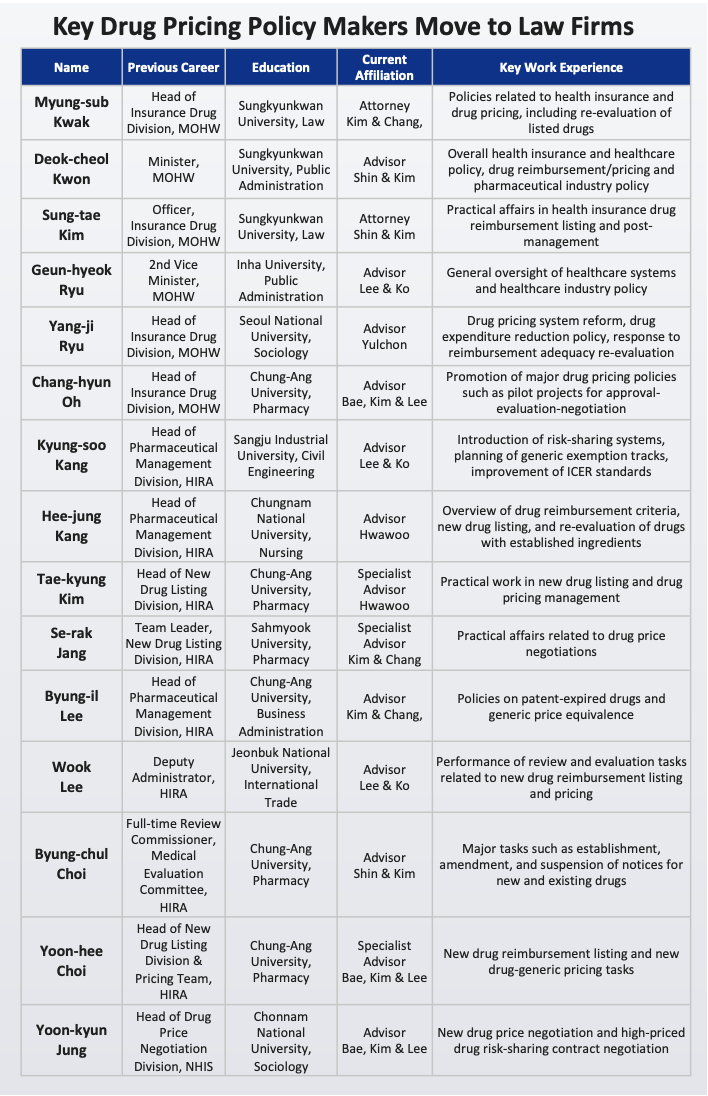
Their government experience extends well beyond simply having worked in the division. During his tenure as its head, Ryu oversaw a major overhaul of the drug pricing system and policies aimed at reducing pharmaceutical expenditure. Kwak also handled major policies concerning health insurance coverage and drug pricing. Oh served as both head of the Pharmaceutical Benefits Division and director of the Health Industry Promotion Division, gaining experience across pharmaceutical benefits and biopharmaceutical industry policy.
The successive movement to law firms of senior personnel who directly oversaw the systems governing new drug pricing and reimbursement symbolically demonstrates the recent changes to the pharmaceutical and healthcare advisory market.
A number of former HIRA officials have also joined the legal sector. Former heads of HIRA’s Pharmaceutical Benefits Department Byung-il Lee, Hee-jung Kang and Kyung-soo Kang have each joined major law firms.
Their work in the previous sector is closely connected to the industry’s current pricing and reimbursement issues. Lee handled transaction price-based reimbursement, the reorganization of the existing reimbursement list, and pricing policy for off-patent drugs and generics. Former director Kyung-soo Kang was involved in changes to the new drug listing system, including the introduction of risk-sharing agreements, pharmacoeconomic evaluation submission exemptions and improvements to cost-effectiveness assessment criteria.
Officials with direct experience in new drug reimbursement listings have also moved to law firms, including Se-rak Jang, a former team leader at HIRA’s New Drug Listing Division, and former division officials Tae-kyung Kim and Yoon-hee Choi. Their experience includes new drug reimbursement listings, pharmacoeconomic evaluation, and price determination.
There are also former NHIS officials who negotiated prices directly with pharmaceutical companies. Yoon-kyun Jung, a former head of the Drug Price Negotiation Division, handled new drug pricing negotiations and risk-sharing agreements for high-priced new drugs before moving to a law firm.
Former MOHW minister Deok-cheol Kwon and former vice ministers Geun-hyuk Ryu and Young-chan Lee, all of whom have broad experience in healthcare policy, are also now practicing healthcare at major law firms.
Taken together, their careers reflect the major stages through which a new drug enters the health insurance market. MOHW establishes the overall pricing and reimbursement framework; HIRA evaluates the drug’s eligibility for reimbursement and its economic value; and the NHIS negotiates its price and any risk-sharing agreements with the pharmaceutical company.
With professionals who have experience at each stage, from policymaking to reimbursement assessment and price negotiations, joining their ranks, law firms are further specializing their pharmaceutical and healthcare advisory capabilities. These professionals are also actively voicing their opinions on major pending issues, including proposed changes to generic drug pricing.
These personnel moves have also drawn criticism. Concerns have long been raised about potential conflicts of interest when government officials who directly handled pricing and reimbursement policy retire and join law firms that advise pharmaceutical companies. Similar concerns were raised recently when former Pharmaceutical Benefits Division head Chang-hyun Oh joined a law firm.
Separate from such controversy, however, major law firms’ continued recruitment of these professionals also demonstrates the growing use of pricing, reimbursement and policy advisory services within the pharmaceutical and biotechnology industry.
Beyond legal services to policy advice….Law firms’ expanded roles
The scope of services that law firms provide to pharmaceutical companies is also changing.
Patent disputes were traditionally the most prominent area of legal work for the pharmaceutical industry. This subsequently expanded to administrative litigation over rebates, violations of Good Manufacturing Practice requirements, drug price reductions, and restrictions on reimbursement.
More recently, law firms have broadened their role beyond responding to disputes and are increasingly analyzing regulatory changes and assessing their potential effects on corporate clients.
Pricing and reimbursement are complex fields shaped not only by statutes and official notices but also by HIRA’s assessment standards, committee decisions, and negotiations with the NHIS. Even when listing a single new drug for reimbursement, companies must consider numerous variables, including whether to undergo a conventional pharmacoeconomic evaluation, seek an exemption from the submission of economic evaluation data or pursue a risk-sharing agreement.
The expansion of these services is closely related to major law firms’ recruitment of former MOHW, HIRA and NHIS experts to strengthen dedicated healthcare practices alongside their lawyers.
Former heads of the Pharmaceutical Benefits Division are well positioned to analyze the detailed operation of the pricing and reimbursement system and its impact on individual products. Former ministers and vice ministers can provide broader guidance on policy direction and response strategies on health insurance finances and industrial policy.
Inquiries and demand for advice are especially concentrated around periods of major government changes to drug pricing policy. Ahead of and following recent drug pricing reforms, major law firms have held briefings and seminars for pharmaceutical and biotechnology companies to explain the changes and suggest response directions.
Reimbursement consulting expands beyond pharmacoeconomic evaluation to response strategies
Drug pricing and reimbursement consulting is another area in which pharmaceutical companies are making extensive use of external partners.
Outsourcing pharmacoeconomic evaluation has already become common. Demonstrating a new drug’s cost-effectiveness requires companies to build economic evaluation models from clinical data and establish comparators, costs, utility values, and other inputs. Because this requires specialized health economics expertise, companies often commission professional consulting firms to perform related work.
Recently, however, external consulting has expanded well beyond the preparation of pharmacoeconomic evaluation data submissions. Demand is growing for external advice from the earliest stages of determining how a new drug should enter the health insurance system, to analysis of how pricing policy changes will affect existing products and the development of response strategies.
In particular, the government’s planned overhaul of the drug pricing system is pushing the scope of work covered by consulting firms.
Changes to pricing criteria or post-listing management mechanisms affect pharmaceutical companies differently depending on their portfolios. Patent-protected new drugs, off-patent medicines and generics all have different characteristics, so the same policy change may have different pricing implications and require different responses.
On the pharmaceutical companies’ part, companies need to do more than understand the reform; they must identify which products in their portfolios will be affected, estimate the potential price impact, and determine which reimbursement and pricing strategies should be applied to new drugs in their pipelines.
Consulting firms are consequently expanding their role beyond explaining policy changes to include company-specific impact assessments and response strategies reflecting each client’s portfolio and product characteristics. Alongside the increase in industry briefings and training sessions before and after drug pricing reforms, customized advisory work for individual companies is also increasing.
In the past, a pharmaceutical company might first establish its reimbursement strategy internally and then outsource the preparation and analysis of the necessary pharmacoeconomic evaluation materials. More recently, some companies have begun working with external experts from the initial market access stage to determine the appropriate reimbursement pathway and pricing strategy.
New pricing and reimbursement issues continue to arise even after a product is listed, including adjustments to reimbursement scope following indication expansions, budget impact analyses, and post-listing price management triggered by increased usage.
This does not mean that external providers are replacing pharmaceutical companies’ internal Market Access teams. Rather, the internal MA teams continue to oversee product strategy, final decision-making and communications with health authorities, while external capabilities are used for specialized, project-based tasks such as pharmacoeconomic evaluation models and regulatory impact analyses.
In this sense, boundaries between the services offered by law firms and consulting companies are also beginning to overlap. Major law firms are recruiting drug pricing and reimbursement experts and expanding into policy analysis and market access consulting, while consulting companies are broadening their services beyond health economic evaluation to reimbursement and pricing strategy and policy response.

Growing number of new drugs and indications drives PR outsourcing
External specialists are also playing an increasingly important role in public relations.
The Korean pharmaceutical market has recently seen a steady stream of new drug launches and indication expansions. Cancer drugs and rare disease treatments, in particular, create an ongoing need to communicate information about diseases and therapies at each major stage of development and commercialization.
Before approval, companies need to raise awareness of the disease. After approval, they must communicate the clinical value of the new treatment option. Once reimbursement is secured, improved patient access becomes the next issue. Even after launch, additional indications, new clinical trial findings, long-term follow-up data, and real-world evidence continue to emerge.
Communications therefore do not end when a new drug is launched. Each major milestone—regulatory approval, reimbursement, indication expansion or the publication of new clinical findings—generates a new communications project.
However, multinational pharmaceutical companies do not necessarily expand their internal PR teams in proportion to the growth in new drugs and indications. Instead, internal communications teams focus on corporate strategy, coordination with global headquarters and major decisions, while execution of individual product projects is allocated to external agencies.
The work performed by these agencies is no longer limited to writing press releases or organizing press conferences. Their services are becoming increasingly specialized, encompassing disease awareness campaigns, product communications strategy, and media content development.
As a result, competition for securing professionals is intensifying within the healthcare PR industry. The sector requires specialists who understand not only clinical trial findings and medical terminology but also regulatory approval and reimbursement systems.
The restructuring of multinational pharmaceutical companies and the growth of the pharmaceutical services industry are not separate trends.
Streamlining a pharmaceutical company’s organization does not eliminate the work required to bring new drugs to market and sell them. On the contrary, as high-priced new drugs proliferate and pricing and reimbursement systems become more complex, product-related functions, including pharmacoeconomic evaluation, policy analysis, consulting and product communications, are becoming increasingly segmented and specialized.
What has changed is how that work is performed. Rather than maintaining all functions and personnel in-house, pharmaceutical companies are retaining responsibility for core strategy and decision-making internally while drawing on external professionals and expertise for specific projects and specialized assignments.
Even as pharmaceutical companies continue to streamline their internal organizations, the work surrounding new drugs is becoming more specialized. With external specialist companies taking on functions that are increasingly difficult to perform entirely in-house, the role of the pharmaceutical services industry, including law firms, consulting firms and PR agencies, is expanding.
-

- 0
댓글 운영방식은
댓글은 실명게재와 익명게재 방식이 있으며, 실명은 이름과 아이디가 노출됩니다. 익명은 필명으로 등록 가능하며, 대댓글은 익명으로 등록 가능합니다.
댓글 노출방식은
댓글 명예자문위원(팜-코니언-필기모양 아이콘)으로 위촉된 데일리팜 회원의 댓글은 ‘게시판형 보기’와 ’펼쳐보기형’ 리스트에서 항상 최상단에 노출됩니다. 새로운 댓글을 올리는 일반회원은 ‘게시판형’과 ‘펼쳐보기형’ 모두 팜코니언 회원이 쓴 댓글의 하단에 실시간 노출됩니다.
댓글의 삭제 기준은
다음의 경우 사전 통보없이 삭제하고 아이디 이용정지 또는 영구 가입제한이 될 수도 있습니다.
-
저작권·인격권 등 타인의 권리를 침해하는 경우
상용 프로그램의 등록과 게재, 배포를 안내하는 게시물
타인 또는 제3자의 저작권 및 기타 권리를 침해한 내용을 담은 게시물
-
근거 없는 비방·명예를 훼손하는 게시물
특정 이용자 및 개인에 대한 인신 공격적인 내용의 글 및 직접적인 욕설이 사용된 경우
특정 지역 및 종교간의 감정대립을 조장하는 내용
사실 확인이 안된 소문을 유포 시키는 경우
욕설과 비어, 속어를 담은 내용
정당법 및 공직선거법, 관계 법령에 저촉되는 경우(선관위 요청 시 즉시 삭제)
특정 지역이나 단체를 비하하는 경우
특정인의 명예를 훼손하여 해당인이 삭제를 요청하는 경우
특정인의 개인정보(주민등록번호, 전화, 상세주소 등)를 무단으로 게시하는 경우
타인의 ID 혹은 닉네임을 도용하는 경우
-
게시판 특성상 제한되는 내용
서비스 주제와 맞지 않는 내용의 글을 게재한 경우
동일 내용의 연속 게재 및 여러 기사에 중복 게재한 경우
부분적으로 변경하여 반복 게재하는 경우도 포함
제목과 관련 없는 내용의 게시물, 제목과 본문이 무관한 경우
돈벌기 및 직·간접 상업적 목적의 내용이 포함된 게시물
게시물 읽기 유도 등을 위해 내용과 무관한 제목을 사용한 경우
-
수사기관 등의 공식적인 요청이 있는 경우
-
기타사항
각 서비스의 필요성에 따라 미리 공지한 경우
기타 법률에 저촉되는 정보 게재를 목적으로 할 경우
기타 원만한 운영을 위해 운영자가 필요하다고 판단되는 내용
-
사실 관계 확인 후 삭제
저작권자로부터 허락받지 않은 내용을 무단 게재, 복제, 배포하는 경우
타인의 초상권을 침해하거나 개인정보를 유출하는 경우
당사에 제공한 이용자의 정보가 허위인 경우 (타인의 ID, 비밀번호 도용 등)
※이상의 내용중 일부 사항에 적용될 경우 이용약관 및 관련 법률에 의해 제재를 받으실 수도 있으며, 민·형사상 처벌을 받을 수도 있습니다.
※위에 명시되지 않은 내용이더라도 불법적인 내용으로 판단되거나 데일리팜 서비스에 바람직하지 않다고 판단되는 경우는 선 조치 이후 본 관리 기준을 수정 공시하겠습니다.
※기타 문의 사항은 데일리팜 운영자에게 연락주십시오. 메일 주소는 dailypharm@dailypharm.com입니다.

- [Reporter's View] Surgical robotics, What is needed to export domestic tech?
- Reporter's view | Hwang, byoung woo