- LOGIN
- MemberShip
- 2026-08-27 04:37:38
- Multinational pharmas get leaner as restructuring accelerates
- by Son, Hyung Min | translator Alice Kang | 2026-08-26 10:15:51
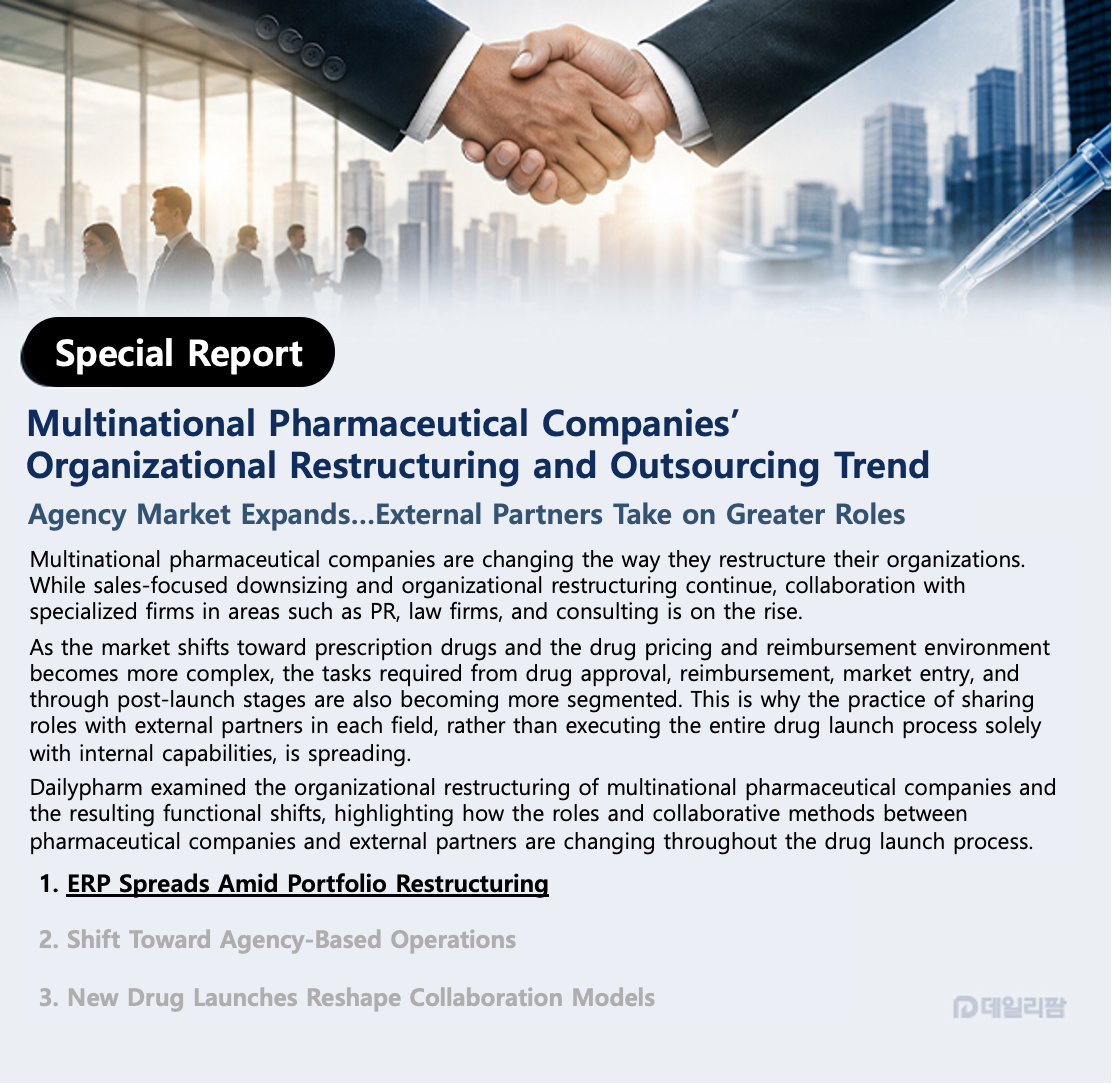
Multinational pharmaceutical companies are changing the way they structure their organizations. As global headquarters reshape their business portfolios, their Korean affiliates have repeatedly implemented early retirement programs (ERPs), while increasingly transferring the management of existing businesses and products to external partners.
While organizational restructuring in the past largely focused on headcount reductions and cost efficiency, companies are now reassessing which businesses and functions should remain in-house. They are concentrating personnel on high-growth new drugs and core therapeutic areas, while scaling back organizations for products that have lost patent protection or fallen in strategic priority and outsourcing some functions, including sales and distribution.
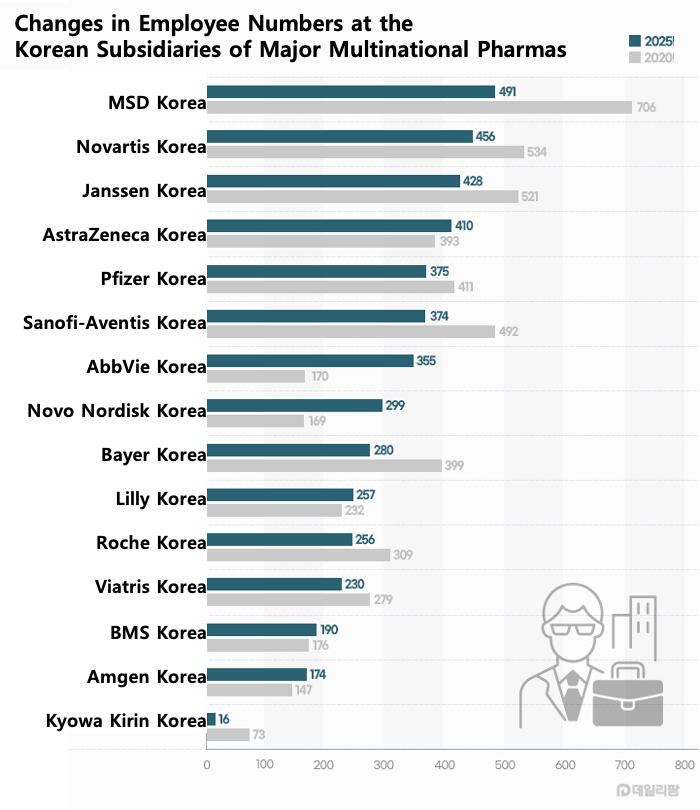
An analysis of 15 major multinational pharmaceutical companies in Korea found that their combined workforce declined by 420 (8.4%) from 5,011 employees in 2020 to 4,591 in 2025.
The trend, however, varied by company. Employee numbers declined at MSD Korea, Sanofi-Aventis Korea and Novartis Korea, among others, while some companies actually expanded their workforces alongside new drug launches and business expansions.
Rather than uniformly downsizing across the board, multinational pharmaceutical companies are seeing their organizational size and composition shift in accordance with global business priorities.
Most see workforce declines…but workforce trends vary widely by company
Workforce changes among multinational pharmaceutical companies in Korea have varied significantly over the past 5 years.
MSD Korea’s workforce fell by 215 (30.5%) from 706 employees in 2020 to 491 last year. Over the same period, Sanofi-Aventis Korea reduced its workforce by 118 (24.0%) from 492 to 374, while Novartis Korea saw a decline of 78 (14.6%) from 534 to 456.
Pfizer Korea’s workforce also declined by 36 (8.8%) from 411 to 375. Kyowa Kirin Korea, which underwent a sweeping restructuring of its Asia-Pacific operations, reduced its workforce by 78.1%, from 73 to 16 employees.
Companies with particularly large workforce reductions shared a common feature: significant changes to their business portfolios.
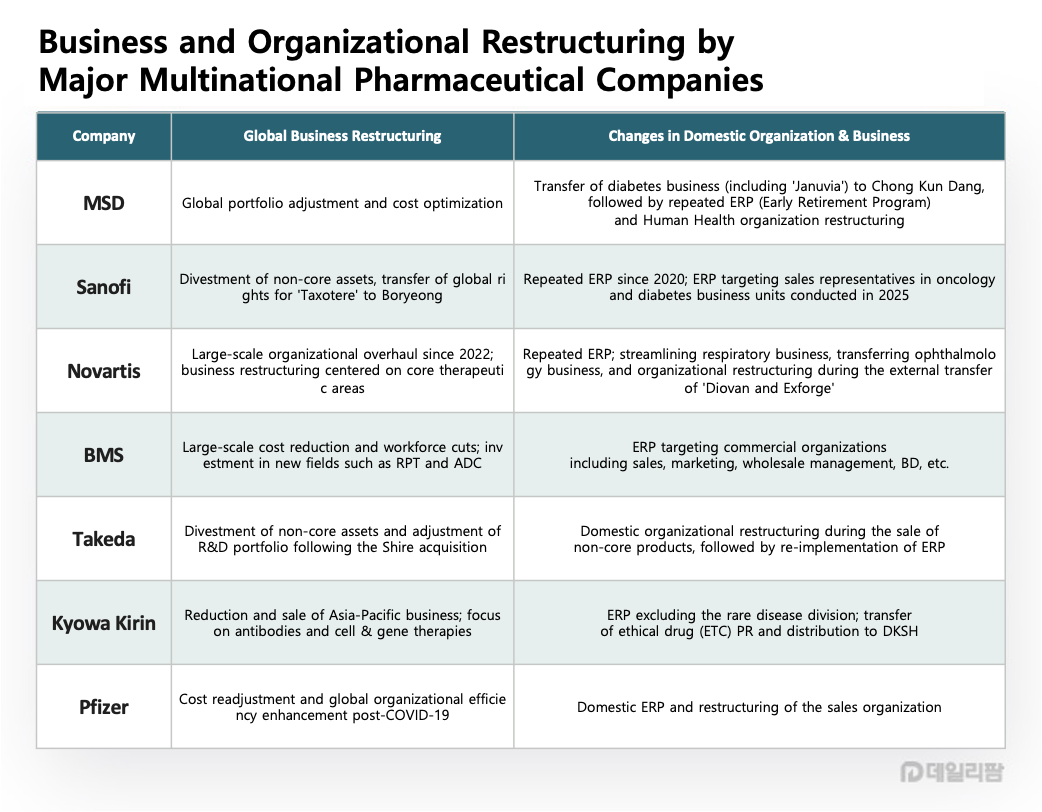
MSD Korea has continued to restructure its organization since transferring its domestic ‘Januvia (sitagliptin)’ diabetes pipeline to Chong Kun Dang. Most recently, it conducted an ERP targeting its Human Health organization.
Sanofi-Aventis Korea has also repeatedly adjusted its domestic organization in line with global business restructuring. With the exception of 2021, the company conducted ERPs every year from 2020 through 2025.
By contrast, some companies significantly increased their workforce as their businesses expanded. AbbVie Korea grew its organization after its 2020 acquisition of Allergan, adding aesthetics and neuroscience to its existing immunology and oncology businesses.
Novo Nordisk has also substantially expanded its workforce over the past 5 years. As GLP-1 products such as Ozempic (semaglutide) and Wegovy (semaglutide) grew rapidly worldwide, the company aggressively expanded production and commercialization personnel, with its Korean workforce also increasing alongside expansion of its GLP-1 business.
Shifting global priorities reshape Korean businesses and organizations
The key feature of recent organizational changes is not simply reducing overall headcount, but deciding where to retain or reduce personnel in line with changes in global portfolios.
BMS has pursued cost reductions in response to patent expirations of major products while stepping up investment in new technologies including radiopharmaceuticals, antibody-drug conjugates (ADCs) and targeted protein degraders. In 2024, it announced plans to cut around 2,200 jobs, equivalent to roughly 6% of its global workforce.
Novartis has also been carrying out major restructuring since 2022. It integrated its oncology and OTC organizations and shifted its R&D focus toward core therapeutic areas including cardiovascular, immunology, neuroscience and oncology. While streamlining its existing organization, it has continued investing in advanced manufacturing and research.
Pfizer launched a global cost realignment program in response to declining COVID-19 vaccine and treatment sales post-pandemic, while Takeda has also pursued restructuring in line with changes in its financial performance and R&D portfolio.
These global changes have directly and indirectly affected the companies’ Korean affiliates, contributing to repeated ERPs and organizational restructuring at companies including Sanofi, Pfizer, Novartis, BMS, Takeda and MSD over the past 5 years.
BMS Korea, for example, continues to restructure its organization. Its immunology business unit in particular is understood to have undergone workforce adjustments that included management positions such as the unit head and sales managers.
The performance of its domestic immunology portfolio is believed to have played a significant role. BMS has sought to expand its immunology business with products including plaque psoriasis treatment Sotyktu (deucravacitinib) and ulcerative colitis treatment Zeposia (ozanimod), but the products are understood to have fallen short of initial expectations in Korea.
The restructuring is particularly notable as Sotyktu and Zeposia need to be developed as new growth drivers following patent expirations of the company’s established key products. It illustrates how companies are adjusting personnel and organizational structures even for newer drugs according to actual market performance and future growth potential, rather than maintaining dedicated organizations simply because new products have been launched.
Products stay, but organizations shrink…companies increase outsourcing
When a product declines in strategic significance, companies are increasingly opting to keep it on the market while transferring commercial rights, sales and marketing, or distribution to external partners rather than withdrawing it altogether.
Sanofi’s oncology drug Taxotere (docetaxel) is one typical example. Approved by the US FDA in 1995, Taxotere has been used to treat various solid tumors, but declining sales following generic entry led Sanofi to classify it as a non-core global asset.
Sanofi transferred the global rights to Taxotere to Boryung. As a result, Sanofi-Aventis Korea included oncology sales employees in its ERP, while offering some employees assistance in seeking positions at Boryung or transferring to office-based roles.
Kyowa Kirin Korea took a more direct approach during its Asia-Pacific restructuring. While conducting an ERP covering employees outside its rare disease business, the company transferred promotion and distribution of established prescription products including Nesp (darbepoetin alfa) and Neulasta (pegfilgrastim) to DKSH.
Kyowa Kirin was generating stable sales in Korea at the time. The move therefore appears to have been less about abandoning the Korean market because of poor performance and more about reallocating resources globally from established businesses toward newer areas such as antibodies and cell/gene therapies.
Novartis has followed a similar path. After winding down its respiratory business and transferring its ophthalmology business externally, it is now restructuring the relevant organization as it transfers the Korean businesses for hypertension treatments Diovan (valsartan) and Exforge (valsartan/amlodipine) to DKSH Korea.
AstraZeneca’s hypertension treatments Atacand (candesartan) and Atacand Plus have likewise shifted to a model in which an external partner manages the domestic business.
These products have one thing in common. They already have an established prescription base in the market. Companies are increasingly concluding that they can maintain product sales without necessarily retaining their own dedicated sales and marketing organizations.
In the past, owning a product generally meant maintaining an internal organization dedicated to it. More recently, separating products from the organizations that commercialize them and entrusting off-patent brands to external partners has emerged as a viable option.
Core new drugs stay in-house…other functions are shared with external partners
The growing use of external partners also reflects changes in multinational pharmaceutical companies’ new drug portfolios.
Multinational pharmaceutical companies are increasingly concentrating R&D and commercialization resources on high-growth areas such as oncology, rare diseases, immunology, and cell and gene therapies.
On the other hand, rather than maintaining a separate organization for existing brands whose patents have expired or with limited growth potential, companies can leverage external firms that already possess sales and distribution infrastructure. This structure allows internal personnel to focus on new drugs and core businesses, while legacy brands are managed through external partners.
The roles required within pharmaceutical organizations are also changing.
Oncology and rare disease therapies generally target relatively limited patient populations and prescriber groups, and clinical trial results, biomarkers, and treatment guidelines play a major role in treatment selection. This has increased the importance not only of traditional large-scale sales organizations but also of medical functions such as medical science liaisons (MSLs), who engage healthcare professionals on clinical evidence, and Market Access functions responsible for reimbursement and pricing.
This does not mean that sales organizations are disappearing or that MSLs are replacing sales representatives. Rather, changes in product portfolios are altering the priority given to the functions pharmaceutical companies need to maintain directly in-house.
At the same time, bringing new drugs to market is becoming increasingly complex. After regulatory approval, companies must develop reimbursement and pricing strategies, prepare pharmacoeconomic evaluation data, respond to policy changes and legal issues, and manage communications with healthcare professionals and patients.
While the scope of necessary work is expanding, companies have less need to maintain full in-house teams for every individual function. Instead, pharmaceutical companies can retain responsibility for core decision-making and strategy while drawing on outside partners such as consulting firms, PR agencies and law firms for pharmacoeconomic evaluations, policy response, external communications and legal advice.
Ultimately, the recent restructuring of multinational pharmaceutical companies is no longer simply a question of how many employees to cut. It has evolved into a process of redefining what should remain in-house and which functions should be shared with external partners based on business priorities.
As outside partners become involved in a wider range of activities, from commercialization of off-patent products to support for new drug market entry, the broader ecosystem surrounding pharmaceutical companies is also changing. This is also why pharmaceutical service industries, including PR, consulting, and law firms, are gaining a greater presence alongside the organizational restructuring of multinational drugmakers.
-

- 0
댓글 운영방식은
댓글은 실명게재와 익명게재 방식이 있으며, 실명은 이름과 아이디가 노출됩니다. 익명은 필명으로 등록 가능하며, 대댓글은 익명으로 등록 가능합니다.
댓글 노출방식은
댓글 명예자문위원(팜-코니언-필기모양 아이콘)으로 위촉된 데일리팜 회원의 댓글은 ‘게시판형 보기’와 ’펼쳐보기형’ 리스트에서 항상 최상단에 노출됩니다. 새로운 댓글을 올리는 일반회원은 ‘게시판형’과 ‘펼쳐보기형’ 모두 팜코니언 회원이 쓴 댓글의 하단에 실시간 노출됩니다.
댓글의 삭제 기준은
다음의 경우 사전 통보없이 삭제하고 아이디 이용정지 또는 영구 가입제한이 될 수도 있습니다.
-
저작권·인격권 등 타인의 권리를 침해하는 경우
상용 프로그램의 등록과 게재, 배포를 안내하는 게시물
타인 또는 제3자의 저작권 및 기타 권리를 침해한 내용을 담은 게시물
-
근거 없는 비방·명예를 훼손하는 게시물
특정 이용자 및 개인에 대한 인신 공격적인 내용의 글 및 직접적인 욕설이 사용된 경우
특정 지역 및 종교간의 감정대립을 조장하는 내용
사실 확인이 안된 소문을 유포 시키는 경우
욕설과 비어, 속어를 담은 내용
정당법 및 공직선거법, 관계 법령에 저촉되는 경우(선관위 요청 시 즉시 삭제)
특정 지역이나 단체를 비하하는 경우
특정인의 명예를 훼손하여 해당인이 삭제를 요청하는 경우
특정인의 개인정보(주민등록번호, 전화, 상세주소 등)를 무단으로 게시하는 경우
타인의 ID 혹은 닉네임을 도용하는 경우
-
게시판 특성상 제한되는 내용
서비스 주제와 맞지 않는 내용의 글을 게재한 경우
동일 내용의 연속 게재 및 여러 기사에 중복 게재한 경우
부분적으로 변경하여 반복 게재하는 경우도 포함
제목과 관련 없는 내용의 게시물, 제목과 본문이 무관한 경우
돈벌기 및 직·간접 상업적 목적의 내용이 포함된 게시물
게시물 읽기 유도 등을 위해 내용과 무관한 제목을 사용한 경우
-
수사기관 등의 공식적인 요청이 있는 경우
-
기타사항
각 서비스의 필요성에 따라 미리 공지한 경우
기타 법률에 저촉되는 정보 게재를 목적으로 할 경우
기타 원만한 운영을 위해 운영자가 필요하다고 판단되는 내용
-
사실 관계 확인 후 삭제
저작권자로부터 허락받지 않은 내용을 무단 게재, 복제, 배포하는 경우
타인의 초상권을 침해하거나 개인정보를 유출하는 경우
당사에 제공한 이용자의 정보가 허위인 경우 (타인의 ID, 비밀번호 도용 등)
※이상의 내용중 일부 사항에 적용될 경우 이용약관 및 관련 법률에 의해 제재를 받으실 수도 있으며, 민·형사상 처벌을 받을 수도 있습니다.
※위에 명시되지 않은 내용이더라도 불법적인 내용으로 판단되거나 데일리팜 서비스에 바람직하지 않다고 판단되는 경우는 선 조치 이후 본 관리 기준을 수정 공시하겠습니다.
※기타 문의 사항은 데일리팜 운영자에게 연락주십시오. 메일 주소는 dailypharm@dailypharm.com입니다.

- [Reporter's View] Surgical robotics, What is needed to export domestic tech?
- Reporter's view | Hwang, byoung woo