- LOGIN
- MemberShip
- 2026-07-22 18:06:00
- Pharma-distributor 'margin war' heats up again
- by Son, Hyung Min | translator Hong, Ji Yeon | 2025-06-13 06:03:11
The pharmaceutical industry and distribution industry are in conflict over profit margins.
Janssen Korea reportedly notified its training companies of a 2%p reduction in margins and continuing negotiations with individual companies.
Some domestic pharmaceutical companies are implementing margin reductions starting this year.
Pharmaceutical companies are citing sluggish sales, drug price reductions, and increasing debt ratios as background for these margin cuts.
However, the distribution industry is showing strong resistance, claiming that if they bear labor costs, delivery fees, and other commissions, they will incur losses with every transaction.
Domestic and foreign pharmaceutical companies announce margin reductions

According to the official letter, the company will reduce the sales discount rate from the current 4% to 3% of the cash collection starting in July.
The pharmaceutical distribution industry interprets this as a strategy to cut margins.
The distribution industry is expressing concern that numerous pharmaceutical companies are implementing margin reductions this year.
Indeed, Korea Pharma, Kolon Pharm, and Ahn-Gook Pharmaceutical have also announced plans to lower their distribution margins this year.
Recently, the global pharmaceutical company Janssen Korea joined in.
Janssen Korea notified its trading partners that it would pursue a 2%p reduction from existing margins.
The distribution industry asserts that while some pharmaceuticalcompanies have attempted margin adjustments of around 1%p due to declining profitability, it's rare for a company like Janssen to pursue a reduction as significant as 2%p.
The distribution industry has expressed strong objection, particularly because this measure was announced without prior discussion or consultation with the distribution industry.
The distribution industry immediately began to protest, demanding negotiations through their association.
They assert that if Janssen Korea negotiates with individual companies, it's highly likely to result in a mere notification.
However, Janssen Korea maintains that negotiations with individual companies are appropriate, given the varying contract terms and scale of trading partners, rather than with the association.
In this regard, Janssen Korea is reportedly conducting individual negotiations with companies starting this week.
Industry leaders, including Korea Pharmaceutical Distributors Association Chairman Park Ho-young, are expressing a strong commitment to respond, stating, "The association will reflect on its member companies and strive to eliminate factors threatening the pharmaceutical distribution industry."
Margin narrowing and conflict increasing...the endless tug-of-war between pharma-distribution

Pharmaceutical companies push for lower margins, while distributors try to prevent them.
The recent decision by Janssen Korea to cut margins, in particular, signals a potential escalation of this conflict, as the distribution industry mounts a strong backlash.
The association recently agreed that Janssen's margin cut threatens the very existence of the distribution industry.
In fact, this is the first time in several years that the issue of pharmaceutical companies' distribution margins has been formally placed on the association's agenda, highlighting the severity of the current situation.
The distribution industry began direct confrontation, including demonstrations against pharmaceutical companies, years ago.
In 2013, the association held collective protests, including one-person demonstrations against Handok, demanding an increase in distribution margin rates.
At the time, the association emphasized that a 5% margin, as proposed by Handok, made distribution unfeasible and strongly advocated for additional margins.
In 2014, the distribution industry requested a margin increase from GSK, citing deteriorating business conditions, leading to another conflict.
They stressed the necessity of a margin increase to cover credit card fees and labor costs, among other expenses, and threatened to refuse to handle GSK products if their request was not met.
However, the conflict was temporarily resolved in October of the same year when the Korea Pharmaceutical Distributors Association and GSK agreed on a margin increase.
Since then, the distribution industry has engaged in discussions and negotiations with pharmaceutical companies regarding margin reductions, aiming for mutual growth.
However, in the case of Janssen Korea's recent margin cut, they are adopting strong opposing stance.
The distribution industry refutes the pharmaceutical companies' calls for mutual growth, asserting that their very survival is at stake.
Indeed, the gross margin rate for the pharmaceutical distribution industry has been on a continuous decline.
The gross margin rate is a key indicator used to measure distributors' profitability before deducting all expenses, including labor costs and selling, general, and administrative expenses.
While the exact margin pharmaceutical distributors earn from purchasing drugs from manufacturers is not precisely known, they generally consider gross profit, the opposite of cost of goods sold, as their margin.
A comparison of the gross margin rates of 55 pharmaceutical distribution companies with over KRW 100 billion in sales last year showed an average of 6.2%.
The margin rate, which was 7.1% in 2020, recorded 7.0% in 2021 before entering a downward trend.
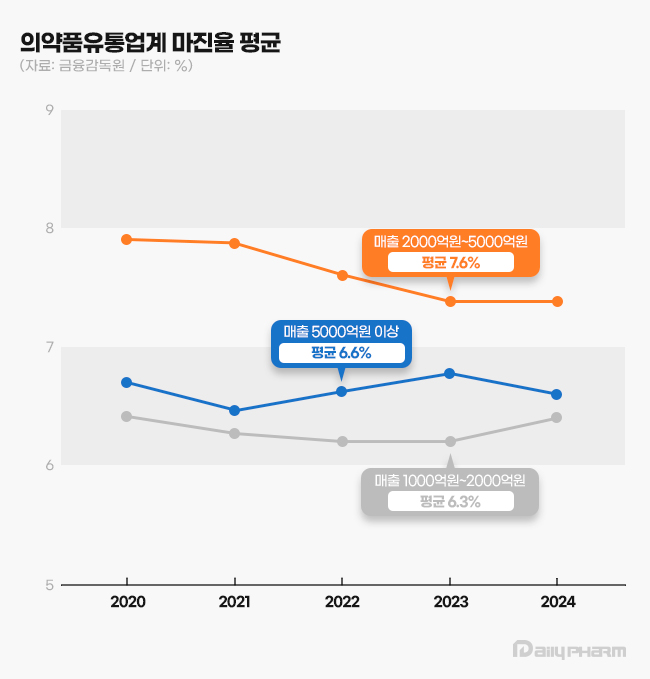
The highest margin rate recorded in the last five years was 6.8% in 2023, failing to exceed 7%.
Companies with sales between KRW 200 billion and KRW 500 billion also saw their margin rates decline.
Their average margin rate last year was 7.4%, the lowest in the past five years.
Notably, excluding Korea Medix, which operates under a CSO (Contract Sales Organization) model and had a margin rate of 43.9%, the average for this group sharply drops to 5.8% based on last year's figures.
The average margin rate for companies with annual sales between KRW 100 billion and KRW 200 billion has also been decreasing each year.
Their average margin rate last year was 6.4%, a 0.2 percentage point increase from 2023, but it has remained at an average of 6.3% over the past five years.
The pharmaceutical distribution industry believes that current margin rates make survival difficult, considering credit card fees, labor costs, delivery fees, and returns.
An official from the pharmaceutical distribution industry said, "The continuous decrease in margin rates is attributable to the pharmaceutical companies' declining sales.
Pharmaceutical companies are responding to losses incurred from drug price reductions by reducing margins for pharmaceutical distributors.
If margins continue to decrease, small and medium-sized distributors simply cannot survive." Adding, "It's a situation where pharmaceutical companies advocate for mutual growth while the distribution industry asserts its right to survival.
A compromise needs to be found, but relationships between trading partners must also be considered.
The proliferation of distributors and CSO companies has intensified competition, making excessive return orders and aggressive labor cost expenditures issues that also need careful consideration.
However, it is an undeniable fact that operating businesses is not easy with the current margin rates."
-

- 0
댓글 운영방식은
댓글은 실명게재와 익명게재 방식이 있으며, 실명은 이름과 아이디가 노출됩니다. 익명은 필명으로 등록 가능하며, 대댓글은 익명으로 등록 가능합니다.
댓글 노출방식은
댓글 명예자문위원(팜-코니언-필기모양 아이콘)으로 위촉된 데일리팜 회원의 댓글은 ‘게시판형 보기’와 ’펼쳐보기형’ 리스트에서 항상 최상단에 노출됩니다. 새로운 댓글을 올리는 일반회원은 ‘게시판형’과 ‘펼쳐보기형’ 모두 팜코니언 회원이 쓴 댓글의 하단에 실시간 노출됩니다.
댓글의 삭제 기준은
다음의 경우 사전 통보없이 삭제하고 아이디 이용정지 또는 영구 가입제한이 될 수도 있습니다.
-
저작권·인격권 등 타인의 권리를 침해하는 경우
상용 프로그램의 등록과 게재, 배포를 안내하는 게시물
타인 또는 제3자의 저작권 및 기타 권리를 침해한 내용을 담은 게시물
-
근거 없는 비방·명예를 훼손하는 게시물
특정 이용자 및 개인에 대한 인신 공격적인 내용의 글 및 직접적인 욕설이 사용된 경우
특정 지역 및 종교간의 감정대립을 조장하는 내용
사실 확인이 안된 소문을 유포 시키는 경우
욕설과 비어, 속어를 담은 내용
정당법 및 공직선거법, 관계 법령에 저촉되는 경우(선관위 요청 시 즉시 삭제)
특정 지역이나 단체를 비하하는 경우
특정인의 명예를 훼손하여 해당인이 삭제를 요청하는 경우
특정인의 개인정보(주민등록번호, 전화, 상세주소 등)를 무단으로 게시하는 경우
타인의 ID 혹은 닉네임을 도용하는 경우
-
게시판 특성상 제한되는 내용
서비스 주제와 맞지 않는 내용의 글을 게재한 경우
동일 내용의 연속 게재 및 여러 기사에 중복 게재한 경우
부분적으로 변경하여 반복 게재하는 경우도 포함
제목과 관련 없는 내용의 게시물, 제목과 본문이 무관한 경우
돈벌기 및 직·간접 상업적 목적의 내용이 포함된 게시물
게시물 읽기 유도 등을 위해 내용과 무관한 제목을 사용한 경우
-
수사기관 등의 공식적인 요청이 있는 경우
-
기타사항
각 서비스의 필요성에 따라 미리 공지한 경우
기타 법률에 저촉되는 정보 게재를 목적으로 할 경우
기타 원만한 운영을 위해 운영자가 필요하다고 판단되는 내용
-
사실 관계 확인 후 삭제
저작권자로부터 허락받지 않은 내용을 무단 게재, 복제, 배포하는 경우
타인의 초상권을 침해하거나 개인정보를 유출하는 경우
당사에 제공한 이용자의 정보가 허위인 경우 (타인의 ID, 비밀번호 도용 등)
※이상의 내용중 일부 사항에 적용될 경우 이용약관 및 관련 법률에 의해 제재를 받으실 수도 있으며, 민·형사상 처벌을 받을 수도 있습니다.
※위에 명시되지 않은 내용이더라도 불법적인 내용으로 판단되거나 데일리팜 서비스에 바람직하지 않다고 판단되는 경우는 선 조치 이후 본 관리 기준을 수정 공시하겠습니다.
※기타 문의 사항은 데일리팜 운영자에게 연락주십시오. 메일 주소는 dailypharm@dailypharm.com입니다.

- Samoh Pharm’s expansion after Voxzogo reimb…orphan drug portfolio
- Reporter's view | Hwang, byoung woo

- “7-year Lorviqua data reshape trt strategy for ALK-positive lung cancer”
- Reporter's view | Son, Hyung Min