
- LOGIN
- MemberShip
- 2026-05-21 11:41:36
- Product
- Lixiana joins NOAC market race late but takes the lead
- by Byun Kyung A Oct 31, 2019 09:59am
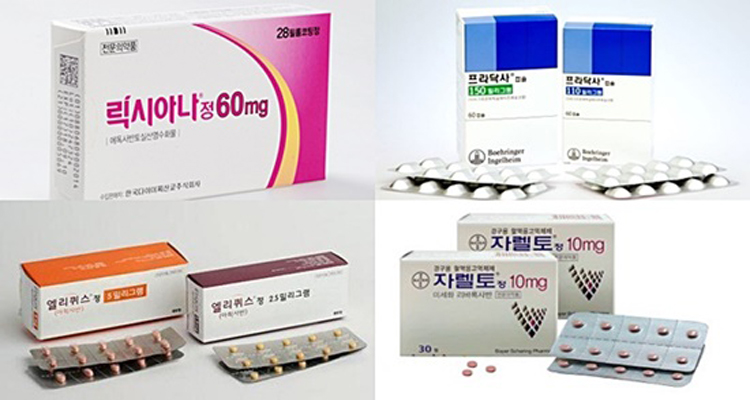
- (Clockwise from upper left) Images of Lixiana, Pradaxa, Xarelto, and Eliquis A follow-on drug in the non-vitamin K antagonist oral anticoagulant (NOAC) market, Lixiana, continues to lead the market. The treatment took the lead from Xarelto in last January for the first time, and it has been the most prescribed drug in the market for nine consecutive months. Pfizer and Bristol-Myers Squibb’s Eliquis had to face a Korean-made generic as a competitor, but its sales performance was unaffected with its original price maintained. On Oct. 28, UBIST, a pharmaceutical market data research firm, reproted Lixiana (edoxaban) marked an accumulated prescription of KRW 40.1 billion in the third quarter. The figure skyrocketed by 68.5 percent from last year same period. Lixiana recorded prescription sale of 14.9 billion won in the third quarter only and marked its record-breaking quarterly performance. The treatment reached outpatient prescription sale of 4 billion won in last January and beat Xarelto’s (rivaroxaban) prescription sale of 3.8 billion won, for the first time. The top spot in the NOAC prescription market has been solidified for nine months straight. The total sale gap between Lixiana and Xarelto’s prescription marked 6.6 billion won and was widened in the third quarter, due Xarelto’s sale dropping 0.2 percent in the third quarter than the year before. The treatment was ranked on second place in the market with 33.5 billion won accumulated prescription sale. Outpatient prescription sales trend of four NOAC items by month (Unit: KRW1 million) Source: UBIST Both internal and external factors played a part in shuffling the NOAC market rank. Bayer’s German production plant issue prolonged the unstable supply management in Korean market, and also the revised pharmaceutical product labeling regulation required all dosage containers to be reprocessed and slowed down Xarelto’s come back. In the meantime, Daiichi Sankyo and Daewoong’s co-promotion revved up the prescription sales of a follow-on drug, Lixiana. Insider from Daiichi Sankyo evaluated, “The healthcare providers and patients were positive about Lixiana’s better drug compliance with once-daily regimen, and improved safety for patients backed by Phase 3. The long-lasting co-promotion partnership with Daewoong, started from Sevika HCT deal, also created a great synergy effect boosting the sales performance”. Monthly prescription sales trend for Eliquis and apixaban generics (Unit: KRW) Source: UBIST Eliquis cumulated 31.3 billion won prescription sales this year, showing 32.1 percent surge than the year before. As of the third quarter, difference in accumulated prescription sales between Xarelto and Eliquis is only about 2.1 billion won. Eliquis was the first NOAC original to compete against generics, but its sales were not influenced as it maintained its original price. After the Korean Supreme Court in last June invalidated drug patent protecting Eliquis, the drug now has Korean-made generics competitors from Chong Kun Dang, Yoo Young, Yuhan, Huons, and Hanmi. But as Ministry of Health and Welfare has decided to defer Eliquis’ price reduction until the final decision on the treatment’s substance patent case is to be made on coming Dec. 31. Currently, the drug still maintains its initial price of 1,185 won per tablet. On the other hand, Chong Kun Dang’s competing generic with the highest content apixaban is about half the price of Eliquis. Boehringer Ingel Heim’s Pradaxa (dabigatran) marked accumulated prescription sales of 12.4 billion won in the quarter. The company sought for a significant increase in market share with a co-promotion deal with Boryung, but the sales performance did not show much increase than last year with 12.3 billion won.
- Policy
- Weighted pricing benefit abused as permanent price booster
- by Byun Kyung A Oct 31, 2019 09:58am
- The government evaluated the current weighted drug pricing system has been digressed as a permanent pricing benefit. Apparently, 96 percent of items have maintained the benefitted pricing for more than three years, and the authority sees that such practice has distanced itself from the initial objective to secure stable supply. Ministry of Health and Welfare (MOHW) submitted a statement answering the National Assembly Health and Welfare Committee Audit addressing the issue. Previously, Liberty Korea Party Lawmaker Kim Soon-Rye questioned the ministry about revising drug pricing system and strengthening competitiveness of Korean companies. In summer, MOHW presented revised 'Decision-making and Modification Standard for Drug Item' and unveiled weighted pricing system revision plan as a part of generic pricing system revision. The system was revised to set one year period of weighted pricing for synthetics and biopharmaceuticals, but provides maximum two years in case number of companies supplying the equivalent generics is less than three. The revision also established generic drug pricing standard and pricing for multi and single-use eye drops. On the revised weighted pricing system, MOHW explained “The initial objective of the system was to stabilize drug supply (weighted pricing for generics with less than three suppliers) and to induce soft landing for a generic entering the market where the original is lowering its price, from 100 percent to 70, and then to 50 percent.” “The revision was planned to keep the regulation faithful to its original objective maintaining stable drug distribution”, the ministry added. And the government emphasized its justification of drug pricing system revision as “244 out of 254 items, or 95 percent of the benefited items have been maintaining its increased price for more than three years, abusing the system as a permanent price boosting tool”. The ministry also ensured it would thoroughly review individual cases that need special support to stabilize drug supply. The statement added MOHW’s commitment to contribute strengthening Korean pharmaceutical company’s global competitiveness by executing the Biohealth Industry Innovation Strategy and Pharmaceutical Industry Fostering and Support Master Plan.
- Product
- Maviret takes up 83% of HCV treatment market share
- by Byun Kyung A Oct 31, 2019 09:41am
- Maviret product image Abbvie broke through the hepatitis C virus (HCV) treatment market and dominated 83 percent of oral outpatient prescription market only with its pan-genotype HCV treatment, Maviret, launched last year. Gilead once dominated the market with two items, but their prescription ratio shriveled down to 12 percent. On Oct. 30, a pharmaceutical market research agency, UBIST reported this year’s third quarter outpatient prescription sales of eight direct-acting antiviral (DAA) regimen HCV treatments recorded 13.2 billion won, soaring 41.4 percent from last year’s third quarter at 9.3 billion won. Abbvie’s Maviret prescription skyrocketed from the launch in last year September, and brought back up then descending total volume of HCV outpatient prescription market. The market had plummeted to 9.3 billion won in September last year, but turned around with Maviret’s launch. Outpatient prescription sales trend of major hepatitis C virus treatments (Unit: KRW 1 million) Source: UBIST This year’s third quarter outpatient prescription sales of Maviret reached 10.9 billion won. The sales easily doubled since last year’s fourth quarter with 4.2 billion won. As its accumulated prescription sales this year marked 31.1 billion won, Maviret is projected to make over 40 billion won by the end of the year. Taking up 82.9 percent of the eight DAA regimen treatments’ outpatient prescription sales, Maviret affirmed its unmatched position in the market. Maviret is the first treatment approved in Korea for chronic HCV infection in adults across all major genotypes. It is a pan-genotype ribavirin-free treatment that combines glecaprevir (100mg), an NS3/4A protease inhibitor, and pibrentasvir (40mg), an NS5A inhibitor, dosed once-daily as three oral tablets. Industry insiders view Maviret rapidly took over the market as it shortened drug treatment period by a month, compared to other DAA regimen. The treatment also mainly targets for patients without cirrhosis and who are new to treatment, the condition most of hepatitis C patients have. Recently, Maviret was able to improve consumption convenience as FDA approved of the drug shortening treatment period of chronic hepatitis C patients with cirrhosis and who are new to treatment, from 12 weeks to eight weeks. Sources also report Ministry of Food and Drug Safety’s approval on the expanded indication is imminent as related application has been submitted. However, due to the fact number of HCV patients is limited and the virus has fairly high full recovery rate, it is unclear if Maviret’s golden days would last long. In fact, Maviret’s prescription sales growth has turned from the third quarter. The total prescription soared every quarter since its launch and peaked in the second quarter, but it’s the figure dropped 9.1 percent in just about three months. Meanwhile, a former HCV treatment market leader, Gilead Sciences seems to have lost a big cut from its own market share. Sovaldi marked 18.1 billion won in last year’s first quarter, but its third quarter prescription sales in this year plunged to 4.68 billion won. Two top selling products of Gilead, Sovaldi and Harvoni, made total prescription of 1.5 billion won. The two drugs combined accumulated prescription sales of 5 billion won, merely taking up 11.7 percent of the whole hepatitis C treatment market. BMS’ Daklinza and Sunvepra combined marked outpatient prescription sales of 4.5 billion won in the third quarter, which is about one-tenth of what they had made last year same quarter. Launched around same season in the second quarter of 2017, MSD’s Zepatier and Abbvie’s Viekira and Exviera watched their sales continue dropping after the launch of Maviret and had short period of sales peak. In the third quarter, Zepatier marked prescription sales of 700 million won, whereas prescription sales for Viekira and Exviera were not even counted from last July. Abbvie insider commented, “Demand for Viekira and Exviera has decreased after Maviret was launched. There isn’t any issue with supply from the company”.
- Product
- Government likely to list Zejula in December
- by Byun Kyung A Oct 31, 2019 09:36am
- Sources predict Zejula, an ovarian cancer treatment, would get listed for healthcare reimbursement in coming December. According to an industry insider on Oct. 16, Takeda Pharmaceuticals Korea is waiting for Health Insurance Policy Deliberation Committee’s (HIPDC) deliberation, after recently reaching an agreement with National Health Insurance Service (NHIS) on drug pricing of Zejula (niraparib), a poly (ADP-ribose) polymerase (PARP) inhibitor. The niraparib treatment has been passed by Drug Reimbursement Evaluation Committee of Health Insurance Review and Assessment Service (HIRA) only after four months it was approved in last July. Zejula can be prescribed as a maintenance treatment for adult patients with recurrent epithelial ovarian cancer, including fallopian tube or primary peritoneal cancer, who are in a complete or partial response to platinum-based chemotherapy. However, the National Health Insurance (NHI) reimbursement would be first available for BRCA mutation patients only. Zejula was approved based on results of Phase 3 trials (ENGOT-OV16/NOVA). Progression-free survival (PFS) of patients taking Zejula, with or without BRCA mutation, showed a meaningful extension than the the control group. Moreover, the treatment proved its efficacy through PRIMA trial testing as a first-line treatment for ovarian cancer, regardless of BRCA mutation. In Korea, AstraZeneca’s Lynparza was listed for NHI reimbursement as a first PARP inhibitor. Lynparza was exempted from pharmacoeconomic analysis and was listed as reimbursed drug with expenditure cap risk sharing agreement (RSA) in October, 2017. However, the reimbursement benefit was suspended for some patients from last January as it was initially listed as post-chemotherapy maintenance therapy up to 15 months. From then on, AstraZeneca underwent reimbursement expansion talks with Korean government and lifted limitation on the fixed period of 15-month since last May.
- Policy
- For reimbursed drug, efficacy and cost-efficiency come first
- by Byun Kyung A Oct 31, 2019 09:34am
- On the last day of the 20th National Assembly Annual Audit for the Health Insurance Review and Assessment Service (HIRA), half the questions were dedicated to pharmaceutical affairs. The lawmakers of the NA Health and Welfare Committee questioned HIRA about NHI reimbursement reevaluation on dementia treatment choline alfoscerate, reimbursement expansion on NOAC Xarelto, and reimbursement expansion on the anticancer treatment reflecting its frequent non-reimbursed off-label use as ophthalmic solution. Some lawmakers claimed the General Principle of Healthcare Reimbursement on liquid solutions, like syrup and suspensions, should be revised and expand utilization cap eligible for reimbursement. As always, however, HIRA had a strictly basic answer for the said topics and stated, “The issues addressed would be sufficiently reviewed when clinical efficacy and cost-efficiency are proven”. Below is Daily Pharm’s summary of HIRA’s written answer submitted to the NA on Oct. 28. ◆Reimbursement reevaluation on choline alfoscerate: The current system does not stipulate a reevaluation for NHI reimbursement based on clinical efficacy, except for special cases of Ministry of Food and Drug Safety (MFDS) revoking an approval. The government's National Health Insurance Comprehensive Plan is to establish a pharmaceutical reevaluation system considering clinical efficacy of listed drug, financial impact and healthcare coverage listing status in foreign countries. HIRA, then, plans to have Drug Post-evaluation Subcommittee under Drug Reimbursement Evaluation Committee (DREC) to conduct NHI reimbursement feasibility reevaluation with the new system. Particularly, HIRA official stressed uncertainty of choline alfoscerate “has been questioned constantly” and that the agency would “establish reevaluation system promptly for it”. The dementia treatment is usually sold as a health functional food in other countries. ◆Expanded reimbursement benefit on Xarelto: Medical industry urges the health authority to grant NHI benefit on new oral anticoagulant (NOAC) Xarelto (rivaroxaban) to high-risk patients with coronary artery disease (CAD), specifically for cases of atrial fibrillation (AF) before and after catheter ablation and electrical cardiodiversion, nonvalvular AF with hypertrophic cardiomyopathy, and nonvalvular AF with CHA₂DS₂-VASc score 1. At the moment, Brilinta (ticagrelor) and Xarelto are listed for reimbursement as antiplatelets, and the benefit for Xarelto only covers high-risk patients with nonvalvular AF. HIRA answered, “As medical academic society has requested expanding reimbursement benefit on Xarelto, the agency plans to promptly review additional clinical evidences, such as revised guideline in foreign countries”, and the treatment’s “reimbursement would be expanded depending on clinically proven efficacy”. ◆Revising General Principle for syrup and suspensions: The current General Principle on Healthcare Reimbursement Criteria and Method stipulates granting NHI reimbursement benefit on pharmaceutical syrup and suspensions, also available in types of table or capsule with equivalent ingredient, in following cases; prescribed to patients younger than 13; patients with old age, dementia or other dysfunctional esophagus unable to swallow; prescribed with antacid, sucralfate, and sodium alginate under approved indication. The National Assembly pointed out the General Principle regarding pharmaceutical liquid solution should be amended and provide healthcare benefit for all Koreans to consume drug more conveniently. But HIRA official explained, “Liquid solution tends to be more expensive than tablet or capsule drugs”, therefore, “the General Principle, on Oct. 1, 2011, stipulated providing benefit to subject drugs meeting cost-efficiency standard under certain medical state and patient condition”. Since 2011, some syrup and suspension with proven cost-efficiency have received reimbursement as an exception to the General Principle. HIRA official added, “The agency would accordingly review the need to amend general reimbursement criteria based on cost-efficiency standard”. ◆Listing Avastin for reimbursement: This year’s National Assembly Audit addressed promptly providing reimbursement for non-reimbursed off-label treatment approved to be used. The issue refers to the use of anticancer treatment Avastin in ophthalmology as a non-reimbursed off-label treatment for macular generation. After consulting with Ministry of Food and Drug Safety (MFDS), HIRA allowed request for use of non-reimbursed treatment at clinics without an institutional review board (IRB) by revising ‘Standard and Procedure of Requesting Usage Approval of Non-reimbursed Off-label Drug’ this month. HIRA stated it would consider providing healthcare reimbursement benefit in the future, when the legitimately used off-label drugs meet clinical efficacy and cost-efficiency standards. ◆Expanding RSA for follow-on drugs: As the RSA subject regulation for severe disease has been revised in last July, HIRA plans to positively review feasibility of expanding RSA subject for follow-on drugs after collecting public opinions. ◆Preventing illegal drug distribution: HIRA has decided to upgrade monitoring system to better manage all drug distribution information and to utilize the collected information properly through the serialization system. HIRA currently requires a serial number to be labeled on minimal drug distribution unit container for the health authority to track individual unit in all phase of distribution, from manufacturing to import, distribution, and consumption. In last May, HIRA cooperated with Seoul city community police to investigate illegal distribution of a weight-loss medicine Saxenda injection. ◆Drug pricing standard for the revised Generic Pricing Policy: The latest revision in the Generic Drug Pricing Policy stipulates drug pricing differentiated with compensation for cost, time and investment spent on generic development, and revised weighted pricing system. Nonetheless, the pricing standard for incrementally modified new drug is same as before. As the new weighted pricing policy could bring down prices of some incrementally modified drugs (IMD), HIRA plans to adequately amend the standard with Ministry of Health and Welfare. HIRA official said, “IMDs are mostly developed by Korean pharmaceutical companies, so drug pricing benefit without limitation on IMD could cause international trade discrepancy as unfairly favorable benefit for Korean companies only”, but “the agency would continue to talk to other related ministries and industry about other means to promote development of IMD with better clinical efficacy”. ◆Revising PE analysis review process: In Australia and Canada, a company is responsible for submitting pharmaco-economic analysis and a public agency is responsible for reviewing the submitted material. But in Korea, pharmaceutical companies have difficulties editing submitted PE analysis report. Lawmakers claimed Korea should adopt ‘Application Registration System’ to prevent such inconvenience. HIRA official answered, “it would be reviewed in detail, surveying overseas cases and current conditions in Korea”.
- Policy
- Jext, only distributed to KOEDC for profits
- by Lee, Jeong-Hwan
- The company that exclusively deals with one of urgent drugs, Jext used for allergic reaction Shock (Anaphylaxis) was criticized for distributing drugs only through KOEDC( Korea orphan & Essential Drug Centers ) for profit. Even though Jext was listed insurance registration last July and it is possible for the company to make direct distribution, The price between general reimbursement and KOEDC reimbursement has big difference. So, Jext distributed only to KOEDC. According to the patients and KOEDC on the 11th, Jext has been distributed and sold patients only through KOEDC since domestic reimbursement listed. It is in patients and KOEDC view that KOEDC reimbursement is much higher than general reimbursement, and it makes economic burden to patients. The company says it is not for profit at all. The headquarters regulates the distribution of general reimbursement items, so the company is inevitably unable to distribute the supply. In fact, KOEDC reimbursement price of Jext is ₩134,933 more than double the general reimbursement price is ₩56,670. The company distributes Jext only through KOEDC until insurance registration listed. But it is still on sale only through KOEDC, even though Jext got general reimbursement listed and can be distributed at clinics or retail pharmacies. The reimbursement price of KOEDC is calculated based on the import cost, whereas the general reimbursement price is meticulously formulated through registraion procedure of Health Insurance Review & Assessment Services. It is the majority opinion of reimbursement specialists that it is much more profitable to sell at KOEDC than to distribute Jext at the general imbursement. Furthermore, the distribution of Jext through KOEDC significantly reduces additional marketing and management tasks such as account management costs required for direct distribution. That's one of the reasons why the direct distribution is delayed. However, if the distributor don't handle the medicine reimbursement listed directly for 6 months, the regulatory action is removed. It even raises doubts that the company deliberately distributes Jext only to KOEDC. Regardless of the company's intentions, as a result, patients need to get Jext ony by paying more expensive money through KOEDC because thiere is no distribution volume, even though there is a way to purchase Jext at significantly lower reimbursement. KOEDC official said, the prodcut is not in shortage of distribution, but the the company distributes medicines only to KOEDC and dose not supply them directly. It's reluctant. In the end, patients have to go and buy through KOEDC with higher price for almost 6 months even after reimbursement listed, there has never been a company using this trick so far. The deliberate coordination disregards the purpose of establishing KOEDC and the policy of expanding access to ER medicines for patients. In response to such criticism, the company said that it is not a distribution control for profitability, and will start direct distribution as soon as possible. The company official said, It was true that Jext was distributed only to KOEDC after July when reimbursement listed, but it was not intended. It was a supply disruption at the headquarters in preparation for improved Korean insert, etc. The official added, "The company will import Jext products within this month and supply them directly from next January after our own quality inspection".

- Company
- 3분기만에 1천억 '거뜬'...잘 나가는 K-신약 캐시카우
- by Chon, Seung-Hyun
- [데일리팜=천승현 기자] 국내 개발 의약품이 외래 처방시장 상위권에서 맹활약을 이어갔다. 한미약품의 복합신약 로수젯과 HK이노엔의 케이캡이 3분기만에 처방액 1000억원을 훌쩍 넘어섰다. 대웅바이오의 뇌기능개선제 글리아타민도 선전했다.19일 의약품 조사기관 유비스트에 따르면 비아트리스의 고지혈증치료제 리피토가 올해 3분기 누계 가장 많은 1468억원의 외래 처방금액을 기록했다. 작년 같은 기간보다 2.6% 감소했지만 선두 자리를 견고하게 지켰다. 리피토는 지난 1999년 국내 발매됐다. 국내 출시된 지 20년이 넘었고 100여개 제네릭과 다양한 조합의 복합제가 집중적으로리피토를 견제하고 있지만 여전히 처방 의약품 시장에서 강력한 영향력을 나타냈다. 특허만료 이후 제네릭의 집중 견제에도 처방 의약품 시장에서 강력한 영향력을 과시했다. 다만 최근 성장세는 주춤한 모습이다. 리피토는 지난 2018년부터 지난해까지 5년 연속 외래 처방금액 선두를 기록했다. 국내기업 한미약품과 HK이노엔이 자체 개발한 로수젯과 케이캡이 3분기만에 1000억원 이상을 올리며 선두권에서 고공행진을 이어갔다.로수젯은 지난 9월까지 누적 처방액이 전년보다 19.5% 증가한 1309억원을 기록하며 전체 2위에 이름을 올렸다. 2015년 말 출시된 로수젯은 로수바스타틴과 에제티미브 2개 성분으로 구성된 고지혈증 복합제다.로수젯은 시장 선점 효과와 스타틴·에제티미브 복합제 인기몰이로 가파른 성장세를 거듭하고 있다. 스타틴·에제티미브 복합제는 저밀도 지단백 콜레스테롤(LDL-C)을 낮추는 데 탁월한 효과를 보이는 데다 2개의 약을 따로 복용하는 것보다 약값 부담이 크지 않다는 이유로 선호도가 높아지는 추세다.로수젯은 지난 2020년 처음으로 처방액 1000억원을 넘어섰고 4년 연속 1000억원 돌파를 가볍게 확정지었다.로수젯의 분기별 처방액을 보면 2018년 3분기 처방액 112억원에서 올해 3분기 455억원으로 5년 새 4배 가량 뛰었다. 로수젯은 발매 이후 매 분기 신기록을 경신하며 꾸준한 상승세를 지속했다. 지난 2019년 3분기 처방액 200억원 넘어섰고 2021년 3분기와 지난해 4분기에 각각 300억원과 400억원을 돌파했다. 로수젯의 3분기 처방액 455억원은 선두 리피토와의 격차가 27억원에 불과했다. 케이캡은 3분기 누계 처방실적이 1141억원으로 전년보다 18.7% 성장했다. 케이캡의 지난 3분기 처방액은 400억원으로 전년동기대비 20.6% 뛰었다. 2020년 3분기 213억원에서 3년동안 88.1% 상승하며 성장세가 꺾이지 않고 있다. 지난 2018년 국내개발 신약 30호로 허가받은 케이캡은 '칼륨 경쟁적 위산분비억제제(P-CAB)’ 계열의 항궤양제다. 위벽 세포에서 산분비 최종 단계에 위치하는 양성자펌프와 칼륨이온을 경쟁적으로 결합시켜 위산 분비를 저해하는 작용기전을 나타낸다.케이캡은 기존 프로톤펌프억제제(PPI) 계열 제품보다 약효가 빠르게 나타나고, 식사 전후 상관 없이 복용이 가능한 점 등 장점을 앞세워 높은 성장세를 지속하고 있다. 케이캡은 출시 3년째인 2021년 처방액 1000억원을 돌파했고 지난해까지 2년 연속 1000억원을 넘어섰다. 올해는 일찌감치 처방액 '1000억원 클럽'에 이름을 올렸다.케이캡은 미란성과 비미란성 위식도역류질환에 이어 위궤양, 소화성 궤양·만성 위축성 위염 환자에서 헬리코박터파일로리 제균을 위한 항생제 병용요법, 미란성 위식도역류질환 치료 후 유지요법 등 5개 적응증을 순차적으로 확보했다. 당초 위식도역류질환에 이어 위궤양에 건강보험 급여가 적용됐고 최근 나머지 적응증도 모두 건강보험이 적용되면서 성장세가 더욱 높아진 것으로 분석된다.국내 개발 의약품 중 대웅바이오의 뇌기능개선제 글리아타민이 지난달까지 전년동기보다 23.5% 증가한 1150억원의 처방액을 올리며 전체 3위에 이름을 올렸다. 글리아타민은 효능 논란에 이은 급여축소, 환수협상 명령 등 고비를 겪고 있는데도 처방 시장에서는 오히려 영향력을 확대했다. 콜린알포세레이트 성분의 종근당글리아틴도 3월 누계 처방액이 전년보다 12.2% 증가한 827원으로 고공행진을 이어갔다.한국오가논의 고지혈증복합제 아토젯은 3분기 누계 처방액이 749억원으로 11.9% 증가하며 상위권에 포진했다. 아토젯은 아토르바스타틴과 에제티미브를 결합한 복합제다. 2021년부터 국내기업 100여곳이 아토르바스타틴·에제티미브 시장에 동시다발로 진입했지만 아토젯 시장은 더욱 견고한 상승세를 나타냈다. 아토젯은 종근당이 판매하고 있다.
