
- LOGIN
- MemberShip
- 2026-05-18 17:10:27
- Policy
- 58 companies agree on the redemption of α- GPC benefits
- by Lee, Hye-Kyung Sep 17, 2021 05:56am
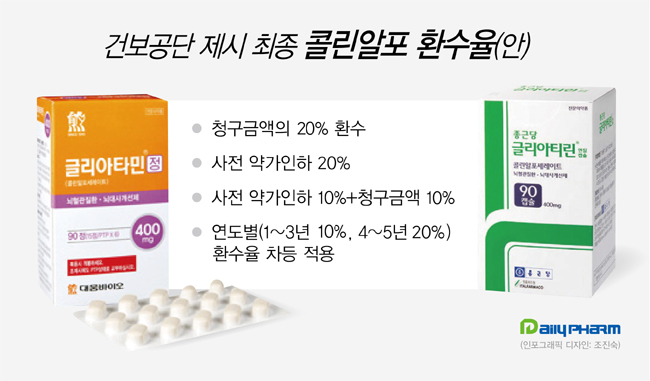
- Negotiations on the conditional return of benefits for clinical reevaluation of "Choline alfoscerate," a brain function improving agent that has been going on for about nine months, will end today (15th). The final result is that all 58 pharmaceutical companies with 123 Choline alfoscerate agreed to "return 20% of their health insurance claims from the date the MFDS approves the clinical trial to the NHIS if the clinical trial fails." The details of the agreement apply slightly differently to each pharmaceutical company. The method of redemption, such as a pre-drug price reduction or differential application of the redemption rate by year, will follow the plan chosen by each company. It is not known in detail how far it will be applied to the temporary payment or installment payment plan of the amount of redemption that has been coordinated until the end. Lee Yong-gu, head of the drug price management office at the NHIS, said at a briefing of the Professional Journalists' Council held on the 14th, "The redemption period was contracted in a lump sum five years (after clinical re-evaluation)."He said, "Some pharmaceutical companies complained of difficulties. "We are reviewing it as the clinical period is long and the cumulative amount depends on the results." There is a possibility that the contract may be changed in the final negotiations that run until today (15th). "There are several more clinical re-evaluation drugs other than Choline alfoscerate," he said, "We will discuss and decide when Choline alfoscerate negotiations are completed, but since this negotiation is completed, it is reasonable to negotiate the return of other clinical re-evaluation items."
- Company
- Blockbuster anticancer drug series 4 - Avastin
- by Sep 17, 2021 05:55am
- "By blocking blood vessels generated to proliferate cancer, cancer is starved to death.There is a drug that realizes the theory of a professor at Harvard University in the U.S., who caused a "sensation" in the 1970s. Avastin, a Vascal Endothermic Growth Factor (VEGF) inhibitor, which is also considered a good partner for immuno-cancer drugs. It's the first anti-VEGF event to surpass 100 billion won. Avastin was launched when Genentech in the United States was interested in angiogenesis research and discovered VEGF and genes. Avastin has greatly succeeded along with new antibody drugs such as Rituxan and Herceptin. After Avastin's approval, Roche completely acquired Genentec. Avastin received a lot of expectations and concerns at once. Avastin, which started as a treatment for colorectal cancer, had indications for various carcinomas such as breast cancer, lung cancer, and kidney cancer. In particular, Avastin significantly increased the treatment effect in carcinoma. However, side effects such as high blood pressure, blood clots, and heart failure caused by excessive inhibition of angiogenesis have become controversial. Indications for breast cancer have been withdrawn in the United States due to ambiguous effects against toxicity. Controversy also arose in unauthorized indications. Wet macular degeneration, which causes blindness, is also caused by excessive proliferation of new blood vessels under the retina. Avastin preference was much higher because of the low cost. Avastin was widely used in the treatment of macular degeneration. In Korea, Avastin has expanded its indications relatively smoothly to breast cancer, non-small cell lung cancer, kidney cancer, glioblastoma, ovarian cancer, and cervical cancer since it was approved as a treatment for colorectal cancer in 2005. It was used as a primary treatment in all indications other than glioblastoma and became essential for chemotherapy. With the first registration in 2014, Avastin surpassed 100 billion won in sales for the first time in 2018, 13 years after approval based on IQVIA. Last year, it posted 118 billion won in sales. This is the third-highest selling figure in the entire drug market in Korea. Will Avastin find a new opportunity? Avastin is a good drug to use with other anticancer drugs due to its mechanical nature. It is used with conventional chemotherapy in all indications other than glioblastoma. Targeted anticancer drugs have obtained primary treatment indications for EGFR-positive non-small cell lung cancer with good effects with Tarceva, an EGFR target treatment. It is also used in primary maintenance therapy for ovarian cancer in combination with the PARP inhibitor Lynparza. Roche received primary treatment indications for liver cancer and non-small cell lung cancer through combination therapy with its anti-PD-L1 immuno-cancer drug Tecentriq and Avastin. Keytruda and Opdivo are also exploring the possibility of being used in combination with Avastin in various carcinomas. It is expected that anti-VEGF drugs will compensate for the limitations of cancer immunotherapy alone. Some clinical trials have failed, but combination of cancer immunotherapy and Avastin is still a good strategy. Avastin is widely used. Big Pharma such as Amgen, Pfizer, and Beringer Ingelheim are participating overseas, and two biosimilars have been released in Korea this year. They are Onbevzi of Samsung Bioepis and Zirabev of Pfizer. Onbevzi, the first simulator sold by Boryeong Pharmaceutical, has been paid since this month, and is in the midst of preparing for prescriptions at general hospitals. However, Zirabev is more advantageous in indications. Onbevzi, did not receive some indications for ovarian cancer related to the patent for use. Celltrion and Prestige Biopharma are also developing biosimilar products, so competitive drugs are expected to increase further. When competition begins in earnest, Avastin sales, which amount to 120 billion won, are expected to be inevitable. Avastin sales have already declined as biosimilars have already entered the largest European and U.S. markets. Global sales fell 25% year-on-year last year. In the case of Korea, drug prices have been continuously lowered since Avastin was registered, and the actual difference between the original and biosimilars is expected to be insignificant as only 5% of the patient's burden is applied. The results may vary depending on the non-reimbursed item. In particular, there are biosimilars that are cheaper than Avastin in off-label diseases such as macular degeneration. Sales of expired patents are usually falling, but Avastin has new opportunities. It is an expansion of benefits in combination with Tecentriq. In the primary treatment of liver cancer, combined therapy passed the HIRA's Cancer Drugs Benefit Application Committee in February. In particular, it is more difficult to replace biosimilars with combination therapy with immuno-cancer drugs. The primary benefit for liver cancer is currently in the presumption stage for more than six months. The key is how quickly Roche Korea and the government will be able to reach an agreement over Avastin drug prices, which are burdensome at high prices.

- Company
- JAK inhibitors may fall to 2nd-line due to safety concerns
- by Nho, Byung Chul Sep 16, 2021 05:59am
- With the health authorities seriously considering changing the reimbursement standards for Janus kinases (JAK) inhibitors which have recently been caught up in controversy over its safety issues, what the results will be is gaining industry-wide attention. According to industry sources, the Ministry of Health and Welfare (MOHW) and the Health Insurance Review and Assessment Service (HIRA) have been collecting opinions from relevant academic societies on the clinical efficacy and sequential therapy (first-line·second-line treatment) of JAK inhibitors for consideration. Although there had been cases where the authorities had removed drugs from the insurance benefit list according to the revocation of licenses, the authorities’ preemptive and voluntary action to change and amend the prescription guidelines is very rare, to the extent that actual cases of such examples are difficult to find. This is interpreted as the health authorities’ determination to take a step closer to advancing regulatory science for public health and prioritizing the patient’s safety in drug intake in line with the vision set by the FDA, the authority that is considered the international standard for drug approval and regulations. Recently, the MFDS had issued a Dear Healthcare Professional Letter regarding the safety of JAK inhibitors such as Pfizer’s ‘Xeljanz (tofacitinib),’ Lilly's ‘Olumiant (baricitinib),’ ‘Abbvie’s ‘Rinvoq PR Tab (Upadacitinib),’ etc. The MFDS’ measure was made after reviewing the results of the FDA’s randomized, large-scale clinical trial on the safety of ‘tofacitinib’ that was released on the 1st. The FDA had announced that tofacitinib increased the risk of serious heart-related events such as heart attack, stroke, cancer, blood clots, and death. The drug that is receiving particular interest among the JAK inhibitors is Pfizer’s Xeljanz, which had already had a safety issue in 2019 in addition to the heart attack risk that was discussed this time. Xeljanz is an oral JAK inhibitor indicated for rheumatoid arthritis and ulcerative colitis. After discussions with Pfizer, the FDA had ▲changed the ulcerative colitis indication from first-line to second-line and ▲added warnings to refrain from prescribing the drug to patients at risk of embolisms, at the time of issue development. On why the health authorities have made such prompt measures to address the issue of JAK inhibitors is considered to be because this is the second time the safety issue of the JAK inhibitor Xeljanz rose in 3 years with concerns for two side effects - increased risk of heart attacks and the 'risk of embolism.'. The prospect is that the academic society will show neutral or tacit consent to the authorities' move to amend the other reimbursement standards after changing the scope of approval. As in the FDA’s case of restricting Xeljanz's indication from first-line to second-line, where academic societies abroad made changes to the prescription guidelines after taking a neutral stance in respect to the opinions set by the regulatory authorities, rather than showing strong consent. If the Korean health authorities and academia reach a consensus on changing the indication for JAK inhibitors from 1st line to 2nd line treatment, the market for injectable traditional biopharmaceuticals is highly likely to expand. The current market established for JAK inhibitors is around ₩30 billion, and the prescription market for biologics such as Humira, Remicade, Simponi, Mabthera, Actemra, Cosentyx, Kynteles, and Stelara is around ₩350 billion annually.
- Company
- Nocdurna can be prescribed at general hospitals
- by Eo, Yun-Ho Sep 16, 2021 05:59am
- #iNight urination treatment "Nocdurna" has been settled on the prescription ticket of a general hospital. According to related industries, Nocdurna (Desmopressin), co-sold by Ferring and Chong Kun Dang, passed DC, drug committee of Big 5 General Hospital such as SNUH, SMC, Seoul St. Mary's Hospital, and except for Sinchon Severance Hospital. In addition, Korea University Anam Hospital, NMC, Inje university Busan Paik hospital, Inje university Ilsan Paik hospital, Ewha Womans University Medical Center, Pusan National University Hospital, Haeundae Paik Hospital, Ajou University Hospital, Chonnam National University Hospital, and Chungnam National University Hospital also completed the process Ferring and Chong Kun Dang have been jointly selling "Minirin," a treatment for night urination, since 2019. Nocdurna, which signed an additional contract, is said to have reduced the burden of hyponatremia, which was feared in elderly patients, with Minirin's low-dose product. Nocdurna improves night urination symptoms caused by night urination, which overproduces urine at night, accounting for up to 88% of the causes of night urination. As a new treatment that can reduce the number of night urination in adults and improve the quality of sleep, Nocdurna 50 μg is administered once a day for men and Nocdurna 25 μg is administered once a day for women. As a result of the phase 3 study, Nocdurna 25μg and Nocdurna 50μg were found to be effective in controlling night urine-related symptoms in women and men, respectively. Nocdurna reduced the average number of night urination compared to placebo, and extended the initial sleep period due to increased time until the first night urination. Compared to placebo, the quality of life and sleep related to night urine have increased significantly. Meanwhile, Nocdurna, like the existing anti-diuretic hormone drug (Desmopressin), is covered by insurance benefits to treat night urination symptoms caused by nighttime urination.
- Policy
- Will Jeil Pharm gain a hold over the varenicline market?
- by Lee, Tak-Sun Sep 16, 2021 05:59am
- Following the government’s measures to reduce impurities in smoking cessation drugs that contain varenicline, Jeil Pharamceutcial’s products, which satisfy the set standards, is expected to gain a hold over the smoking cessation treatment market for the time being. The Ministry of Food and Drug Safety has allowed the lot release of varenicline products that only contain less than 185ng/day of N-nitroso-varenicline (NNV). On the 7th, the MFDS announced the NNV test results and that the ministry will temporarily allow varenicline products that contain less than 185ng/day of NNV. Also, drugs that exceed the 733 ng/day NNV limit were voluntarily recalled by the manufacturers. Accordingly, CTC Bio has been recalling 19 lots of 3 products (including 2 CMO products). Three companies have been distributing manufactured or imported varenicline products in the domestic market. Among the three, Jeil Pharmaceutical and CTC Bio manufacture varenicline products domestically on consignment for 24 and 7 companies, respectively. Pfizer Korea, which supplies the original Champix, is the only company that imports its products for distribution. Results of the self-inspections showed that the level of NNV was 16.70~43.28ng/day for Jeil Pharmaceuticals, 151~632ng/day for Pfizer Korea, and 812~1849ng/day for CTC Bio. Accordingly, items that were produced by CTC Bio exceeded the accepted level for lot release as well as the recall standards. On the other hand, Pfizer’s products managed to barely avoid recalls, but not all the items met the acceptable level of NNVs for lot release. Jeil Pharmaceutical's items were the only items to meet the NNV level allowed for lot release. Due to this, concerns on whether Jeil Pharamcetucial alone can meet the demand for varenicline products were raised at the Central Pharmaceutical Affairs Council on the 30th, prior to the MFDS’s announcement. Regarding the concern, the MFDS had explained that “The 0.5mg and 1.0mg dose varenicline products produced by company C (presumed to be Jeil Pharmaceutical) account for 10% and 5% of the domestic supply. Upon inquiry, the company had replied that it can produce the amount sold by Company A (presumed to be Pfizer) and Company B (presumed to be CTC Bio) by focusing on producing varenicline products, if necessary.” The minutes of the meeting also presented the case for Champix, which currently holds the dominant share of the market. The MFDS said, “Varenicline products in the US exceed the NNV level of 733 ng/day, and were unfit under the distribution standards. Therefore, the products that are imported to Korea are Apo-Varenicline distributed in Canada, and the NNV detected in the said drug exceeds 37ng/day, but is less than 185ng/day. The ministry stressed that it will take some time for companies other than Jeil Pharmaceutical to satisfy the 185ng/day or less level set for the lot release. For example, Champix, whose supply was discontinued since June, had been able to avoid recalls but is still unable to resume its supply in Korea. Therefore, according to the NNV reduction measures, the dominant opinion is that products produced by Jeil Pharmaceutical will increase its hold over the market. On how this change will affect the market structure remains to be seen.
- Policy
- Drug substances with impurities are collected voluntarily
- by Lee, Tak-Sun Sep 16, 2021 05:59am
- The recovery of antihypertensive drugs exceeding impurities is expanding. Following the Drug product, Drug substance began to recover. The MFDS announced on the 14th that it will voluntarily retrieve some of Kukjeon and Pharmacostech's Irbesartan's Drug Substance. Kukjeon and Pharmacostech start collecting four manufacturing number products each. Following the drug product, the recovery of drug substances began. Initially, the MFDS announced on the 9th that it would voluntarily recover 73 items from 36 companies that manufacture Sartan hypertension treatments (1.51 to 7.677/day) exceeding the daily intake of AZBT, which is an impurity. All of these items are Drug products, and only manufacturing number items that have been problematic in safety surveys are recovered. The withdrawal list did not include Drug substance. In response, an official from the MFDS explained, "Raw Material did not include it in the announcement list because there was no consumer recovery like Drug Product," adding, "The local government is also voluntarily collecting the drug in question." According to the MFDS' explanation, it is estimated that there will be more items to recover raw materials. The Ministry of Food and Drug Safety announced on the 9th that the pharmaceutical company voluntarily collects 183 manufacturing numbers of Sartan drugs. Accordingly, patients taking the drug should not stop taking it arbitrarily, but should decide whether to continue taking it after consulting with a pharmacist. It added that patients with health concerns can be exchanged for manufacturing numbers below the standard at pharmacies. The MFDS emphasized that it will manage only Sartan drugs that are less than the daily intake allowance so that they can be supplied and distributed to the market.
- Company
- Idiance reveals the results of Venadaparib
- by Kim, Jin-Gu Sep 16, 2021 05:59am
- Idience, a new drug development company of Ildong Holdings, announced on the 14th that it will announce the results of phase 1b clinical trials of the targeted anticancer drug Venadaparib (IDX-1197) at the ESMO conference to be held from the 16th to the 21st. Venadaparib is a new drug candidate for targeted anticancer drugs based on precision medicine with a PARP (Poly ADP-ribose polymerase) inhibitory mechanism. Currently, Idience is conducting phase 1b/2a clinical "VASTUS" to evaluate the safety, tolerability, and effectiveness of Venadaparib in solid cancer patients with homologous recombination recovery mutations. What will be announced this time is the first interim result of the VASTUS test released through the American Cancer Society (AACR) in April. According to the abstract released on the 13th, Venadaparib was administered to metastatic BRCA mutated breast cancer patients, and there were no nausea, fatigue, or loss of appetite corresponding to Grade 3, which is the main side effects of existing PARP inhibitors.In particular, excellent efficacy was observed, with an objective response rate (ORR) of 80% of 10 patients administered Venadaparib, Idiance said. The company explained that it plans to secure additional related data through follow-up research. Based on the results of the clinical phase 1b study, Idience is known to have initiated phase 2a clinical trials. The ORR levels of Venadaparib observed in breast cancer patients with BRCA mutations are very meaningful compared to conventional PARP inhibitors, an Idiance official said. "We will continue further clinical studies to prove the excellent anticancer effect of Venadaparib."

- Policy
- 299 items were voluntarily withdrawn
- by Lee, Hye-Kyung Sep 15, 2021 06:12am
- The NHIS's self-evaluation came out that the "National Health Insurance Medical Care Benefit Standards" revised on October 8 last year prevented the registration at will. At the Korea Special Press Association briefing held on the 14th, Lee Sang-soo, executive director of insurance benefit, said, "As soon as the drug benefit list was registered, as items that cannot perform supply obligations were voluntarily withdrawn, the items that have been pointed out have been blocked." The NHIS has also been negotiating drugs subject to calculation (generics, IMDs, combination drugs, and herbal medicines, etc.), which upper limit is determined according to the drug calculation criteria since October 8 last year. The contents of the negotiations are not the amount, but the obligation to supply generics, promises to quality control, and confidentiality. According to the results of the negotiations so far, a total of 1,869 items were subject to negotiations as of the end of August, and 296 negotiations are currently underway. There were 1,382 items that negotiated medical care benefits, including the recently conducted additional revaluation drug, and only 778 items were agreed upon. The remaining 604 items have been broken down or negotiations are underway. The 1,382 items also included negotiations on additional revaluation, and 468 out of 487 items have been agreed on supply and quality. Lee Yong-gu, head of the drug price management office, said, "Among the generic negotiations, supply obligations and quality control are more important," adding, "If there is a pharmaceutical company that seeks to reach an agreement due to the breakdown of negotiations, we are negotiating again with the MOHW." Director Lee added, "However, we believe that drugs that cannot voluntarily withdraw or perform supply obligations immediately have no choice but to be deleted."
- Company
- Novartis Korea appoints Byungjae Yoo as new head
- by Eo, Yun-Ho Sep 15, 2021 06:11am
- Byungjae Yoo, new General Manger of Novartis Korea Byungjae Yoo, the former Managing Director of Johnson & Johnson Medical North Asia, has been appointed as the new head to lead Novartis Korea. The company had recently announced through an internal notice that Yoo will be officially appointed as its General Manager from October 1st. This will be the second time since the company's establishment that the Korean subsidiary will be managed by a Korean leader. After completing his MBA at Harvard Business School, the newly appointed General Manager Yoo had joined J&J in 2006 through the company’s International Recruitment & Development Program. Since then, Yoo had held various roles in the company, including ones in North America’s Endovascular team, DePuy UK, and DePuy Australia. In Korea, he had served in the Cardiovascular Care Business Unit across North Asia and then appointed the Managing Director of Johnson & Johnson North Asia to oversee Korea, Taiwan, and Hong Kong. Although Novartis has been operating its oncology and pharmaceutical division independently as separate divisions, with reimbursement discussions for the CAR-T therapy ‘Kymriah (tisagenlecleucel)’ and SMA treatment ‘Zolgensma’ in progress, on what synergy will the appointed new head bring remains to be seen. Since its establishment in 1997 and the first president Frans Hompe, the company had mostly appointed foreign heads to lead the Korean subsidiary, including Jean-Luc Scalabre in 1998, Peter Maag in 2003, Andrin Oswald in 2006, Peter Jager in 2008, Brian Galdsden in 2014, and most recently, Joshi Venugopal. The only Korean national that had been appointed until now was Hak-sun Moon in 2015.

- Company
- Pharma companies fail to suspend renegotiations for CAs
- by Chon, Seung-Hyun Sep 15, 2021 06:11am
- Once again, the suspension of execution for the second negotiation order to retrieve reimbursement that was paid for choline alfoscerate (cholinergic agent) that was filed by pharmaceutical companies was dismissed. In other words, the companies have failed to suspend the execution of both the first and second negotiation order to retrieve reimbursement. According to industry sources on the 14th, the 9th Administrative Branch of the Seoul High Court dismissed the appeal to suspend execution of the order for renegotiations on choline alfoscerate products that was filed by 26 companies including Chong Kun Dang on the 8th. The suit was filed for the second negotiation order that was issued by the government to negotiate the terms for retrieving the reimbursement paid for choline alfoscerate drugs. At the end of last year, the Ministry of Health and Welfare ordered the National Health Insurance Service to make insurance retrieval agreements on choline alfoscerate drugs. The order was to reach agreements with the companies that ‘If the clinical trial fails, the full amount of health insurance prescriptions, from the date the clinical trial design submission was submitted to the MFDS to the date of indication removal, should be returned to the NHIS,.’ After the companies refused to negotiate, the MOHW again ordered renegotiations in June last year. Upon order, two groups consisting of 26 companies including Daewoong Bio and 26 companies including Chong Kun Dang filed for the cancellation and suspension of execution of renegotiations. In July, the suspension of execution filed by Daewoong Bio and others was dismissed, and the suspension of execution of negotiations filed by Chong Kun Dang and others was also dismissed. Chong Kun Dang and others again re-appealed but the case was again dismissed. As a result, all pharmaceutical companies that requested suspension of executions failed to suspend renegotiations for reimbursement retrieval. Prior to the second try, the companies had filed administrative suits and suspension of execution for the first renegotiation order as well. At that time, two groups consisting of 28 companies including Daewoong Bio and 28 companies including Chong Kun Dang separately filed their cases, but both cases were dismissed by the Supreme Court. The suspension of execution filed by Chong Kun Dang, etc. was first dismissed in January, then again dismissed at the appeal hearing in May. Chong Kun Dang and others filed for a reappeal, and but this was again dismissed last month. The suspension of execution filed by Daewoong Bio and others was dismissed at the first and second trial and then dismissed again by the Supreme Court in July without hearing as discontinuance of a trial. Meanwhile, the companies have also reached an agreement with the NHIS to negotiate for the retrieval of reimbursement. Recently, the NHIS had reached an oral agreement for negotiations with companies to retrieve the reimbursement paid for choline alfoscerate drugs. The NHIS and the companies agreed that the companies will back 20% of the health insurance prescriptions amount paid from the date of submission of the clinical trial design to the MFDS to the date of indication removal if the clinical trial on choline alfoscerate drugs fail and its indication is deleted. However, despite reaching such agreements, the companies are continuing with litigations to defer negotiations. The companies have filed all-round lawsuits, including suits for cancellation and suspension of execution to block negotiations, but none were dropped since.
