
- LOGIN
- MemberShip
- 2026-05-18 16:29:40
- Policy
- ’With Covid’ scheme unclear with over 5,000 cases expected
- by Lee, Jeong-Hwan Oct 07, 2021 05:53am
- Concerns have been raised that Korea will be unable to adopt the ‘With Corona’ scheme due to the public’s distrust in vaccinations, the government’s non-acceptance of casualties of adverse reactions from vaccines, and the surge in daily COVID-19 cases, etc. Based on the mathematical model that took into account current incidence, the transmission of COVID-19, and the vaccination rate, the authorities expect that the number of new COVID-19 cases may increase on average up to 5,000 cases per day if the fourth wave of the COVID-19 pandemic persists. The National Assembly member Jong Hean Baek of the People Power Party announced the above results on the 6th based on the data submitted by the Korea Disease Control and Prevention Agency. According to KDCA data, if the current incidence, transmission, and vaccination rate are applied to a mathematical model, around 5,000 new COVID-19 cases are expected to arise per day. As for the reason, Baek pointed to the public distrust in vaccines despite inoculation being required for the living ‘With Corona’ scheme, the government’s non-acceptance of casualties of adverse reactions from vaccinations, and the lack of responsibility of the nation in taking care of those who suffer from misinoculations or side effects pre- and post-vaccination. The actual recognition rate of vaccine’s side effects was 53.4% in general patients and a mere 0.3% in deaths. More specifically, KDCA’s immunization surveillance investigation team’s assessment report showed that causality of 1,764 in 3,305 cases, or 53.4% of the cases were recognized. However, among the 678 cases of deaths after vaccination, the causality of only 2 was recognized. Also, 2,014 cases of vaccine misinoculations arose due to the government's neglect, but none were compensated for the damages. Baek said, “To live ‘With Corona’, we must first address the public’s distrust in vaccinations and prepare post-management measures. The citizens are anxious and disappointed by the government’s irresponsible response to the deaths from vaccinations.” He added, “I do not understand why the government is irresponsible in dealing with this life-threatening issue for administrative convenience. The government needs to show responsibility so that the people can trust the authorities and receive their vaccinations.”
- Policy
- Nexviazyme has been applied for domestic permission
- by Lee, Tak-Sun Oct 07, 2021 05:53am
- Sanofi plans to release a new Pompe's disease treatment in Korea. It is known that Nexviazyme, which was approved by the U.S. FDA in August, recently applied for permission from the MFDS. According to the MFDS on the 1st, Sanofi Aventis Korea submitted a report on the results of clinical trials by Nexviazyme (Avalglucosidase alfa-ngpt) and applied for permission. This drug is a Pompe's disase treatment. Pompe's disease is a genetic disorder in which respiratory failure and myocardial disease appear due to muscle strength loss and muscle atrophy. It is a rare disease that is reported to be about one person per 40,000 people worldwide, and it is known that there are about 1,300 patients in Korea. Pompe's disease is divided into IOPD, a fast-onset infant disease in infancy, and LOPD, a late-onset disease that develops at all ages and gradually weakens muscles. As muscles are damaged, heart failure, respiratory failure, exercise disorders, and sleep disorders also occur. The disease administers drugs targeting M6P receptors that allow GAA enzymes to migrate to intracellular lysosomes to treat GAA gene abnormalities. Existing treatments include Sanofi's Myozyme. Nexviazyme, which applied for permission this time, reportedly increased the M6P content by about 15 times compared to Myozyme. Nexviazyme was approved by the U.S. FDA in August. The MFDS designated the drug as a rare drug for patients to use before it was officially approved in June. If designated as a rare drug, the drug can be purchased through the KODC.
- Policy
- Introduction of pre-registration is difficult
- by Kim, Jung-Ju Oct 07, 2021 05:53am
- The government said it is difficult due to concerns over weakening NHIS' drug price negotiation power, while various fields are proposing the introduction of a system that is first registered and evaluated later for access to treatments for severe rare and intractable diseases. Regarding referring to Korean drug prices such as China, the government also said it is actively responding by expanding RSA to prepare for "China risks" such as "Korea Passing." The MOHW recently submitted the "2020 National Assembly Processing Results Report on the Requirements for Correcting and Processing the National Assembly" with such contents. First of all, the National Assembly previously demanded the MOHW to consider introducing a "pre-registration and post-evaluation system" to access treatments for severe rare and intractable diseases. The MOHW said that it is difficult to operate a realistic system for post-registration evaluation. The MOHW replied, "It is expected that it will be difficult to operate a realistic system and manage reasonable drug spending, so careful review is needed." This is because it is difficult to adjust drug prices if pharmaceutical companies do not accept the evaluation results after being registered, and the NHIS' drug price negotiation power may weaken, causing problems. They would expand RSA on countermeasures against so-called "Korea Passing" concerns due to China's drug price system. Overseas countries such as China are deciding their own drug prices by referring to Korean drug prices. Due to the current strict drug price system in Korea, it can lead to " In response, the MOHW replied, "We have introduced RSA since 2014 to respond to delays in insurance registration due to reference to foreign drug prices," adding, "We have been expanding the applicable drugs since October 2020." Regarding the demand to raise funds through the National Health Promotion Fund and the primary benefit of the immuno-cancer drug Keytruda, he replied in July that the HIRA is in the process of expanding benefits of Keytruda and Tecentriq. However, the MOHW said that the National Health Promotion Fund needs to be carefully reviewed by comprehensively considering the target, scope, and allocation of required resources within the scope of support.
- Company
- Roche and Lilly to launch RET targeted cancer drugs in Korea
- by Eo, Yun-Ho Oct 06, 2021 06:06am
- Two types of RET targeted anticancer therapies are concurrently seeking domestic entry. According to industry sources, Roche Korea's Gavreto (pralsetinib)’ and Lilly Korea ‘Retevmo (selpercatinib)’ are under review for domestic approval. Both are anticancer drugs that target RET (Rearranged during transfection) gene fusions. The drugs not only inhibit primary RET fusions and mutations but also secondary RET mutations that cause resistance to treatment, and are receiving much attention on whether they will be able to address unmet needs in various types of cancer. Retevmo became the first to receive global approval by a few months. Retevmo received marketing authorization from the US FDA in May last year, and Gavreto in September. Retevmo was approved for the Non-small Cell Lung Cancer (NSCLC) and thyroid cancer indications, whereas Gavreto was first approved as a lung cancer treatment, then approved for the thyroid cancer indication in December of the same year. Although the drugs were initially approved for lung cancer and thyroid cancer indications, the companies are expected to actively pursue more indications for RET inhibitors in the future. RET gene fusions are present at a low frequency in colorectal cancer, breast cancer, pancreatic cancer, and EGFR-positive NSCLC. Like NTRK (Neurotrophic tyrosine receptor kinase) targeted therapies like ‘Rozlytrek (entrectinib)’ etc., RET inhibitors have the potential to be used as tumor-agnostic, personalized treatment. Meanwhile, Retevmo’s efficacy was verified through the Phase I/II LIBRETTO-001 study. Retevmo’s overall response rate (ORR) was 64% in 105 RET-gene positive patients with small cell lung cancer who have previously received platinum-based chemotherapy. Also, 81% of the patients who showed treatment response showed a response for at least 6 months. Also, Retevmo recorded a high ORR of 84% in 39 RET-gene positive, treatment-naive patients. In 143 medullary thyroid cancer patients that have previous treatment experience with ‘cabozantinib’ or ‘vandetanib,’ etc., the ORR was 69%. And 76% of the patients maintained treatment response for at least 6 months. In other RET-gene positive thyroid cancer, the ORR of patients with radioactive iodine-refractory (RAI) was 79%, 87% of which showed continued treatment response for over 6 months. Gaverto was initially approved as a lung cancer treatment based on the ARROW study. In the study, Gavreto showed an ORR of 57 % and a complete response (CR) rate of 5.7 % in NSCLC patients that were previously treated with platinum-based chemotherapy (87 patients). Also, ORR was 70% and CR 11% in newly treated patients (27 patients).
- Company
- Evrysdi (PO) is differentiated due to its low price
- by Oct 06, 2021 06:06am
- Roche's "Evrysdi (Risdiplam)," the second treatment for spinal muscular atrophy (SMA) in Korea, signaled its launch after about a year of approval. With the differentiation of the only PO drug and low prices, fierce competition in the SMA market was predicted. "Evrysdi is the first oral drug among SMA treatments and is applicable to patients with difficulty in treating SMA, and has confirmed its effectiveness and safety in patients of a wide range of ages and types," Roche Korea stressed at an Evrysdi meeting on the 5th. Evrysdi (Risdiplam) is a prescription medicine used to treat spinal muscular atrophy (SMA) in adults and children 2 months of age and older. Spinal muscular atrophy (SMA) is a rare genetic disease in which the SMN1 gene is inherently deficient or mutated, resulting in gradually shrinking muscles. It is known that about one per 10,000 newborns worldwide, and about 30 patients (based on 300,000 newborns) occur every year in Korea. Three new drugs were released in Korea in three years, starting with Biogen's Spinraza in SMA diseases, which had no cure so far. Evrysdi is the second new drug approved in November last year and is the only PO drug. It has been almost a year since the license was granted, but it has not yet been released on the market. As a result, it was delayed than Novartis' Zolgensma, which was belatedly approved. Novartis applied for Zolgensma's benefit in June. Evrysdi began the registration process only in July, eight months after the permit. Roche is expected to officially release Evriesdi after completing the registration process. It is expected to be reimbursed well as Spinraza, which is already more expensive, has been reimbursed. Evriesdi is also known to be likely to follow RSA ( the Expenditure Cap) applied to Spinraza. Lee Seung-hoon, director of Roche Korea, said, "We are currently trying to get reimbursed within the same range as Spinraza." He explained, "I think access to insurance is more important than anything else because receiving rapid treatment for patients has a great impact on the prognosis." Roche explained that it is the only PO drug and that the relatively low cost is Evrydi's strength. Spinraza prices exceed 90 million won, and Zolgensma, which is negotiating benefits, is a "one-shot" treatment that costs more than 2 billion won per time. Evrysdi's final drug price has not been determined, but it is much lower than the prices of Zolgensma and Spinraza. In particular, it is expected to be cheaper for infants and toddlers. Jung-hyun Chang of Roche Korea said, "Unlike other products, Evrysdi's dosage is determined by age and weight, so we expect infants and toddlers under the age of 2 to be treated at a much lower price than adults, greatly reducing the burden of drug costs." Evriesdi can be self-administered at home, which can reduce the socioeconomic burden, he added. Attention is also being paid to which drugs medical staff and patients will choose. Lee Yoon-jung, a professor of pediatrics at Kyungpook National University, emphasized "patient accessibility." Fast diagnosis and treatment are of paramount importance because SMA's symptoms deteriorate rapidly within a short period of time and the slower the treatment, the less effective it is. Professor Lee said, "No matter how active treatment is, the disability often remains no matter how active the treatment is," adding, "As diagnosis and initial administration are very important, we need to consider what drugs can speed up the initial administration as much as possible."
- Policy
- “Elderly polypharmacy rate Korea 70% vs OECD countries 48%"
- by Lee, Jeong-Hwan Oct 06, 2021 06:06am
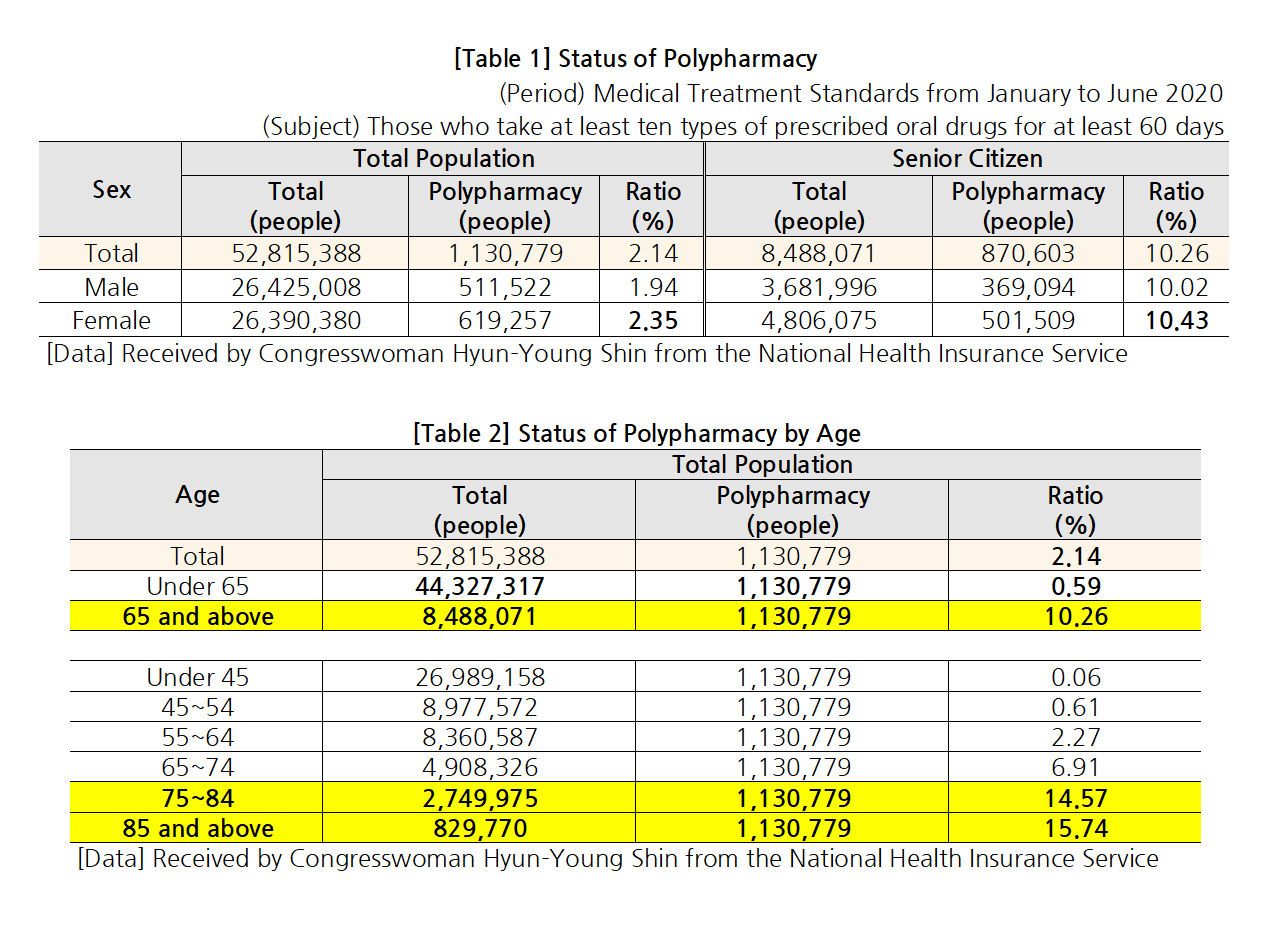
- Statistics showed that a high rate - 70.2% - of older adults (aged 75 or over) in Korea chronically take ‘more than 5 drugs for over 3 months.’ The average of 7 OECD countries other than Korea that submitted the same data was only 48%. In other words, concerns over the current polypharmacy status of elderly patients in Korea have been reaffirmed. On the 4th, NA member Hyung-young Shin of the Democratic Party of Korea announced the results above after analyzing OECD data. The medication rate of elderly patients in Korea has been globally high. According to the OECD’s data on the ‘rate of patients aged 75 or over who chronically take 5 or more drugs for over 3 months,’ the average of the 7 countries that submitted the data was 48.3%, compared to the much higher rate of 70.2% in Korea. However, Using an unnecessarily high amount of drugs in older adults can have a negative impact on their health. According to the National Health Insurance Service Ilsan Hospital's report, patients aged 65 or older who take 5 or more drugs have an 18% increased risk of hospitalization and 25% increased risk of death than those who take 4 or fewer drugs. According to the data that Shin received from the NHIS, 2.14% of the total population (1.13 million) in Korea takes 10 or more drugs. Among those, the elderly accounted for the largest proportion with 10.26%, and the polypharmacy rate was higher in women (2.35%) than men. The rate and number of patients using multiple drugs also increased with age. The polypharmacy rate was 10.26% for people over 65 but 15.74% for people over 85. By insurance premium quintile, polypharmacy rate was higher (12.52%) in medical aid beneficiaries than NHI policyholders. The polypharmacy rate in elderly medical aid beneficiaries was 22.57%, which roughly translates to one in 4 to 5 patients. Also, the proportion of the elderly was highest in the 1st and 10th insurance premium quintile (9.88%). Furthermore, the polypharmacy rate was higher in patients with underlying diseases such as diabetes, heart disease, cerebrovascular disease, asthma/COPD, chronic renal failure, pulmonary tuberculosis, etc. By population, the polypharmacy rate was highest in patients with chronic renal failure (18.38%), heart disease, (15.36%), cerebrovascular disease (13.86%). The order was the same in elderly patients but at a higher rate - chronic renal failure (23.80%), heart disease (20.97%), cerebrovascular disease (18.31%). Shin said, “As the rate of patients who take 10 or more drugs increases with age, we need to review whether the patients are taking unnecessary drugs due to over-prescription or redundant prescriptions. In other words, institutional support on the appropriate use of drugs is needed, and a system that assigns primary care physicians for the elderly should be introduced to manage the elderly’s use of multiple drugs, as well as provide customized support on the appropriate use of healthcare.”
- Policy
- The patient died due to the delay in Kymriah benefits
- by Lee, Jeong-Hwan Oct 06, 2021 06:06am
- Ko Eun-chan Korea leukemia patients organization launched a one-man protest, urging the first C-ART treatment Kymriah (Tisagencleucel)'s fast track. The Korea Leukemia Association held a press conference in front of the National Human Rights Commission of Korea at 10 a.m. on the 1st and announced that it submitted a petition to the National Human Rights Commission of Korea demanding Kymriah's health insurance registration and fast track for new drugs. Kymriah is the world's first chimera antigen receptor T-cell treatment that is effective in treating patients with recurrent or refractory B-cell acute lymphocytic leukemia and refractory giant B-cell lymphoma. Although patients are expected to have an effect of 82% cure rate even with one dose, the cost of one dose amounts to about 460 million won. Novartis applied for health insurance registration with the HIRA in March, but failed to pass the Cancer Drugs Benefit Application Committee. Lee Eun-young said, "Kymriah was not presented as an agenda at the 5th Cancer Drugs Benefit Appeal Committee in July and was not passed by the 6th Committee in September." She said, "If pts don't receive Kymriah treatment, they may die within three to six months." Lee Bo-yeon, the mother of Ko Eun-chan, who died in June while battling acute lymphocytic leukemia, also urged the introduction of fast track, saying that the government approved drugs to treat the disease, but they were useless due to the price of 500 million won. Mr. Lee said, "The government has not prepared a plan to allow high-priced drugs such as Kymriah and pay for them by dividing the amount or support the loan system for the use of new drugs." "This forced us to use loans from the second financial sector to raise drug prices," she said. "It's been nearly four months since my child died. "I thought health insurance would be applied soon because the effectiveness of the drug has already been proven and the number of people needed is limited, but I'm angry that the children are dying without any change," she said. "A malignant lymphocyte tumor progresses quickly. Through Kymriah's fast track, we need to make sure that there are no people in Korea who are dying because of lack of money like Eun-chan,"she said. Ahn Ki-jong, CEO of the Patient Association, said, "The Constitution prohibits the right to life and discrimination. Even though Korea is a citizen who pays taxes and health insurance premiums equally, people's lives should not be at stake depending on their economic capabilities." He then said, "After obtaining approval from the MFDS among the expensive new drugs, I only waited for health insurance registration. Eventually, this situation of death has been repeated over the past 15 years, at least patients who need new drugs directly related to life should temporarily apply health insurance at the same time as the MFDS approves to treat patients." Ahn also said, "Starting with Kymriah, we will not let any patients who cannot be treated because they do not have money at least in Korea." The patient association will hold a one-man relay protest in front of Novartis Korea's headquarters from the 1st to urge them to come up with active financial sharing measures. A national petition will be posted on Cheongwadae to convey the position of the patient association to the government and demand improvement.
- Company
- Yoo Byung-Jae took office as the new president of Novartis
- by Oct 06, 2021 06:05am
- Yoo Byung-Jae, the new CEO of Novartis Korea Yoo Byung-Jae took office on the 1st as the new president of Novartis Korea. New President Yoo is an expert who has accumulated organizational management and management skills in the global healthcare industry for 15 years. Until recently, he served as president of North Asia, including South Korea, Taiwan, and Hong Kong, at Johnson & Johnson Medical, exceeding his target performance every year. It is evaluated that it has created business excellence and led organizational development by growing in all business fields. New President Yoo said, "I am happy to join Novartis, which leads the global pharmaceutical industry, based on our innovative portfolio." "We will do our best to provide patients with various innovative treatments, including the cellular therapy portfolio that Novartis is currently focusing on, contribute to the innovative ecosystem of the domestic healthcare industry, and become a socially trusted company," he said. The new president Yoo, a graduate of Korea University's business administration department and Harvard Business School, joined the marketing team of Johnson & Johnson Medical's blood vessel division in 2006. Since then, he has been in charge of marketing leaders in orthopedic departments in the United States, the United Kingdom, and Australia, and has successfully led various business fields since returning to Korea in 2010. In addition, he gained brand management experience in famous consumer goods companies such as Coca-Cola and Unilever, and worked as a management consultant for Boston Consulting Group.
- Policy
- Boryung's Dukarb Plus is about to be commercialized
- by Lee, Tak-Sun Oct 05, 2021 05:58am
- Dukarb, Tuvero, and Kanarb It was found that commercialization of the high blood pressure combination drugs including Boryung's Fimasartan is imminent. If this product is approved, a total of four products will form treatment options in the hypertension treatment lineup leading to Kanarb-Kanarb Plus-Dukarb. Through this, it is expected that the diversity of patient prescriptions can be secured. According to the industry on the 4th, Boryung recently submitted an application for permission for the tentatively named Dukarb Plus to the MFDS. Dukarb Plus is a complex in which a diuretic component, HCTZ, is bonded to Dukarb (Fimasartan-Amlodipine), a second complex. Already, Boryung has conducted phase 3 clinical trials in 250 hypertensive patients at 32 hospitals in Korea since May 2019 under the name of FAH. FAH is the first alphabet of Fimasartan, Amlodipine, and HCTZ. If Dukarb Plus is approved, it will be the seventh product containing Fimasartan since the launch of Kanarb in 2011. It is the fourth product to treat hypertension only after Kanarb (Fimasartan), Kanarb Plus (Fimasartan+HCTZ), and Dukarb (Fimasartan+Amlodipine). Patients who are not well controlled by Dukarb will be able to choose Dukarb Plus with diuretics added. Including Tuvero (Fimasartan + Rosuvastatin), Dukaro (Fimasartan + Rosuvastatin + Amlodipine), and Akarb (Fimasartan + Atorvastatin), it will be released up to the 7th drug. With Kanarb showing an annual performance of 49.2 billion won (as of UBIST 2020), combination drugs are also successfully settling in the market. Sales of Dukarb recorded 35.1 billion won last year, and Dukaro is also expected to become a blockbuster with 10 billion won this year. Dukarb Plus is expected to be released amid the imminent expiration of Kanarb patents. Material patent of Kanarb expires on February 1, 2023. Accordingly, pharmaceutical companies have started developing generics for Kanarb and Dukarb. The two drugs are so popular that many pharmaceutical companies are expected to release generics. In this situation, if complex with exclusive rights comes out, it is expected to boost the competitiveness of original products. This is because if Dukarb Plus is approved, it is likely that a six-year PMS (reexamination) will be granted.
- Company
- “Dupixent, a trusted AD treatment without safety concerns"
- by Oct 05, 2021 05:58am
- The biologic agent ‘Dupixent (dupilumab)’ holds an 'unrivaled' position in the treatment of severe atopic dermatitis. In the AD treatment environment that had used immunotherapies that bring a high burden of side effects, the introduction of a safe and effective option has greatly improved the symptoms and quality of life in AD patients. Due to its strong effect, requests for reimbursement to be extended to cover the pediatric and adolescent indications have been flooding. Unlike systemic immunosuppressants, Dupxient selectively inhibits IL-4, IL-13 signals, the key drivers of type 2 inflammation, and therefore is known as a drug that can be safely used without concern over side effects. Dailypharm met with Dong Hun Lee, Professor of Dermatology at the Seoul National University Hospital to hear about the effect and safety of Dupixent. The following is a full QA with Professor Lee. Professor Dong Hun Lee-How has the introduction of Dupixent changed the atopic dermatitis treatment environment? =Before Dupixent, we mainly prescribed immunosuppressants such as cyclosporine and methotrexate, etc. to treat severe atopic dermatitis. Atopic dermatitis is a chronic condition that requires continued treatment and management, however, immunosuppressants have limitations in their treatment efficacy or have side effects that occur with long-term use that prohibit continuous use. This is why major practice guidelines do not recommend continued use of cyclosporin for over 1-2 years. In addition to clinical trials that demonstrated Dupixent’s superior efficacy, the company also recently disclosed the drug’s long-term safety data in adult patients with moderate-to-severe atopic dermatitis. Also, in clinical practice, Dupixent generally showed a good effect in patients whose symptoms were not controlled by immunosuppressants such as cyclosporine. Unlike other immunosuppressants that require regular monitoring every 1-3 months after administration, no separate blood tests are required for the use of Dupixent. In this aspect, patients may see this convenience in administration as a benefit. -Dupixent is being reimbursed applied the special calculation system in adults, but it has been pointed out that the set standards are too strict. What is your opinion on this? =First, I would like to say that I am glad and thankful that many patients with severe AD are now benefiting through the reimbursement and special calculation system. The EASI score that is used to assess the severity of AD only considers a patient’s symptoms and the extent (area) of eczema. However, adult AD patients with atopic dermatitis mainly show symptoms on exposed areas such as the face, neck, and hands, and even though the area is small, the quality of life is greatly reduced and itching is severe and requires aggressive treatment. To address this, the Korean Atopic Dermatitis Association presented an atopic dermatitis severity guideline that comprehensively reviews the Dermatology Life Quality Index (DLQI) and Numerical Rating Scale (NRS) score, in addition to the EASI score to assess the severity. -Recently, Dupixent was approved for the treatment of moderate-to-severe atopic dermatitis in pediatric patients aged 6 to 11 in addition to adults and adolescents. What were the limitations of previous treatment options for pediatric patients with moderate-to-severe atopic dermatitis? What should be considered when expanding Dupixent reimbursement to pediatric patients in the future? = Prevalence of AD is around 10% in children and 3% in adults. Like adult patients with AD, pediatric patients also often have severe symptoms and are prescribed systemic immunosuppressants or Dupixent. However, long-term use of systemic immunosuppressants is not recommended in major guidelines because of the risk of side effects with long-term administration. The burden of disease, school, peer relationships, and the increased burden of care borne by the family is larger for pediatric and adolescent patients. Considering the specificities, such as the importance of initial treatment and a relatively small number of patients who will be needing reimbursement, I do hope that the reimbursement standards are relieved to cover these patients. -Recently, a JAK inhibitor, ‘Olumiant,’ was approved in Korea for AD, with more JAKis to come. Some companies developing JAK inhibitors have been taking active steps to such as conducting head-to-head clinical trials with Dupixent in AD. How do you see the use of JAK inhibitors will go in the treatment of AD? =JAK(Janus kinase) inhibitors block a range of cytokines related to inflammatory responses by acting on the JAK signal pathway. Its MOA works broader than Dupixent but narrower than other immunosuppressants such as cyclosporine in blocking inflammatory responses. Although clinical trial results for the use of JAK inhibitors in AD are available, no real-world data is yet available. We would need to wait and observe these results from the field. Therefore it is yet difficult to make short- and long-term comparisons of JAK inhibitors and Dupxient. -I would like to know your opinion on the safety issue that recently arose for JAK inhibitors. The FDA’s black box warning does not include Dupixentl. Is Dupixent safe in this respect? =The US FDA’s recent Dear healthcare Professional letter indicated that the use of the JAK inhibitor ‘tofacitinib’ in rheumatoid arthritis patients raises the risk of cardiovascular disease compared to the use of TNF inhibitors. However, the JAK inhibitor in question is not approved for atopic dermatitis, and JAK inhibitors do not need to be avoided as a whole as drugs in the same class can also have different efficacy and safety. However, in consideration of the commonality in MOA of JAK inhibitors, continued monitoring as well as caution when prescribing the class in high-risk patients may be needed until further data is available. In the case of Dupixent, the 3-year long-term safety data of the drug in adult patients have been recently added to the product label. Also, patients in Korea who have been using the drug for over 3 years with the ‘Early Access Program (EAP)' before it was approved in Korea, are continuing their treatment in satisfaction until now. No notable adverse reactions have been observed in patients who received Dupxient long-term, therefore no separate monitoring is required for its prescription, such as blood tests. Also, patients do not prefer such additional tests. -What common characteristics do patients who do not respond to Dupixent have? =It is effective in most patients, however, there were occasional cases where the effect was relatively small in patients who have high lgE or LDH levels that reflect the severity of disease or in overweight patients. However, the level of non-response was not particularly noteworthy. Also, almost no notable side effects were observed in patients that were prescribed Dupixent. Symptoms such as conjunctivitis or facial redness did appear, but at a controllable level.
