- LOGIN
- MemberShip
- 2026-09-10 06:49:21
- ADC shows new potential in lung cancer
- by Son, Hyung Min | translator | 2025-12-29 08:54:35
An antibody-drug conjugate (ADC) targeting TROP-2 has confirmed new potential in non-small cell lung cancer. Amid repeated setbacks in lung cancer clinical trials involving major ADC candidates such as Trodelvy and Datroway, attention is focused on whether this achievement could mark a turning point for reevaluating TROP-2 ADCs.

According to industry sources on the 29th, China's Sichuan Kelun Biotech, a partner of MSD, recently secured significant results in a Phase III clinical trial for first-line treatment of non-small cell lung cancer (NSCLC) using the TROP-2-targeted antibody-drug conjugate (ADC) ‘sasituzumab tirumotecan’ in combination with the immunotherapy drug 'Keytruda (pembrolizumab).
MSD previously licensed the ADC candidate sacituzumab tirumotecan from Kelun Biotech in 2022.
Sacituzumab tirumotecan consists of a ▲TROP-2–targeting monoclonal antibody, a ▲ topoisomerase-1 (TOP1) inhibitor payload, and a ▲ novel hydrolyzable linker. The ADC has a relatively high drug-to-antibody ratio (DAR) of approximately 7.4, designed to enhance intratumoral drug delivery.
These results were derived from an interim analysis of the ongoing Phase III OptiTROP-Lung05 study conducted in China.
OptiTROP-Lung05 compared the combination therapy of satisutuzumab tirumotecan and Keytruda versus Keytruda monotherapy in previously untreated non-small cell lung cancer (NSCLC) patients with a PD-L1 tumor proportion score (TPS) ≥1%.
According to Kelun, the study met its primary endpoint of improved progression-free survival (PFS), with a positive trend also observed in overall survival (OS). The company plans to discuss regulatory approval for the lung cancer indication with Chinese regulatory authorities.
This achievement is significant as it represents the first instance where a combination therapy of an ADC and an immuno-oncology drug has met the primary endpoint in a Phase III clinical trial for first-line non-small cell lung cancer. However, some note that caution is needed in its interpretation due to the study design, as Keytruda monotherapy, rather than the current global standard of Keytruda plus chemotherapy, was used as the control arm.
The current global standard of care primarily involves Keytruda combined with chemotherapy, leading to an analysis suggesting that direct comparison data with combination chemotherapy is needed to clearly define its clinical position.
Kelun and MSD are aggressively pursuing the expansion of sacituzumab tirumotecan’s lung cancer indications. In China, the ADC has already received approval for second-line treatment of EGFR-mutated NSCLC, marking its third approved indication within China alone. This approval was supported by Phase III data showing improvements in both PFS and OS versus chemotherapy.
Nevertheless, because OptiTROP-Lung05 enrolled only Chinese patients, its applicability to global first-line lung cancer practice remains limited. MSD is therefore advancing a broader global development strategy, currently conducting over 10 registrational trials for sacituzumab tirumotecan, 5 of which are global Phase III studies. To date, MSD has not announced any official plans for a first-line NSCLC trial using Keytruda plus chemotherapy as the comparator.
More refined patient-selection strategies are also underway. MSD’s TroFuse-007 trial is evaluating sacituzumab tirumotecan plus Keytruda versus Keytruda monotherapy in PD-L1 TPS ≥50% NSCLC patients. This patient group has historically been classified as having limited additional benefit from combination chemotherapy, making this trial a key test of the ADC combination strategy's distinctive benefit.
MSD and Kelun aim to position sacituzumab tirumotecan as a “workhorse” within the TROP-2 ADC class. To support its development, MSD recently secured up to USD 700 million in funding through a royalty agreement with Blackstone.
A history of setbacks for TROP-2 ADCs in lung cancer
Despite the recent success, the prevailing industry view remains that TROP-2 ADCs still need to prove they can deliver consistent survival benefits in lung cancer.
Indeed, given that TROP-2 ADCs from Gilead and AstraZeneca/Daiichi Sankyo previously suffered consecutive setbacks in lung cancer trials, whether sacituzumab tirumotecan can fully overcome this history of failure will be a key question moving forward.
TROP-2 is a cell surface protein overexpressed in various epithelial-derived solid tumors, including triple-negative breast cancer. It is known to be involved in tumor proliferation, invasion, and metastasis. TROP-2 ADCs induce anticancer effects by selectively binding to cancer cells expressing this protein and delivering cytotoxic agents into the cells.
However, unlike TROP-2 ADCs that have demonstrated efficacy and gained approval in breast cancer, they have repeatedly failed to prove effectiveness in lung cancer.
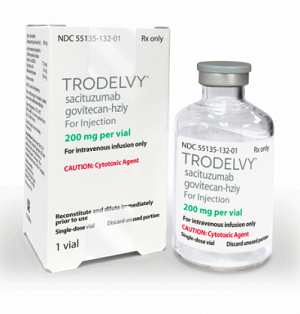
Gilead’s Trodelvy (sacituzumab govitecan) achieved blockbuster status in triple-negative breast cancer but failed to replicate this success in lung cancer.
The Phase III EVOKE-01 trial compared Trodelvy with docetaxel in patients with stage IV metastatic NSCLC who had received prior treatment. The primary endpoint was overall survival (OS).
Ultimately, Trodelvy failed to achieve statistical significance in OS, only showing a trend toward efficacy in some secondary endpoints. Based on these results, Gilead halted its strategy to expand the indication into lung cancer.
AstraZeneca and Daiichi Sankyo also faced similar challenges. Their jointly developed ‘Datroway (datopotamab deruxtecan)’ was seen as Daiichi Sankyo's second ambitious project after ‘Enhertu (trastuzumab deruxtecan),’ which reshaped the ADC market, but it failed to deliver expected results in lung cancer trials.
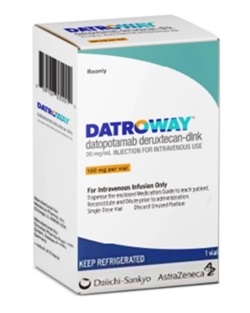
The Phase III TROPION-Lung01 study compared datopotamab and docetaxel in a 1:1 ratio in patients with previously treated advanced or metastatic non-squamous NSCLC.
The results showed improvement in progression-free survival (PFS) in some patient subgroups, but failed to demonstrate a significant difference in overall survival (OS). Notably, only limited efficacy was observed in the non-squamous patient subgroup, revealing limitations for expanding the indication.
Based on these results, both companies withdrew their marketing applications in Europe following the withdrawal in the US. This decision followed pre-submission discussions with regulatory authorities, who determined the clinical significance was insufficient. Subsequently, AstraZeneca and Daiichi Sankyo are re-evaluating biomarker-based patient selection strategies and exploring potential combination therapies with targeted agents.
Industry analysts attribute these failures to the limitation of directly applying the success formula that the companies experienced with breast cancer to lung cancer. Key factors cited include the high intratumoral heterogeneity in lung cancer and the less clear correlation between TROP-2 expression levels and treatment response compared to breast cancer. Additionally, managing cumulative toxicity with repeated dosing was also seen as a burden.
Consequently, contrary to initial expectations that TROP-2 ADCs would be a universal platform expandable to all solid tumors, it is becoming clear that success varies dramatically depending on the specific indication. Against this backdrop, the recent confirmation of efficacy for sasituzumab tirumotecan in China is being viewed as a meaningful proof-of-concept that may reopen the door for TROP-2 ADCs in lung cancer.
-

- 0
댓글 운영방식은
댓글은 실명게재와 익명게재 방식이 있으며, 실명은 이름과 아이디가 노출됩니다. 익명은 필명으로 등록 가능하며, 대댓글은 익명으로 등록 가능합니다.
댓글 노출방식은
댓글 명예자문위원(팜-코니언-필기모양 아이콘)으로 위촉된 데일리팜 회원의 댓글은 ‘게시판형 보기’와 ’펼쳐보기형’ 리스트에서 항상 최상단에 노출됩니다. 새로운 댓글을 올리는 일반회원은 ‘게시판형’과 ‘펼쳐보기형’ 모두 팜코니언 회원이 쓴 댓글의 하단에 실시간 노출됩니다.
댓글의 삭제 기준은
다음의 경우 사전 통보없이 삭제하고 아이디 이용정지 또는 영구 가입제한이 될 수도 있습니다.
-
저작권·인격권 등 타인의 권리를 침해하는 경우
상용 프로그램의 등록과 게재, 배포를 안내하는 게시물
타인 또는 제3자의 저작권 및 기타 권리를 침해한 내용을 담은 게시물
-
근거 없는 비방·명예를 훼손하는 게시물
특정 이용자 및 개인에 대한 인신 공격적인 내용의 글 및 직접적인 욕설이 사용된 경우
특정 지역 및 종교간의 감정대립을 조장하는 내용
사실 확인이 안된 소문을 유포 시키는 경우
욕설과 비어, 속어를 담은 내용
정당법 및 공직선거법, 관계 법령에 저촉되는 경우(선관위 요청 시 즉시 삭제)
특정 지역이나 단체를 비하하는 경우
특정인의 명예를 훼손하여 해당인이 삭제를 요청하는 경우
특정인의 개인정보(주민등록번호, 전화, 상세주소 등)를 무단으로 게시하는 경우
타인의 ID 혹은 닉네임을 도용하는 경우
-
게시판 특성상 제한되는 내용
서비스 주제와 맞지 않는 내용의 글을 게재한 경우
동일 내용의 연속 게재 및 여러 기사에 중복 게재한 경우
부분적으로 변경하여 반복 게재하는 경우도 포함
제목과 관련 없는 내용의 게시물, 제목과 본문이 무관한 경우
돈벌기 및 직·간접 상업적 목적의 내용이 포함된 게시물
게시물 읽기 유도 등을 위해 내용과 무관한 제목을 사용한 경우
-
수사기관 등의 공식적인 요청이 있는 경우
-
기타사항
각 서비스의 필요성에 따라 미리 공지한 경우
기타 법률에 저촉되는 정보 게재를 목적으로 할 경우
기타 원만한 운영을 위해 운영자가 필요하다고 판단되는 내용
-
사실 관계 확인 후 삭제
저작권자로부터 허락받지 않은 내용을 무단 게재, 복제, 배포하는 경우
타인의 초상권을 침해하거나 개인정보를 유출하는 경우
당사에 제공한 이용자의 정보가 허위인 경우 (타인의 ID, 비밀번호 도용 등)
※이상의 내용중 일부 사항에 적용될 경우 이용약관 및 관련 법률에 의해 제재를 받으실 수도 있으며, 민·형사상 처벌을 받을 수도 있습니다.
※위에 명시되지 않은 내용이더라도 불법적인 내용으로 판단되거나 데일리팜 서비스에 바람직하지 않다고 판단되는 경우는 선 조치 이후 본 관리 기준을 수정 공시하겠습니다.
※기타 문의 사항은 데일리팜 운영자에게 연락주십시오. 메일 주소는 dailypharm@dailypharm.com입니다.


-

- "SpaceOAR reduces rectal bleeding…major shift in radiation therapy"
- Prostate cancer is the most common cancer diagnosed in men…treatment demand increases among elderly patients