- LOGIN
- MemberShip
- 2026-09-23 08:55:19
- 2 new JAK inhibitors secure expanded reimb
- by Son, Hyung-Min | translator Kim, Jung-Ju | 2023-12-19 05:54:04
The treatment market for active ankylosing spondylitis, which had been previously dominated by Tumor Necrosis Factor-alpha (TNF-α) inhibitors such as Humira and Remicade, is transforming.
As of the 1st of this month, reimbursement has been applied and expanded to include major Janus Kinase (JAK) inhibitors and biologic agents for treating active ankylosing spondylitis; thereby, forecasting a likely surge in market competition.
According to the industry on the 16th, the two JAK inhibitors, Pfizer’s Xeljanz (tofacitinib) and AbbVie’s Rinvoq (upadacitinib), newly passed the reimbursement criteria for treating active ankylosing spondylitis.
Eli Lilly’s Taltz (ixekizumab) and Novartis’ Cosentyx (secukinumab) now receive expanded reimbursement criteria for primary treatment options active ankylosing spondylitis.
Active ankylosing spondylitis is an autoimmune disease that involves inflammation in the spine and, over time, can cause progressive spinal rigidity.
The inflammation in spine joints results in pain and loss of flexibility.
If left untreated, active ankylosing spondylitis can restrict movements because the bones in the spine fuse in a fixed position.
Until now, TNF-α inhibitors were used as the first-line treatment for active ankylosing spondylitis.
Due to the lack of treatment options for patients who developed resistance, anticipation is rising on the effect the newly reimbursement treatments will provide to the field.
Xeljanz and Rinvoq, first JAK inhibitors to add reimbursement standards for active ankylosing spondylitis. Patients with severe active ankylosing spondylitis who have stopped receiving treatment due to poor response to one or more types of TNF-α inhibitor or IL-17A inhibitor will be able to receive reimbursement for the JAK inhibitors Rinvoq and Xeljanz.
JAK inhibitors suppress JAK enzymes., which play a critical role in facilitating processes in the immune system; however, their overactivation can lead to several autoimmune diseases.
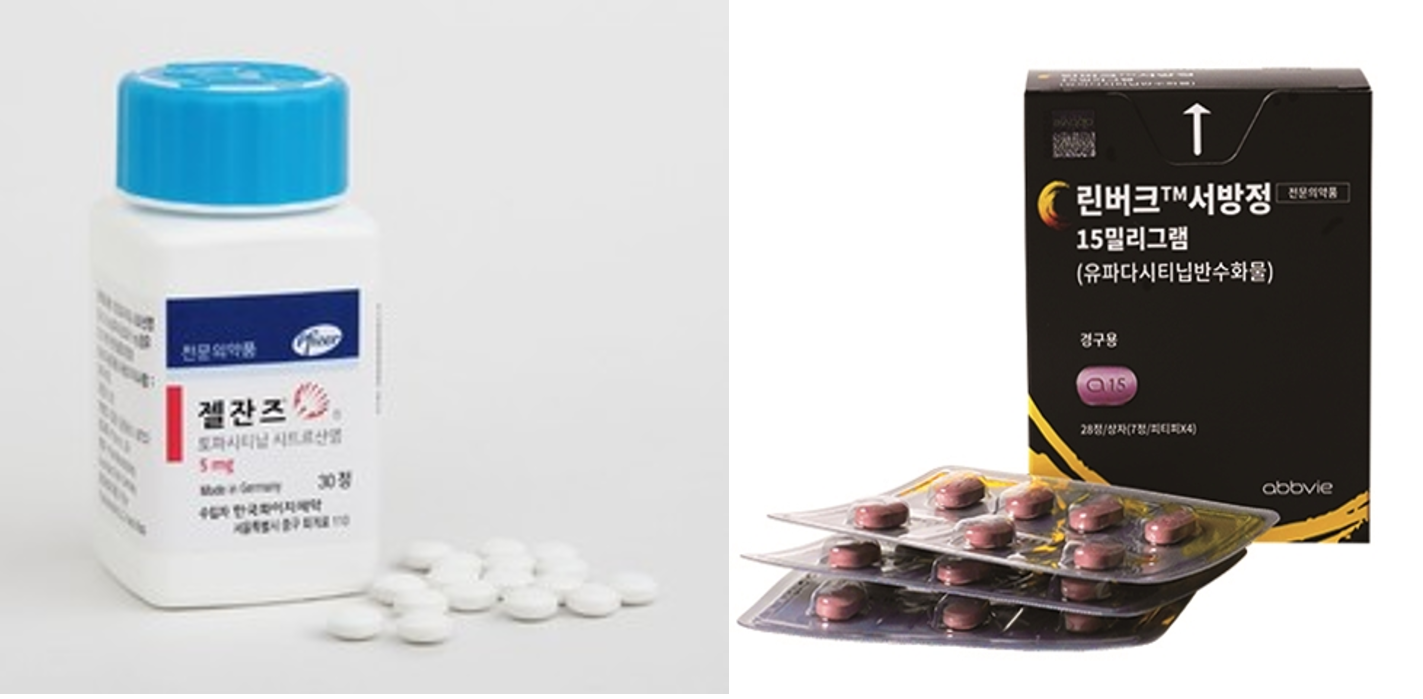
In the Phase 3 SELECT-AXIS 2 clinical studies, which enrolled patients with ankylosing spondylitis who failed previous treatments with TNF-α inhibitor or IL-17A inhibitor, the ASAS40 (Assessment of Spondyloarthritis International Society response standard improvement of 40% or more) response rate for patients treated with Rinvoq was 45.0% at week 14.
This was significantly higher than that of the placebo group (18.0%).
In the Phase 3 S-I clinical trial, which enrolled patients with active ankylosing spondylitis who had an inadequate response to prior TNF-α inhibitor treatments, the ASAS40 response rate for patients treated with Xeljanz was 41%, as opposed to 13% in the placebo group.
Due to the current expansion of reimbursement, the patients with active ankylosing spondylitis will be able to receive reimbursement for Xeljanz and Rinvoq, the drugs previously used for eczema, rheumatoid arthritis, and ulcerative colitis.
Notably, two drugs offer an advantage over other treatment options due to their convenience in administration, as they are oral treatments.
Cosentyx and Taltz, which are biologic drugs, succeeded in expanding the reimbursement criteria as first-line treatments for active ankylosing spondylitis The reimbursement criteria are expanded for Novartis's Cosentyx and Eli Lilly's Taltz, biologics that inhibit IL-17A, to include first-line treatments for ankylosing spondylitis.
Previously, reimbursement criteria were limited to cases where there was an inadequate response to one or more TNF-α inhibitors, or when treatment was discontinued due to side effects or incompatibility.
Cosentyx and Taltz both function by selectively binding to the cytokine IL-17A, an inflammatory mediator, and inhibiting its interaction with respective receptor.
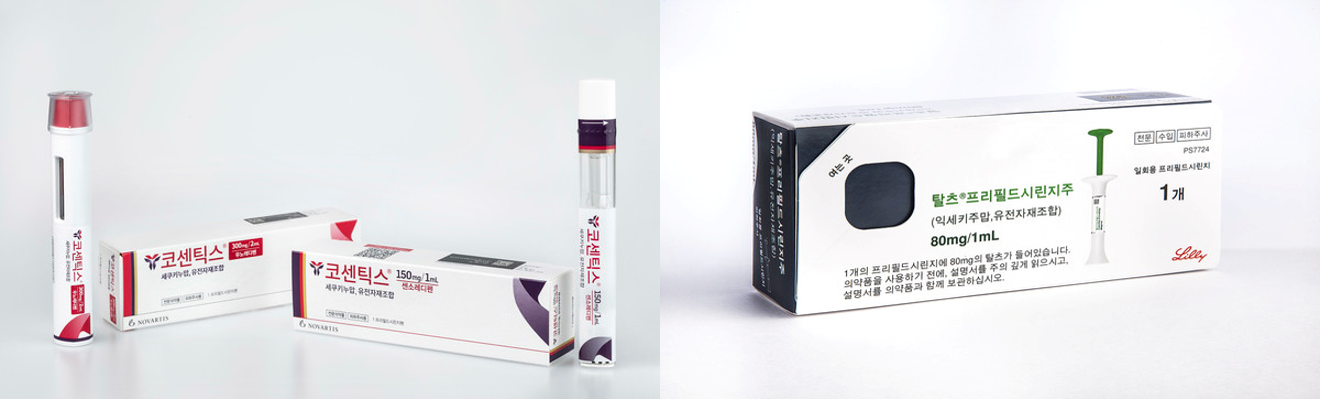
The reimbursement criteria for these treatments have been expanded for patients with severe active ankylosing spondylitis who had shown insufficient response or drug side-effects despite treatment with two or more types of non-steroidal anti-inflammatory drugs (NSAIDs) or biological Disease-Modifying Anti-Rheumatic Drugs (bDMARDs) for over three months.
In the four-year long-term MEASURE 1 study, Cosentyx has shown that in approximately 80% of active ankylosing spondylitis patients, there was no progression of spinal deformity (modified Stoke Ankylosing Spondylitis Spinal Score (mSASSS) changes less than 2) over four years.
Moreover, the MEASURE 2 study demonstrated the long-term effect of Cosentyx in improving key symptoms of active ankylosing spondylitis, including morning stiffness, spinal pain, fatigue, and nocturnal back pain up to 5 years.
The effectiveness of Taltz was demonstrated in COAST-V clinical studies in patients who are biologic disease-modifying antirheumatic drug (bDMARD)-naïve, and COAST-W Phase 3 studies in patients who previously had an inadequate response or were intolerant to tumor necrosis factor (TNF) inhibitors.
The COAST-V clinical trial result demonstrated that the ASAS40 response rate for patients treated with Taltz was 48% at week 16, a significantly higher response rate compared to the 18% in the placebo group.
In addition, the COAST-W clinical trial also demonstrated a higher ASAS40 response rate for Taltz compared to the place group (Taltz: 25.4%, Placebo: 12.5%).
Cosentyx and Taltz have shown consistent results not only in clinical trials but also in real-world data, confirming their effectiveness and safety in real medical settings.
-

- 0
댓글 운영방식은
댓글은 실명게재와 익명게재 방식이 있으며, 실명은 이름과 아이디가 노출됩니다. 익명은 필명으로 등록 가능하며, 대댓글은 익명으로 등록 가능합니다.
댓글 노출방식은
댓글 명예자문위원(팜-코니언-필기모양 아이콘)으로 위촉된 데일리팜 회원의 댓글은 ‘게시판형 보기’와 ’펼쳐보기형’ 리스트에서 항상 최상단에 노출됩니다. 새로운 댓글을 올리는 일반회원은 ‘게시판형’과 ‘펼쳐보기형’ 모두 팜코니언 회원이 쓴 댓글의 하단에 실시간 노출됩니다.
댓글의 삭제 기준은
다음의 경우 사전 통보없이 삭제하고 아이디 이용정지 또는 영구 가입제한이 될 수도 있습니다.
-
저작권·인격권 등 타인의 권리를 침해하는 경우
상용 프로그램의 등록과 게재, 배포를 안내하는 게시물
타인 또는 제3자의 저작권 및 기타 권리를 침해한 내용을 담은 게시물
-
근거 없는 비방·명예를 훼손하는 게시물
특정 이용자 및 개인에 대한 인신 공격적인 내용의 글 및 직접적인 욕설이 사용된 경우
특정 지역 및 종교간의 감정대립을 조장하는 내용
사실 확인이 안된 소문을 유포 시키는 경우
욕설과 비어, 속어를 담은 내용
정당법 및 공직선거법, 관계 법령에 저촉되는 경우(선관위 요청 시 즉시 삭제)
특정 지역이나 단체를 비하하는 경우
특정인의 명예를 훼손하여 해당인이 삭제를 요청하는 경우
특정인의 개인정보(주민등록번호, 전화, 상세주소 등)를 무단으로 게시하는 경우
타인의 ID 혹은 닉네임을 도용하는 경우
-
게시판 특성상 제한되는 내용
서비스 주제와 맞지 않는 내용의 글을 게재한 경우
동일 내용의 연속 게재 및 여러 기사에 중복 게재한 경우
부분적으로 변경하여 반복 게재하는 경우도 포함
제목과 관련 없는 내용의 게시물, 제목과 본문이 무관한 경우
돈벌기 및 직·간접 상업적 목적의 내용이 포함된 게시물
게시물 읽기 유도 등을 위해 내용과 무관한 제목을 사용한 경우
-
수사기관 등의 공식적인 요청이 있는 경우
-
기타사항
각 서비스의 필요성에 따라 미리 공지한 경우
기타 법률에 저촉되는 정보 게재를 목적으로 할 경우
기타 원만한 운영을 위해 운영자가 필요하다고 판단되는 내용
-
사실 관계 확인 후 삭제
저작권자로부터 허락받지 않은 내용을 무단 게재, 복제, 배포하는 경우
타인의 초상권을 침해하거나 개인정보를 유출하는 경우
당사에 제공한 이용자의 정보가 허위인 경우 (타인의 ID, 비밀번호 도용 등)
※이상의 내용중 일부 사항에 적용될 경우 이용약관 및 관련 법률에 의해 제재를 받으실 수도 있으며, 민·형사상 처벌을 받을 수도 있습니다.
※위에 명시되지 않은 내용이더라도 불법적인 내용으로 판단되거나 데일리팜 서비스에 바람직하지 않다고 판단되는 경우는 선 조치 이후 본 관리 기준을 수정 공시하겠습니다.
※기타 문의 사항은 데일리팜 운영자에게 연락주십시오. 메일 주소는 dailypharm@dailypharm.com입니다.