- LOGIN
- MemberShip
- 2026-09-11 08:08:57
- AI-driven imaging competition heats up at KCR
- by Hwang, byoung woo | translator Alice Kang | 2026-09-10 08:44:32
Competition in artificial intelligence (AI) for diagnostic imaging is expanding beyond lesion detection and interpretation assistance to encompass the entire imaging workflow.
As AI becomes involved in everything from image acquisition and reconstruction to automated measurements and report generation, companies are increasingly competing not simply on diagnostic accuracy but on their ability to improve examination speed and consistency while reducing clinicians’ workload.
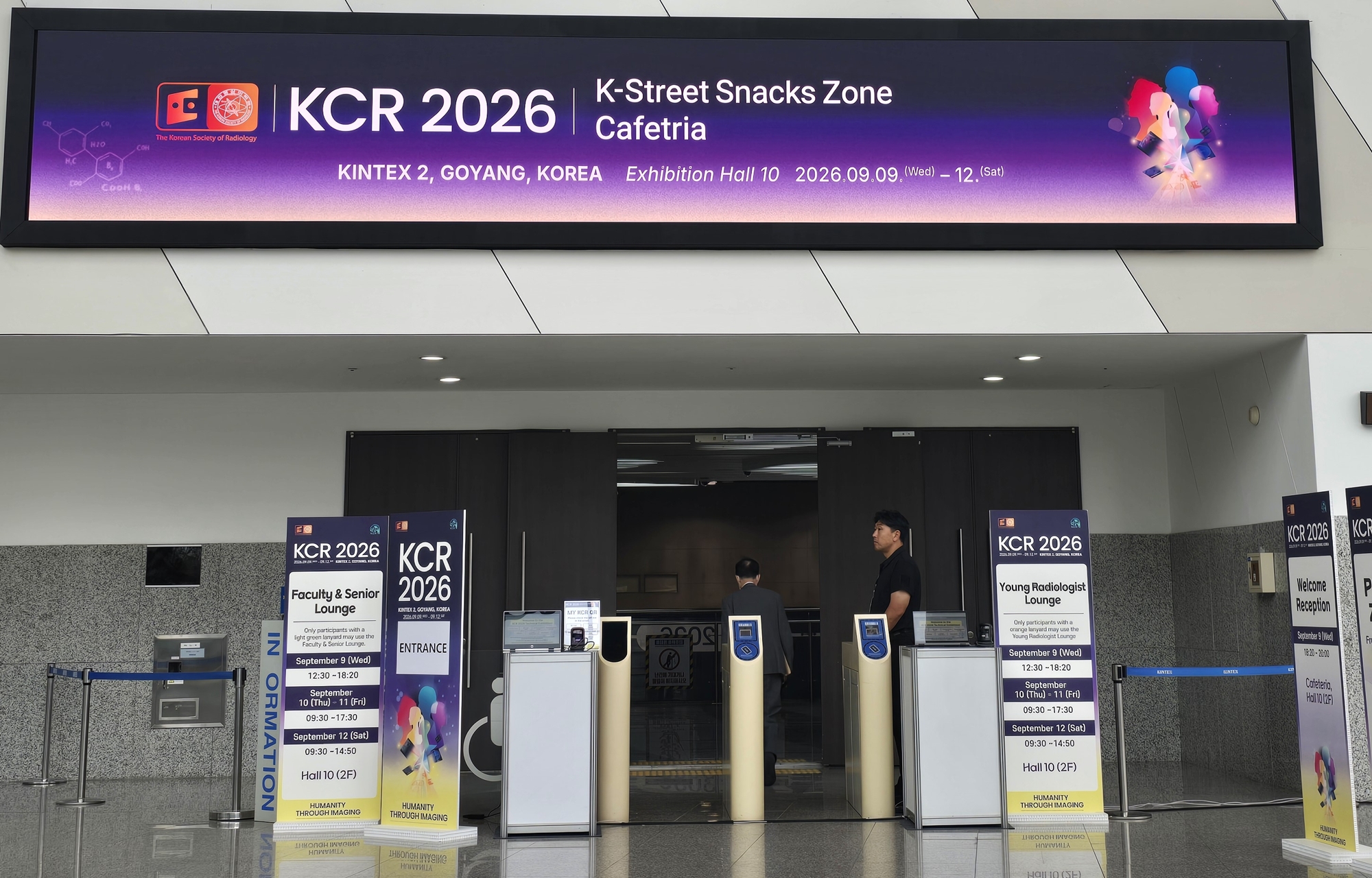
This shift was on full display at the Korean Congress of Radiology 2026 (KCR 2026), held Sept. 9–12 at KINTEX Exhibition Center 2 in Goyang.
AI incorporated into imaging equipment…automating the entire examination process
The theme of this year’s congress is “Humanity Through Imaging.” Participating companies emphasized the clinical value that healthcare professionals and patients can gain from technologies in actual examination settings, rather than focusing solely on technological performance.
While last year’s KCR centered on the hardware specifications needed to support high-performance AI and the possibility of upgrading existing equipment, a new area of competition has emerged this year -- how AI can be integrated into the imaging workflow.
Competition among global diagnostic imaging companies has shifted from obtaining clearer images alone toward simultaneously reducing the time required for image acquisition, reconstruction and measurement. AI, meanwhile, is moving beyond standalone interpretation software and becoming embedded in CT, MR and ultrasound systems themselves.
In CT and MR, the integration of hardware with AI-based reconstruction technology was particularly prominent. Siemens Healthineers applied its high-quality Quantum Iterative Reconstruction (QIR) technology to the NAEOTOM Alpha photon-counting CT system, while Philips showcased the second-generation Spectral CT 7500, which acquires conventional CT images and spectral data simultaneously, as well as the 3.0T MR BlueSeal Horizon, which is yet to be approved in Korea.
GE HealthCare, meanwhile, presented Sonic DL, which accelerates MR image acquisition, and AIR Recon DL, which reduces image noise.

In ultrasound, where examinations depend heavily on operator technique, automated recognition and measurement technologies were a common feature.
Philips’ EPIQ Elite VM14 highlighted technology that automatically measures the kidneys and spleen and selects optimal image frames. GE HealthCare’s LOGIQ series similarly uses AI to identify and measure structures including the common bile duct, kidneys and abdominal aorta, reducing repetitive steps of testing for healthcare professionals.
Samsung Medison presented its Liver Total Solution centered on the premium R20 ultrasound system, which offers combined assessment of fatty liver, liver fibrosis and viscosity-related properties of liver tissue. Its EzSWI liver stiffness measurement technology uses AI to automatically designate the region of interest.A study by a research team led by Professor Jeong-min Lee of Seoul National University Hospital found that the technology reduced examination time by approximately 55% without a statistically significant difference in diagnostic accuracy compared with the conventional method.
Ultimately, competition in imaging equipment is shifting beyond how clearly images can be produced toward how quickly and consistently images of equivalent quality can be acquired.
Young-beom Cho, Director of Domestic Sales Team at Samsung Medison, said, “Advances in imaging technology should go beyond providing more functions and ultimately help healthcare professionals make more reliable decisions while enabling patients to undergo examinations more efficiently.”
Medical AI expands beyond detection…supports follow-up and reporting
Korean medical AI companies placed greater emphasis on tasks performed after image acquisition. Their technologies are expanding beyond diagnostic assistance that flags lesions to encompass comparison with previous examinations, follow-up management, review of interpretation results and report generation.
Lunit departed from the conventional approach of focusing on brochures and product presentations, instead setting up an interactive booth where visitors could experience the AI-assisted interpretation process firsthand.
Through the Lunit INSIGHT Challenge, visitors could interpret chest X-rays and mammograms themselves and then compare their findings with the AI results. At the product demonstration area, the company showcased the interpretation workflows of Lunit INSIGHT CXR4, Lunit INSIGHT MMG and Lunit INSIGHT DBT, its AI solution for 3D mammography interpretation.
“Sung-ho Back, a Lunit manager, explained, “AI solutions are much easier and faster to understand by experiencing them firsthand than by simply hearing an explanation. We designed the booth so visitors could interpret images themselves, compare their findings with the AI results and experience firsthand the role AI can play in an actual interpretation environment.”

Coreline Soft presented chest CT-based medical imaging AI solutions and clinical and screening applications under the theme “AI in Radiology: Beyond Detection.”
Its AVIEW LCS Plus integrated lung cancer screening solution supports comparison with previous images and longitudinal follow-up in addition to lung nodule detection and quantitative analysis. The system enables clinicians to assess nodule size and changes according to consistent criteria across repeated examinations and link the findings to subsequent examinations and care.
DEEPNOID, meanwhile, incorporated generative AI into the interpretation process. Eight abstracts in the chest and brain imaging fields being presented by the company at KCR 2026 evaluated how accuracy, efficiency and consistency change when AI is integrated into clinicians’ interpretation workflows.
In chest imaging, the research covered a double-reading approach in which AI identifies cases that may have been missed after a physician’s initial interpretation and recommends them for review, as well as the use of generative AI to draft chest X-ray reports.
While Coreline Soft has expanded its clinical reach into post-screening follow-up management and Lunit has focused on direct comparisons between clinicians’ interpretations and AI results, Deepnoid has extended AI into the selection of cases for re-review and report generation.
Reducing only unnecessary repeat scans…will start real-time management from November
Meanwhile, the Korean Society of Radiology agreed with the need for stronger management of CT and MRI imaging histories but stressed that not all repeat imaging should be regarded as unnecessary duplicate testing.
Beginning in November, the Health Insurance Review & Assessment Service (HIRA) will pilot a system that manages patients’ CT and MRI imaging histories in real time through its medical reimbursement benefits history verification system. Once the program is implemented, medical institutions will be required to review a patient’s imaging history from the previous year before performing a scan and submit relevant information to HIRA immediately afterward.
KSR said repeat imaging may be medically necessary when performed to monitor changes in a patient’s condition or treatment outcomes, or when additional scans are needed because previous images were inadequate in quality or did not sufficiently cover the required anatomical area. By contrast, it said examinations repeated without medical justification despite usable existing images should be reduced.
Joon-il Choi, Director of the KSR’s Policy and Advocacy Institute (KSR-PAI) and professor of radiology at Seoul St. Mary’s Hospital,said, “Not every repeat CT or MRI examination should be regarded as unnecessary duplicate imaging. The policy should focus not on indiscriminately reducing the number of repeat examinations, but on accurately identifying and reducing repeat scans that lack medical justification.”

The society proposed measures including entering reason codes for repeat imaging, facilitating the exchange of imaging information among medical institutions, establishing objective image-quality assessments and creating reimbursement for storing outside images in picture archiving and communication systems (PACS).
On reimbursement for medical AI, the society also offered a pragmatic assessment that the National Health Insurance budget alone would be unlikely to provide compensation at the level expected by the industry.
Given Korea’s relatively low medical fees, healthcare institutions have difficulty translating productivity gains from AI adoption into additional revenue. With the government also pursuing reductions in reimbursement for diagnostic imaging, the society said it would be difficult for the National Health Insurance system to provide additional reimbursement for AI usage fees.
Choi said, “We need to fundamentally reconsider why the cost of medical AI should be borne by National Health Insurance,” and suggested that if the objective is largely to foster the industry and support exports, the government could also consider using separate funding from the industry or science and technology sectors.
-

- 0
댓글 운영방식은
댓글은 실명게재와 익명게재 방식이 있으며, 실명은 이름과 아이디가 노출됩니다. 익명은 필명으로 등록 가능하며, 대댓글은 익명으로 등록 가능합니다.
댓글 노출방식은
댓글 명예자문위원(팜-코니언-필기모양 아이콘)으로 위촉된 데일리팜 회원의 댓글은 ‘게시판형 보기’와 ’펼쳐보기형’ 리스트에서 항상 최상단에 노출됩니다. 새로운 댓글을 올리는 일반회원은 ‘게시판형’과 ‘펼쳐보기형’ 모두 팜코니언 회원이 쓴 댓글의 하단에 실시간 노출됩니다.
댓글의 삭제 기준은
다음의 경우 사전 통보없이 삭제하고 아이디 이용정지 또는 영구 가입제한이 될 수도 있습니다.
-
저작권·인격권 등 타인의 권리를 침해하는 경우
상용 프로그램의 등록과 게재, 배포를 안내하는 게시물
타인 또는 제3자의 저작권 및 기타 권리를 침해한 내용을 담은 게시물
-
근거 없는 비방·명예를 훼손하는 게시물
특정 이용자 및 개인에 대한 인신 공격적인 내용의 글 및 직접적인 욕설이 사용된 경우
특정 지역 및 종교간의 감정대립을 조장하는 내용
사실 확인이 안된 소문을 유포 시키는 경우
욕설과 비어, 속어를 담은 내용
정당법 및 공직선거법, 관계 법령에 저촉되는 경우(선관위 요청 시 즉시 삭제)
특정 지역이나 단체를 비하하는 경우
특정인의 명예를 훼손하여 해당인이 삭제를 요청하는 경우
특정인의 개인정보(주민등록번호, 전화, 상세주소 등)를 무단으로 게시하는 경우
타인의 ID 혹은 닉네임을 도용하는 경우
-
게시판 특성상 제한되는 내용
서비스 주제와 맞지 않는 내용의 글을 게재한 경우
동일 내용의 연속 게재 및 여러 기사에 중복 게재한 경우
부분적으로 변경하여 반복 게재하는 경우도 포함
제목과 관련 없는 내용의 게시물, 제목과 본문이 무관한 경우
돈벌기 및 직·간접 상업적 목적의 내용이 포함된 게시물
게시물 읽기 유도 등을 위해 내용과 무관한 제목을 사용한 경우
-
수사기관 등의 공식적인 요청이 있는 경우
-
기타사항
각 서비스의 필요성에 따라 미리 공지한 경우
기타 법률에 저촉되는 정보 게재를 목적으로 할 경우
기타 원만한 운영을 위해 운영자가 필요하다고 판단되는 내용
-
사실 관계 확인 후 삭제
저작권자로부터 허락받지 않은 내용을 무단 게재, 복제, 배포하는 경우
타인의 초상권을 침해하거나 개인정보를 유출하는 경우
당사에 제공한 이용자의 정보가 허위인 경우 (타인의 ID, 비밀번호 도용 등)
※이상의 내용중 일부 사항에 적용될 경우 이용약관 및 관련 법률에 의해 제재를 받으실 수도 있으며, 민·형사상 처벌을 받을 수도 있습니다.
※위에 명시되지 않은 내용이더라도 불법적인 내용으로 판단되거나 데일리팜 서비스에 바람직하지 않다고 판단되는 경우는 선 조치 이후 본 관리 기준을 수정 공시하겠습니다.
※기타 문의 사항은 데일리팜 운영자에게 연락주십시오. 메일 주소는 dailypharm@dailypharm.com입니다.