- LOGIN
- MemberShip
- 2026-09-11 00:44:48
- Expectations and concerns around 'Opakalim,' in-licensed at KRW 1T
- by Cha, Ji-Hyun | translator Hong, Ji Yeon | 2026-09-09 12:26:33

Expectations and concerns have surfaced around Opakalim, an epilepsy drug candidate that SK Biopharmaceuticals has in-licensed for about KRW 1 trillion. While it is projected to surpass $2 billion in net sales by 2042 following a 2029 U.S. launch, SK Biopharmaceuticals must pay sales royalties post-commercialization to both its contracting counterpart, Biohaven, and the original developer, Knopp Biosciences.
According to the biotech industry on the 8th, SK Biopharmaceuticals valued the assets it evaluated during the in-licensing of the epilepsy drug candidate 'Opakalim (BHV-7000),' potassium channel (Kv7) activator compounds, and the Kv7 discovery platform at $909.6 million (KRW 1.2581 trillion). This is about 14% higher than the maximum deal value SK Biopharmaceuticals signed.
The valuation was conducted by calculating free cash flow after deducting cost of goods, research and development (R&D) expenses, selling, general and administrative (SG&A) expenses, and working capital from projected revenues generated by Opakalim, and then discounting it to present value by reflecting clinical success probabilities and the time value of money. It incorporated the risks of drug development failure on top of the standard discounted cash flow (DCF) model.
Previously, on the 26th of last month, SK Biopharmaceuticals signed an agreement with Biohaven Bioscience Ireland to secure exclusive worldwide development and commercialization rights for Opakalim, Kv7 activator compounds, and the Kv7 drug discovery platform. The total contract value is up to $795 million (KRW 1.0995 trillion), including a non-refundable upfront payment of $400 million (KRW 553.2 billion KRW). Royalties based on product sales are separate.
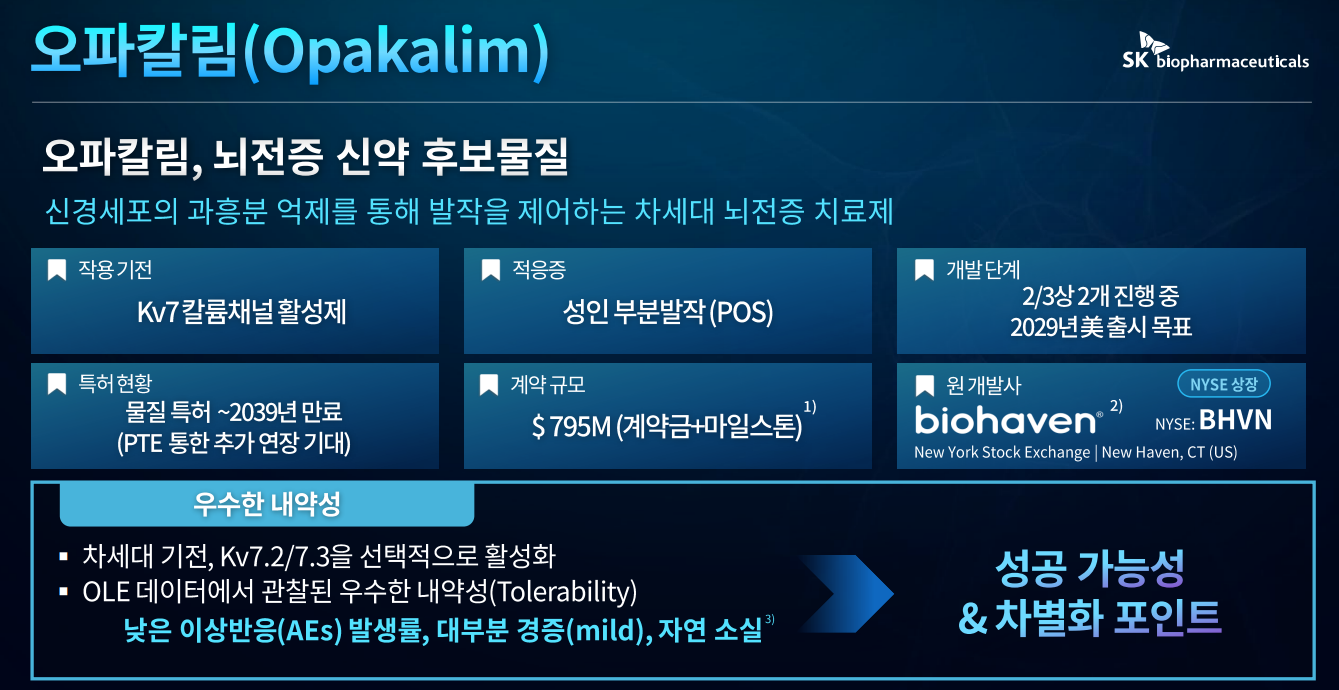
Opakalim is an oral anti-seizure candidate that selectively activates Kv7.2 and Kv7.3 potassium channels regulating neuronal excitability in the brain. Its mechanism of action stabilizes hyperexcited neurons to suppress seizures. Unlike certain conventional anti-seizure medications, it has relatively little influence on gamma-aminobutyric acid (GABA) receptors, and its potential to reduce central nervous system (CNS) side effects is cited as a competitive advantage.
Knopp Biosciences in the United States originally developed Opakalim. Biohaven acquired the Kv7 platform and Opakalim by signing an agreement to acquire Knopp's subsidiary, Channel Biosciences, in February 2022 and completing the transaction in April of the same year. Knopp received $35 million in cash and $65 million worth of Biohaven shares, totaling $100 million in initial consideration. The deal also included milestone payments tied to development and regulatory approval, along with sales royalties.
Currently, Opakalim is undergoing global 'RISE2' and 'RISE3' Phase 2/3 clinical trials in adult patients with focal seizures. RISE3 completed patient enrollment last June and is slated to announce top-line results in the second half of this year. In an open-label extension (OLE) study evaluating long-term efficacy and safety after the preceding Phase 2 trial, 54% of patients treated with the 75 mg dose showed a 50% or greater reduction in seizure frequency over six consecutive months.
Shinhan Accounting Corporation, an external valuation firm, estimated future revenue and cash flows to calculate the asset value, assuming Opakalim successfully navigates clinical trials and regulatory approvals to launch in the United States in 2029. It assumed the compound annual growth rate of 2.6% in total U.S. focal seizure prescriptions from 2016 to 2025 would continue. Opakalim's market share was projected to rise from 0.1% in 2029, its first year of launch, to 0.4% in 2030, 1.9% in 2035, and 2.9% in 2040. The prescription price was estimated to increase by 4.6% annually from a baseline of $1,550.30, reflecting a 20.0% premium over the 2025 average price of four comparable products. Factoring in rebates and various discounts, actual net revenue was modeled at 52.0% of the prescription price.
Based on these assumptions, Opakalim was projected to generate $21.14 million in net sales in its initial U.S. launch year in 2029 and peak at $2.07913 billion in U.S. net sales in 2042, the 14th year post-launch. Subsequently, reflecting loss of exclusivity (LOE) in 2043, market share was projected to decline to 1.6% and net sales to decrease to $1.06173 billion. Applying a cumulative probability of 71.9% for clinical development and marketing approval success through commercialization, alongside a discount rate of 14.4%, yielded the final asset valuation.
Notably, projections that Opakalim will achieve operating profit margins exceeding 70% from the mid-post-launch period onward also drew attention. Shinhan Accounting Corporation anticipated that Opakalim's operating margin would reach 71.5% in 2040, 71.6% in 2041, and 72.3% in 2042. This is more than 30 percentage points higher than SK Biopharmaceuticals' operating profit margin of 39.3% recorded in the first half of this year.
This high profitability reflects a low-cost structure. Shinhan Accounting Corporation applied 10.9% of sales to cost of goods sold and 17.3% to SG&A expenses, based on averages of comparable U.S. biotechs. The rationale is that because SK Biopharmaceuticals has already established a dedicated local sales organization of about 150 personnel and a distribution infrastructure through cenobamate, it can co-commercialize Opakalim without significantly increasing overhead costs.
Analysis suggests that SK Biopharmaceuticals' move to secure rights to Opakalim —investing an upfront payment that approached nearly three times its annual operating profit from last year (KRW 203.9 billion)—was a strategic decision based on commercialization feasibility, revenue growth potential, and high profitability. This indicates that SK Biopharmaceuticals valued Opakalim as a high-margin blockbuster asset capable of exceeding $2 billion in annual sales while delivering operating profit margins in the 70% range.
The two companies also entered into a mutual non-compete clause. SK Biopharmaceuticals and Biohaven agreed to restrictions prohibiting either party from independently developing, manufacturing, or commercializing competing Kv7 activator compounds, or supporting third-party research related thereto, in global markets for several years following the first commercial sale of the product.
Currently, Xenon Pharmaceuticals is leading the Kv7 class with 'azetukalner'. Xenon announced Phase 3 clinical results for azetukalner last March and is scheduled to submit a marketing application to the U.S. Food and Drug Administration (FDA) in the third quarter of this year. If azetukalner is approved as planned, it will become the first Kv7-class therapy in the field of epilepsy. With azetukalner leading commercialization, this provision is interpreted as a safeguard to preserve the market value of the latecomer Opakalim and to support follow-on Kv7 pipeline candidates.
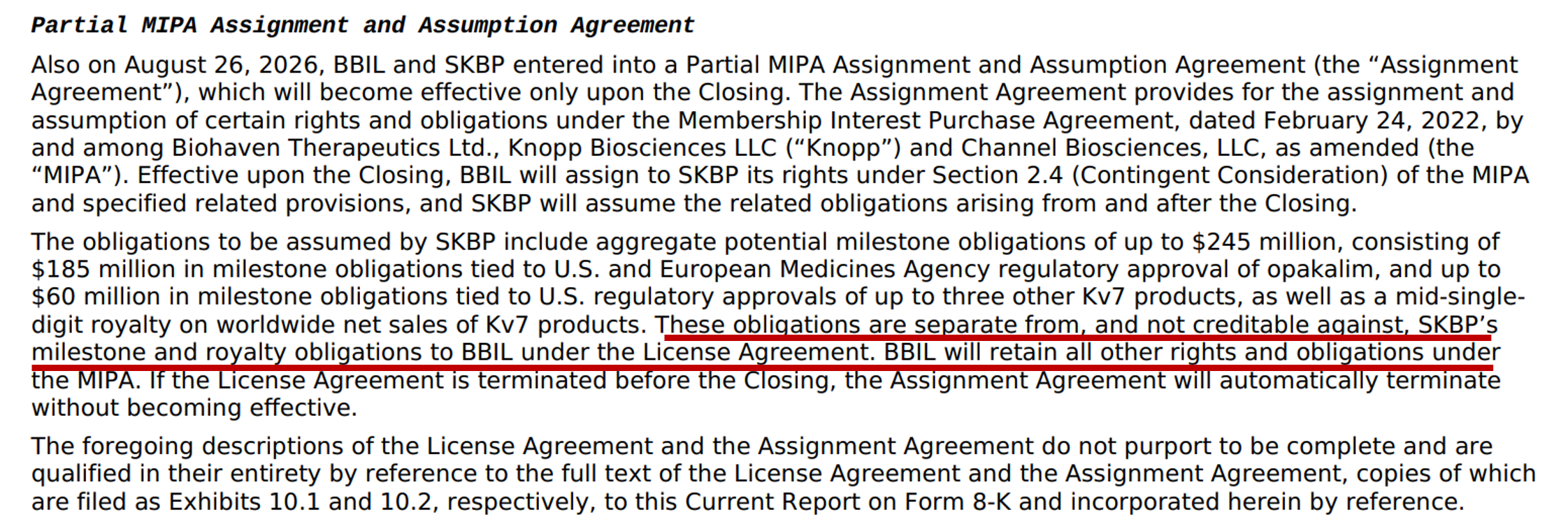
However, contractual royalty obligations will increase as Opakalim succeeds in commercialization and scales revenue, which could burden future profitability.
According to Biohaven's Current Report (Form 8-K) and the original license agreement filed with the U.S. Securities and Exchange Commission (SEC) on the 26th of last month, when SK Biopharmaceuticals sells Opakalim and certain anti-seizure products in the United States, it must pay Biohaven running royalties ranging from the mid-teens to low twenties across net sales tiers. For sales outside the United States, it pays a mid-single-digit royalty rate.
In addition, the share owed to the original developer, Knopp, is separate. As SK Biopharmaceuticals assumed Biohaven's existing contractual obligations, it must pay a separate mid-single-digit royalty to Knopp on worldwide net sales of Kv7 products. This royalty is independent of the royalties paid to Biohaven and cannot be offset.
In summary, when Opakalim generates revenue in the United States, SK Biopharmaceuticals must pay royalties in the mid-teens to low twenties to Biohaven, while simultaneously paying a separate mid-single-digit royalty to the original developer, Knopp. Together, the royalties SK Biopharmaceuticals must pay to both companies each time the drug is sold after commercialization could reach the mid-to-high 20% range. In this case, concerns are raised that even if Opakalim surpasses $2 billion in annual U.S. sales under the valuation scenario, the double royalty burden could reduce the actual profit margin to less than anticipated.
-

- 0
댓글 운영방식은
댓글은 실명게재와 익명게재 방식이 있으며, 실명은 이름과 아이디가 노출됩니다. 익명은 필명으로 등록 가능하며, 대댓글은 익명으로 등록 가능합니다.
댓글 노출방식은
댓글 명예자문위원(팜-코니언-필기모양 아이콘)으로 위촉된 데일리팜 회원의 댓글은 ‘게시판형 보기’와 ’펼쳐보기형’ 리스트에서 항상 최상단에 노출됩니다. 새로운 댓글을 올리는 일반회원은 ‘게시판형’과 ‘펼쳐보기형’ 모두 팜코니언 회원이 쓴 댓글의 하단에 실시간 노출됩니다.
댓글의 삭제 기준은
다음의 경우 사전 통보없이 삭제하고 아이디 이용정지 또는 영구 가입제한이 될 수도 있습니다.
-
저작권·인격권 등 타인의 권리를 침해하는 경우
상용 프로그램의 등록과 게재, 배포를 안내하는 게시물
타인 또는 제3자의 저작권 및 기타 권리를 침해한 내용을 담은 게시물
-
근거 없는 비방·명예를 훼손하는 게시물
특정 이용자 및 개인에 대한 인신 공격적인 내용의 글 및 직접적인 욕설이 사용된 경우
특정 지역 및 종교간의 감정대립을 조장하는 내용
사실 확인이 안된 소문을 유포 시키는 경우
욕설과 비어, 속어를 담은 내용
정당법 및 공직선거법, 관계 법령에 저촉되는 경우(선관위 요청 시 즉시 삭제)
특정 지역이나 단체를 비하하는 경우
특정인의 명예를 훼손하여 해당인이 삭제를 요청하는 경우
특정인의 개인정보(주민등록번호, 전화, 상세주소 등)를 무단으로 게시하는 경우
타인의 ID 혹은 닉네임을 도용하는 경우
-
게시판 특성상 제한되는 내용
서비스 주제와 맞지 않는 내용의 글을 게재한 경우
동일 내용의 연속 게재 및 여러 기사에 중복 게재한 경우
부분적으로 변경하여 반복 게재하는 경우도 포함
제목과 관련 없는 내용의 게시물, 제목과 본문이 무관한 경우
돈벌기 및 직·간접 상업적 목적의 내용이 포함된 게시물
게시물 읽기 유도 등을 위해 내용과 무관한 제목을 사용한 경우
-
수사기관 등의 공식적인 요청이 있는 경우
-
기타사항
각 서비스의 필요성에 따라 미리 공지한 경우
기타 법률에 저촉되는 정보 게재를 목적으로 할 경우
기타 원만한 운영을 위해 운영자가 필요하다고 판단되는 내용
-
사실 관계 확인 후 삭제
저작권자로부터 허락받지 않은 내용을 무단 게재, 복제, 배포하는 경우
타인의 초상권을 침해하거나 개인정보를 유출하는 경우
당사에 제공한 이용자의 정보가 허위인 경우 (타인의 ID, 비밀번호 도용 등)
※이상의 내용중 일부 사항에 적용될 경우 이용약관 및 관련 법률에 의해 제재를 받으실 수도 있으며, 민·형사상 처벌을 받을 수도 있습니다.
※위에 명시되지 않은 내용이더라도 불법적인 내용으로 판단되거나 데일리팜 서비스에 바람직하지 않다고 판단되는 경우는 선 조치 이후 본 관리 기준을 수정 공시하겠습니다.
※기타 문의 사항은 데일리팜 운영자에게 연락주십시오. 메일 주소는 dailypharm@dailypharm.com입니다.