- LOGIN
- MemberShip
- 2026-08-06 03:33:24
- Is there a separate 'drug price premium' track for companies other than innovative firms?
- by Kim, Jin-Gu | translator Hong, Ji Yeon | 2026-08-05 13:17:48
Following the adjustment of the generic drug price calculation rate from 53.55% to 45%, the 'drug price calculation system' is emerging as a critical exit strategy for the pharmaceutical industry to defend profitability.
The drug price bonus tracks under the revised drug pricing system are broadly divided into 'company-level premium' and 'product-level premiums.' While the pharmaceutical industry's focus was previously concentrated on company-level premiums, such as for Innovative Pharmaceutical Companies, the 'in-house API production' premium track granted to individual products is recently surfacing as a new mechanism for price defense.
According to the pharmaceutical industry on the 4th, supplier-based company-level premiums determine the generic price caps for a given company across the board depending on whether specific eligibility criteria are met. Companies certified as Innovative Pharmaceutical Companies based on metrics such as R&D investment relative to revenue receive a premium rate of 60%, while semi-innovative pharmaceutical companies receive 50%. Additionally, pharmaceutical manufacturers maintaining a designated threshold of essential/low-profit drugs (anti-withdrawal drugs) are categorized as supply-stabilization leader companies, qualifying for a 50% price calculation rate premium.
During discussions surrounding the reform of the drug pricing system, these company-level premiums drew significant attention from the pharmaceutical industry. Frontline drugmakers deployed exit strategies such as re-evaluating their R&D investment ratios and restructuring research and development expense line items on their financial statements.
68% Price Cap + Up to 10 Years… Why the Pharma Industry Is Focusing on "In-House API Production"
Recently, in addition to securing eligibility for company-level premiums, interest is mounting in "product-level premiums" tailored to the specific characteristics of individual drugs.
Product-level premiums are granted based on individual product attributes, such as drugs utilizing ▲in-house manufactured APIs, ▲national essential drugs using domestic APIs, ▲injectable antibiotics and essential pediatric medications, and ▲designated pharmaceuticals to resolve supply instability. The underlying objective is to provide preferential pricing benefits for products that contribute to health security and pharmaceutical supply chain stability.
Among these, the track attracting the most focus from the pharmaceutical industry is 'in-house API production.' The government has agreed to guarantee a drug price equivalent to 68% of the original price cap for a baseline period of 5 years if a generic is produced by directly synthesizing active pharmaceutical ingredients in the manufacturer's own facility. Furthermore, if eligibility conditions are continuously met, an additional 5-year extension is granted, allowing drugmakers to maintain elevated drug prices for up to 10 years or more (5 years + 5 years + α).
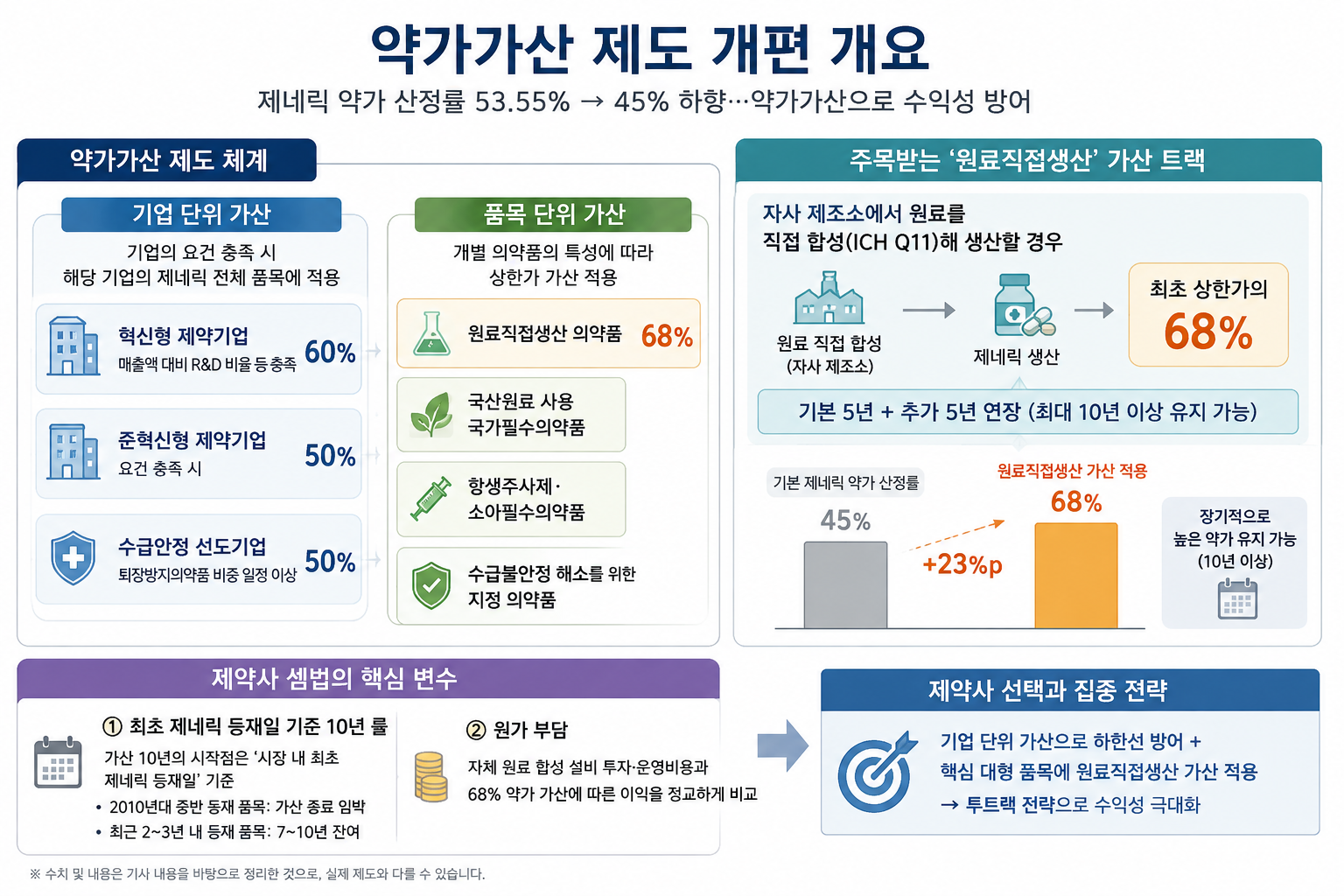
Under the previous drug pricing system, the premium duration was limited to just 1 year, yielding minimal practical benefits. However, under the new pricing framework, sentiment has shifted dramatically, as the premium period has been expanded to 10 years and the premium rate is applied at the highest level (68%). Because companies can secure a price 23 percentage points higher than the baseline calculation rate (45%) over an extended timeframe, certain products can yield even higher profitability than the Innovative Pharmaceutical Company premium rate (60%).
Of course, for companies lacking internal API manufacturing infrastructure, the in-house API production premium track is not an easy path. It requires equipping in-house manufacturing plants with chemical synthesis facilities compliant with ICH Q11 standards, and it consumes substantial time, capital, and administrative resources for manufacturing process development and marketing authorization variations. The government also strictly enforces criteria for recognizing in-house API production, limiting eligibility strictly to "production within the marketing authorization holder's (drugmaker's) own manufacturing site," while excluding facilities owned by parent companies, subsidiaries, or affiliates.
Nevertheless, analysts suggest that the ability to maintain a 68% price cap over an extended duration in an environment where the baseline generic pricing rate has dropped to 45% offsets these entry barriers.
'10-Year Rule' and 'Cost Burden' Variables… Targeting Products with Patent Expirations in 2 to 3 Years
Indeed, drug pricing managers across numerous domestic pharmaceutical companies are reportedly engaging in meticulous return-on-investment calculations regarding entry into the in-house API production track.
The single biggest variable is the 'timing of the first generic listing.' Under the regulations, the starting point for the 10-year premium period is calculated based on the 'listing date of the first generic in the market,' rather than the 'listing date of the company's own product.'
For instance, for hypertension and hyperlipidemia active ingredients where generics were already listed en masse in the mid-2010s, the 10-year limit following the first generic listing has either already passed or is imminent. Even if a drugmaker invests billions of KRW immediately to establish an API synthesis process, there is little practical benefit, as the premium duration has already expired or has only a few months remaining.
Conversely, the situation is different for molecules whose patents expired within the last two to three years or where the generic market has just opened. A prime example is the diabetes treatment market for DPP-4 inhibitors or SGLT-2 inhibitors, where major originator patents expired in or after 2023. Because the timing of the first generic listing in the market is recent, there remains a window of mathematically 7 to 10 years to receive the 68% drug price premium. This structure allows companies to recover facility investment costs and enhance profitability.
Another variable is the "cost burden." Pharmaceutical companies must meticulously weigh the manufacturing cost of using lower-cost Chinese or Indian APIs against the operational and maintenance costs of running their own synthesis facilities versus the profit yielded by the 68% drug price premium.
Under this current structure, rather than indiscriminately applying the in-house API production track to all products, drugmakers are evaluating a selective-and-focused strategy—targeting API synthesis investments specifically toward major products with recently expired patents. This represents a two-track strategy: defending overall generic pricing through company-level premiums like Innovative or Semi-Innovative status, while evaluating in-house API production premiums for core flagship products.
An official from a major pharmaceutical company explained, "If company-level premiums serve as a track to defend the baseline drug prices across the entire company, in-house API production is a targeted strategy to maximize revenue for key products," and added, "The practical benefits of the in-house API production track will be substantially greater for pharmaceutical companies with a high revenue reliance on specific products."
A drug pricing manager at another pharmaceutical company also noted, "For major chronic disease products whose patents have recently expired, we judge that defending a 68% drug price cap for several years is advantageous," and concluded, "We are currently evaluating whether to apply the in-house API production track centered around our key major products."
-

- 0
댓글 운영방식은
댓글은 실명게재와 익명게재 방식이 있으며, 실명은 이름과 아이디가 노출됩니다. 익명은 필명으로 등록 가능하며, 대댓글은 익명으로 등록 가능합니다.
댓글 노출방식은
댓글 명예자문위원(팜-코니언-필기모양 아이콘)으로 위촉된 데일리팜 회원의 댓글은 ‘게시판형 보기’와 ’펼쳐보기형’ 리스트에서 항상 최상단에 노출됩니다. 새로운 댓글을 올리는 일반회원은 ‘게시판형’과 ‘펼쳐보기형’ 모두 팜코니언 회원이 쓴 댓글의 하단에 실시간 노출됩니다.
댓글의 삭제 기준은
다음의 경우 사전 통보없이 삭제하고 아이디 이용정지 또는 영구 가입제한이 될 수도 있습니다.
-
저작권·인격권 등 타인의 권리를 침해하는 경우
상용 프로그램의 등록과 게재, 배포를 안내하는 게시물
타인 또는 제3자의 저작권 및 기타 권리를 침해한 내용을 담은 게시물
-
근거 없는 비방·명예를 훼손하는 게시물
특정 이용자 및 개인에 대한 인신 공격적인 내용의 글 및 직접적인 욕설이 사용된 경우
특정 지역 및 종교간의 감정대립을 조장하는 내용
사실 확인이 안된 소문을 유포 시키는 경우
욕설과 비어, 속어를 담은 내용
정당법 및 공직선거법, 관계 법령에 저촉되는 경우(선관위 요청 시 즉시 삭제)
특정 지역이나 단체를 비하하는 경우
특정인의 명예를 훼손하여 해당인이 삭제를 요청하는 경우
특정인의 개인정보(주민등록번호, 전화, 상세주소 등)를 무단으로 게시하는 경우
타인의 ID 혹은 닉네임을 도용하는 경우
-
게시판 특성상 제한되는 내용
서비스 주제와 맞지 않는 내용의 글을 게재한 경우
동일 내용의 연속 게재 및 여러 기사에 중복 게재한 경우
부분적으로 변경하여 반복 게재하는 경우도 포함
제목과 관련 없는 내용의 게시물, 제목과 본문이 무관한 경우
돈벌기 및 직·간접 상업적 목적의 내용이 포함된 게시물
게시물 읽기 유도 등을 위해 내용과 무관한 제목을 사용한 경우
-
수사기관 등의 공식적인 요청이 있는 경우
-
기타사항
각 서비스의 필요성에 따라 미리 공지한 경우
기타 법률에 저촉되는 정보 게재를 목적으로 할 경우
기타 원만한 운영을 위해 운영자가 필요하다고 판단되는 내용
-
사실 관계 확인 후 삭제
저작권자로부터 허락받지 않은 내용을 무단 게재, 복제, 배포하는 경우
타인의 초상권을 침해하거나 개인정보를 유출하는 경우
당사에 제공한 이용자의 정보가 허위인 경우 (타인의 ID, 비밀번호 도용 등)
※이상의 내용중 일부 사항에 적용될 경우 이용약관 및 관련 법률에 의해 제재를 받으실 수도 있으며, 민·형사상 처벌을 받을 수도 있습니다.
※위에 명시되지 않은 내용이더라도 불법적인 내용으로 판단되거나 데일리팜 서비스에 바람직하지 않다고 판단되는 경우는 선 조치 이후 본 관리 기준을 수정 공시하겠습니다.
※기타 문의 사항은 데일리팜 운영자에게 연락주십시오. 메일 주소는 dailypharm@dailypharm.com입니다.
- “Drug pricing intervention contributes to the crisis in essential healthcare and shortage of drugs”
- Reporter's view | Lee, Jeong-Hwan