- LOGIN
- MemberShip
- 2026-09-09 18:02:28
- Vadanem launches in Korea…draws attention as oral option
- by Son, Hyung Min | translator Alice Kang | 2026-04-07 07:22:25
The treatment paradigm for renal anemia may shift from a traditional ESA-centered approach to a multi-layered structure that includes oral treatment options. Amid this trend, Tanabe Pharma Korea and HK inno.N announced the domestic launch of the renal anemia treatment ‘Vadanem (vadadustat),’ signaling potential changes in treatment strategy.
The two companies recently held a launch symposium titled ‘New Paradigm VADANEM Symposium’ at the Lotte Hotel Busan. The event featured a wide range of discussions on the mechanism of action and clinical data of HIF-PHI class therapies, as well as strategies for their application in real-world clinical practice.

Renal anemia is a common complication in patients with chronic kidney disease (CKD), primarily caused by reduced erythropoietin (EPO) production due to impaired kidney function. Consequently, current treatment primarily relies on recombinant erythropoiesis-stimulating agents (ESAs) administered via injection.
However, since ESAs are administered subcutaneously or intravenously, limitations have been pointed out, including treatment inconvenience, adverse reactions such as increased blood pressure and vomiting, as well as storage constraints. Although long-acting formulations with improved half-lives have emerged, the inconvenience of injection-based administration remains unresolved.
Against this backdrop, oral HIF-prolyl hydroxylase inhibitors (HIF-PHIs) are emerging as a new alternative. This class of drugs works by inhibiting the enzymes that degrade hypoxia-inducible factors (HIF), thereby stimulating endogenous EPO production while simultaneously regulating iron absorption and utilization. They also offer advantages in administration convenience and storage compared to injectables.
Vadanem is an oral HIF-PHI that regulates the HIF pathway. It induces endogenous erythropoietin production and improves iron utilization efficiency through a mechanism distinct from that of conventional ESAs.
The symposium reflected this shift, highlighting the potential transition from ESA-centered treatment to a multi-layered approach that includes oral therapies.
The first day’s session focused intensively on the mechanisms of HIF-PHI-class therapies and the clinical evidence for Vadanem. Chaired by Professor Jong-soo Lee of Ulsan University College of Medicine, presentations were delivered by Professor Bong Soo Park of Inje University College of Medicine and Professor Eun-sil Koh of The Catholic University of Korea College of Medicine.
Professor Bong Soo Park of Inje University College of Medicine explained, “While ESAs supplement exogenous EPO, HIF-PHIs activate the hypoxia response pathway to induce endogenous EPO production. This represents a more physiological treatment strategy, as it also regulates iron metabolism.”
Professor Eun-sil Koh of the Catholic University of Korea College of Medicine introduced the clinical results of Vadanem, stating, “In the INNO2VATE 1 and 2 clinical trials involving dialysis patients, Vadanem demonstrated non-inferiority in terms of hemoglobin (Hb) improvement compared to the injectable drug darbepoetin alfa (brand name Nesp).”
In fact, during the primary efficacy evaluation period (weeks 24–36), the change in hemoglobin (Hb) was 10.36 g/dL for Vadanem and 10.61 g/dL for darbepoetin alfa, and in INNO2VATE 2, these values were 10.36 g/dL and 10.53 g/dL, respectively. Vadanem met the predefined non-inferiority criteria in both studies. Hb levels remained stable and showed similar trends during the long-term evaluation from weeks 40 to 52.
It also demonstrated non-inferiority compared to darbepoetin alfa in terms of the risk of major adverse cardiovascular events (MACE). In the overall population, the hazard ratio (HR) for MACE was 0.96, meeting the predefined non-inferiority criteria (FDA 1.25, EMA 1.3).
Professor Koh explained, “Consistent results were observed for individual cardiovascular events such as death, myocardial infarction, and stroke. We have established clinical evidence regarding both efficacy and safety.”
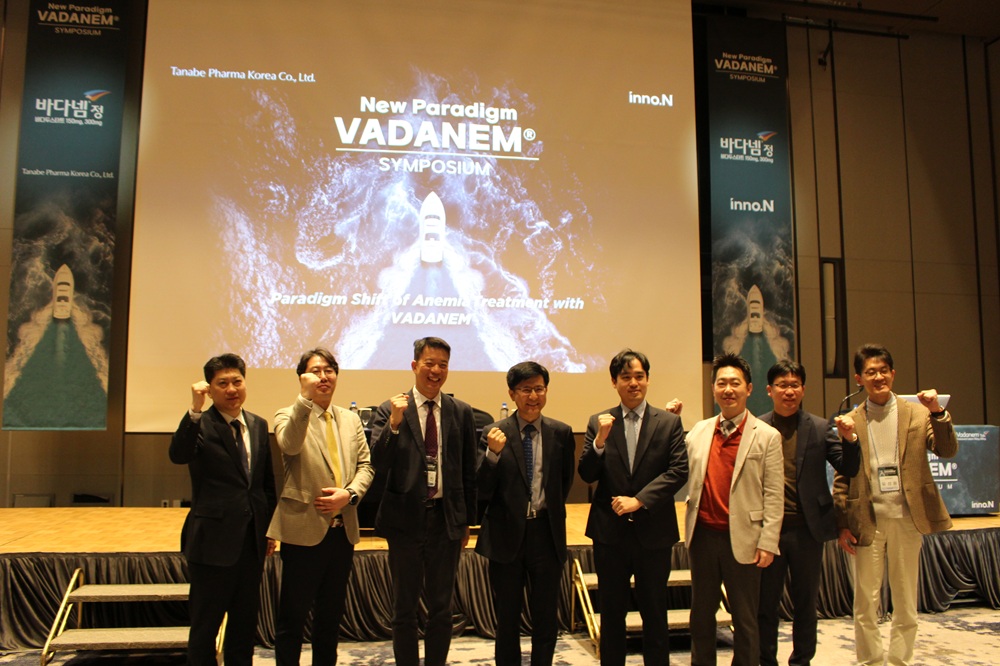
During the second day’s session, titled ‘VADANEM in Practice and Beyond,’ discussions focused on how to apply the mechanisms and clinical evidence presented the previous day to actual clinical practice.
In particular, given the confirmed clinical efficacy and safety data for Vadanem, attention centered on which patient groups should be prioritized for treatment.
Professor Sungjin Chung of the Catholic University of Korea College of Medicine stated, “In patients with CKD-related anemia, various factors such as ESA hyporesponsiveness, iron deficiency, and inflammation interact in a complex manner. For this patient population, HIF-PHI agents could serve as a new treatment alternative.”
He added, “In patients with reduced ESA responsiveness, Hb control is often difficult with existing treatments. HIF-based approaches provide a clinically meaningful option.”
He further noted, “Depending on the patient’s condition, we can adopt a more flexible treatment strategy, such as switching from ESA or considering oral therapy from the outset. Given the nature of the disease, which requires long-term treatment, oral formulations are also significant in terms of adherence. Their scope of application is expected to gradually expand in practice.”
With the launch of Vadanem, attention is focused on whether HIF-PHI therapies will establish themselves as a mainstream option in Korea. The convenience of oral administration and regulation of iron metabolism are considered key factors in future changes to CKD anemia treatment strategies.
Professor Sehoon Park of Seoul National University College of Medicine predicted, “We are entering an era that requires patient-tailored approaches based on multiple options rather than a single treatment strategy. The role of HIF-PHI class therapies will expand within this trend.”
-

- 0
댓글 운영방식은
댓글은 실명게재와 익명게재 방식이 있으며, 실명은 이름과 아이디가 노출됩니다. 익명은 필명으로 등록 가능하며, 대댓글은 익명으로 등록 가능합니다.
댓글 노출방식은
댓글 명예자문위원(팜-코니언-필기모양 아이콘)으로 위촉된 데일리팜 회원의 댓글은 ‘게시판형 보기’와 ’펼쳐보기형’ 리스트에서 항상 최상단에 노출됩니다. 새로운 댓글을 올리는 일반회원은 ‘게시판형’과 ‘펼쳐보기형’ 모두 팜코니언 회원이 쓴 댓글의 하단에 실시간 노출됩니다.
댓글의 삭제 기준은
다음의 경우 사전 통보없이 삭제하고 아이디 이용정지 또는 영구 가입제한이 될 수도 있습니다.
-
저작권·인격권 등 타인의 권리를 침해하는 경우
상용 프로그램의 등록과 게재, 배포를 안내하는 게시물
타인 또는 제3자의 저작권 및 기타 권리를 침해한 내용을 담은 게시물
-
근거 없는 비방·명예를 훼손하는 게시물
특정 이용자 및 개인에 대한 인신 공격적인 내용의 글 및 직접적인 욕설이 사용된 경우
특정 지역 및 종교간의 감정대립을 조장하는 내용
사실 확인이 안된 소문을 유포 시키는 경우
욕설과 비어, 속어를 담은 내용
정당법 및 공직선거법, 관계 법령에 저촉되는 경우(선관위 요청 시 즉시 삭제)
특정 지역이나 단체를 비하하는 경우
특정인의 명예를 훼손하여 해당인이 삭제를 요청하는 경우
특정인의 개인정보(주민등록번호, 전화, 상세주소 등)를 무단으로 게시하는 경우
타인의 ID 혹은 닉네임을 도용하는 경우
-
게시판 특성상 제한되는 내용
서비스 주제와 맞지 않는 내용의 글을 게재한 경우
동일 내용의 연속 게재 및 여러 기사에 중복 게재한 경우
부분적으로 변경하여 반복 게재하는 경우도 포함
제목과 관련 없는 내용의 게시물, 제목과 본문이 무관한 경우
돈벌기 및 직·간접 상업적 목적의 내용이 포함된 게시물
게시물 읽기 유도 등을 위해 내용과 무관한 제목을 사용한 경우
-
수사기관 등의 공식적인 요청이 있는 경우
-
기타사항
각 서비스의 필요성에 따라 미리 공지한 경우
기타 법률에 저촉되는 정보 게재를 목적으로 할 경우
기타 원만한 운영을 위해 운영자가 필요하다고 판단되는 내용
-
사실 관계 확인 후 삭제
저작권자로부터 허락받지 않은 내용을 무단 게재, 복제, 배포하는 경우
타인의 초상권을 침해하거나 개인정보를 유출하는 경우
당사에 제공한 이용자의 정보가 허위인 경우 (타인의 ID, 비밀번호 도용 등)
※이상의 내용중 일부 사항에 적용될 경우 이용약관 및 관련 법률에 의해 제재를 받으실 수도 있으며, 민·형사상 처벌을 받을 수도 있습니다.
※위에 명시되지 않은 내용이더라도 불법적인 내용으로 판단되거나 데일리팜 서비스에 바람직하지 않다고 판단되는 경우는 선 조치 이후 본 관리 기준을 수정 공시하겠습니다.
※기타 문의 사항은 데일리팜 운영자에게 연락주십시오. 메일 주소는 dailypharm@dailypharm.com입니다.


-

- "SpaceOAR reduces rectal bleeding…major shift in radiation therapy"
- Prostate cancer is the most common cancer diagnosed in men…treatment demand increases among elderly patients