
- LOGIN
- MemberShip
- 2026-07-22 03:12:18
- Product
- Daewoong/Novartis promise to cooperate
- by Kim JiEun Feb 27, 2023 05:57am
- On the 22nd, the Korea Pharmaceutical Association (Chairman Choi Kwang-Hoon) disused stock medicine return TF (Team Leader Jung Hyeon-cheol) held a meeting with Daewoong Pharmaceutical and Novartis Korea regarding the return of unused stock medicine and announced that they had agreed to actively cooperate in a settlement. In the case of Daewoong Pharmaceutical, through a meeting with the pharmaceutical society, wholesale shipments are 100%, returns are collected from base logistics within 1 month after being received, the balance is deducted for the settlement method, and a separate settlement rate is deducted for other return processing conditions. It was confirmed that there is no criterion. In addition, at the meeting with the Pharmacy Association, Novartis Korea explained that the return of unused medicines in stock is carried out only when the Pharmacy Association returns business is implemented, and regarding the practice guidelines for return work, 100% of the wholesale shipment price is collected in the reverse order of wholesale transactions, and the settlement method is warehousing. Explained how to deduct the balance within 3 months after The Pharmaceutical Association said at this meeting that these pharmaceutical companies explained that there were some setbacks due to the fact that the contents of the Pharmacy Returns Project were not clearly communicated to practitioners. The pharmacist association agreed to increase contact with pharmaceutical companies in the future and seek ways to coexist at the same time and explained that through this meeting, they had a meaningful time listening to pharmaceutical companies' difficulties related to the promotion of the pharmacists' return business and discussing solutions. Jeong Hyeon-cheol, head of the return TF team, said, “We will continue to hold meetings with pharmaceutical companies that have not participated in the return business in March to do our best to achieve the best results among all unused inventory drug return businesses.” Team leader Jeong also said, “The unwanted inventory drug return TF will continue to cooperate with pharmaceutical companies and distributors so that all returns from pharmacies can be collected without a hitch by the end of March, and settlement can be made sequentially from April.” said. Meanwhile, through this meeting, 143 pharmaceutical companies agreed to cooperate with the pharmacist association's return business, and 102 pharmaceutical companies confirmed detailed guidelines such as settlement rates. The association plans to provide related data to local branches or distribution associations at the end of this month, along with interim aggregated data for entering pharmacy returns.
- Product
- Australian supply of Tylenol 500 mg is embarrassing
- by Kang, Hye-kyung Feb 16, 2023 05:52am
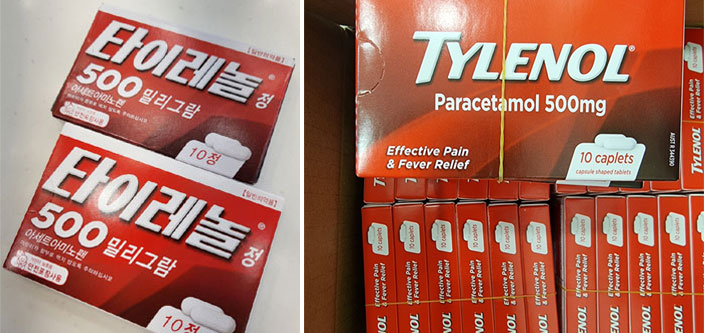
- 500mg of existing Tylenol and 500mg of Australian Tylenol supplied to pharmacies Pharmacists seem to be confused as 500mg of Tylenol products arrive one after another at pharmacies that ordered 500mg of Tylenol at the end of January due to supply increase issues. Pharmacists who bought the product before the price hike responded that the newly distributed Tylenol is expected to cause confusion among pharmacists as well as ordinary consumers as it has different packaging and ingredient names from existing products. Pharmacist A said, "I ordered a completely different product when I heard that the supply price of all Tylenol products will increase by 18% from March. The problem is consumer resistance. Although it is said to be an emergency drug for the smooth supply of antipyretic analgesics in Korea, it is greatly different from existing products, and the ingredient name is also specified as paracetamol, which is feared to cause resistance from consumers. Pharmacist A said, "I have to explain it to consumers, but I don't know how to understand that acetaminophen and paracetamol are the same ingredients," adding, "I'm worried that consumers will resist." Since the efficacy and effect are also specified as "Effective Pain & Fever Relief," some say that it should be written manually or attached to a notice. Pharmaceutical company A said, "The expiration date is also May 2024, which is shorter than the existing products (2025), so caution is required when selling them, and there are places that inevitably consider returning them." Johnson & Johnson Korea is an Australian product that urgently introduced Tylenol, which arrived at the pharmacy, and explains that it has the same ingredients and contents as existing products. An official from a pharmaceutical company said, "It is an Australian product that was urgently introduced by the Tylenol brand with approval from the Ministry of Food and Drug Safety and the KODC for smooth supply of antipyretic painkillers in Korea." The official said, "Australian Tylenol has the same expiration date of 36 months as the existing Tylenol 500mg. Johnson & Johnson Korea is making many efforts to supply Tylenol stably in the market in line with changing domestic market demand."
- Product
- Viatris Korea, "Viagra's supply expected on Jan 23"
- by Kim JiEun Jan 19, 2023 05:58am
- Viatris Korea announced short-term out-of-stock for some products, including Viagra, while predicting normal supply this month. On the 16th, Viatris Korea sent a notice to hospitals, pharmacies, and drug wholesalers on the 16th, saying, "Viagra, Viagra Film, Cardura-XL, Detrusitol Short-Term Out of Stock." In the announcement, the company said, "Based on the currently available information, we mainly expect the time when normal supply is possible on January 23, 2023." He added, "We deeply apologize for the inconvenience caused to medical treatment or work due to this short-term out-of-stock," adding, "We will continue to do our best for a stable supply." The items subject to the announcement have been out of stock not only at online malls for drugs but also at wholesalers since the end of the sales rights of Jeil Pharmaceuticals at the end of last year. The industry expected Menarini Korea to take over the next batch of sales rights for these items, but negotiations with Viatris Korea have not been completed so far.

- Product
- Dispensing drugs through text or KakaoTalk illegal
- by Kang, Shin-Kook Jan 17, 2023 06:02am
- If a patient takes a picture of his or her prescription and sends it via KakaoTalk or text message to the pharmacist, is it legal or illegal to dispense the drug? To Korean Pharmaceutical Association’s question, the Ministry of Health and Welfare recently replied that “Although the situation may differ by case, even with the patient’s consent, sending a prescription recorded on the patient’s mobile phone to the pharmacy and using it to prefill prescriptions in advance is not allowed under the current law unless there are special circumstances. The MOHW said, “According to the Supreme Court ruling and the Pharmaceutical Affairs Act, it is advised that drugs be ordered, delivered, and sold in pharmacies. Pharmacists must fill and dispense drugs according to prescriptions legally issued to patients under the Pharmaceutical Affairs Act and the Medical Service Act.” The MOHW added, “Pharmacists should receive the original prescription form from the patient and dispense the prescription after confirming the authenticity of the prescription and that the visitor is the patient or guardian of the patient specified the prescription." The issue arose with some pharmacies receiving a picture of a prescription through a pharmacist's personal cell phone or KakaoTalk message for dispensing. In other words, there were cases where patients voluntarily send a picture of their prescription using a text message or KakaoTalk to a pharmacist without any company intervention, and then visits the pharmacy with their paper prescription to receive the medicine. It is a sort of pre-booking system between patients and pharmacies.” This allows pharmacies extra time to fill long-term prescriptions for those that exceed 90 days while reducing the waiting time for the patients. Many have countered that there was nothing wrong with such acts as Kiosk-type prescription transmission between large hospitals and pharmacies is common. However, controversy is expected on-site with the MOHW concluding that it is illegal to send pictures of the prescriptions.
- Product
- Viagra is sold out
- by Kim JiEun Jan 17, 2023 06:02am
- Viagra, a treatment for erectile dysfunction, has joined the ranks of untimely sold-out. Some in the market say that the delay in the Viagra sales contract may be affecting supply and demand. On the 15th, Dailypharm confirmed online malls exclusively for major pharmacies and found that 100mg of Viagra was sold out in all online malls, making it impossible to order. In the case of Viagra, Jeil has been selling it until the end of last year, but Viatrice Korea and Jeil ended their sales contracts for a total of seven forms, including 50mg of Viagra and 100mg of Viagra, Cardura XL tablets, and Detrusitol SR capsules, as of December 30 last year. Menarini came to mind to succeed Jeil, but according to the industry, the sales contract between Beatrice Korea and Korea Menarini has not been finalized until now. The industry believes that the shift in sales rights is having a significant impact on the Viagra out-of-stock situation that began at the end of last year. This is because Viagra's inventory is currently running out not only in online malls exclusively for major pharmacies but also in drug wholesalers. In addition, Cardura XL tablets and Detrusitol SR capsules, whose sales contract has ended with Viagra, are all sold out at online malls. Drug distributors as well as front-line pharmacies agreed that 100mg of Viagra tablets, which are relatively prescribed, is out of stock, which has a significant impact on prescription preparation. "The problem is that we don't have stock of 100ml of Viagra, which is in high demand due to a lot of prescriptions," an official from a pharmaceutical wholesaler said. "We asked the company to secure inventory, but we couldn't give a definite answer about when it was possible to secure inventory because the right to sell has not been finalized yet." The official said, "I understand that Jeil released all related inventories on the market at the end of last year as the sales contract was terminated," adding, "The delay in the confirmation of the next runner could affect the market."

- Product
- How is the non-face-to-face tx/delivery going overseas?
- by Jan 02, 2023 06:04am
- With the platform industry and the medical community preparing first ahead of the institutionalization of non-face-to-face treatment next year, calls for measures to be prepared for drug delivery are gaining momentum. A recent study report titled "Non-face-to-face treatment prerequisites" by the Korean Medical Association's Medical Policy Institute (Director Woo Bong-sik), which argued that ▲ face-to-face treatment principles, ▲ non-face-to-face treatment, and non-face-to-face treatment should be an auxiliary means ▲ national health security medical association. "Most countries allow drug delivery," the Korea Institute for Medical Policy said. "The government is also in a position that it is difficult to proceed with non-face-to-face treatment and drug delivery in a separate policy, but recently, it is necessary to address drug concerns and devise measures to increase the effectiveness of the policy." It also introduced overseas cases such as Japan, Australia, Britain, France, the United States, Canada, China, and India. In fact, it was found that drug delivery was allowed in Japan, Australia, the United States, and China due to COVID-19. In Japan, as the amount of non-face-to-face treatment increased after COVID-19, drug delivery was officially allowed through joint notification by the Health, Labor and Welfare Ministry's Medical Policy Bureau and the Pharmaceutical and Household Sanitation Bureau on April 1, 2020. Japan is a country in the form of voluntary division of labor, and when prescribed in the hospital, it can be delivered directly from the medical institution to the patient's home For out-of-house prescriptions, the prescription must be faxed to the pharmacy, and the original prescription must also be sent separately to the pharmacy. After consulting with the patient on medication guidance, pharmacists should prepare appropriate ways to deliver drugs that need special attention and drugs that need rapid delivery, or ask the patient's family to visit the pharmacy. From April 17, 2020, Australia will also be able to receive prescriptions by text message, email, or fax after non-face-to-face treatment. The prescription allows the patient himself or his guardian to go to the pharmacy or receive the medicine home after sending it to the pharmacy he or she wants. If you do not know which pharmacy to send the prescription to, the doctor who treated the patient can suggest a pharmacy in the area or the patient can directly search for a pharmacy in the area using the Health Direct website to select a pharmacy. NHS Digital in the UK abolished the paper prescription issuance system in November 2019 and began issuing electronic prescription services (EPS). After GP treatment, the patient can receive the medicine at the pharmacy by sending the prescription to the pharmacy designated by the patient. When taking drugs regularly, repeated prescriptions are issued, and even if you take all of them, you can order them when necessary without follow-up treatment with your GP until the next drug prescription review. However, only if the GP sets these prescriptions, the patient can request the drug delivery to the pharmacy, and if the drug delivery service is provided by the pharmacy designated by the patient, the drug can be received by courier. France provides drug delivery services to non-face-to-face patients. After non-face-to-face treatment, use the Ordo Express app to scan the prescription and send an electronic signature. The app is sent in the form of an e-mail and an encrypted prescription is sent to the pharmacist selected by the patient to ensure safety. Drugs can be delivered to the patient's home or workplace, and drugs can be delivered to all types of drugs, except drugs, regardless of the presence or absence of prescription. At this time, patients can track their drug delivery process in real time and contact the delivery agent in charge through a real-time chat system to shorten the delivery process. In the United States, doctors are required to send prescriptions to pharmacies selected by patients using e-mail or smartphones after non-face-to-face treatment. After Amazon Pharmacy, an online pharmacy, was officially launched in 2020, a prescription drug delivery service was launched, and the medicine is delivered to the patient's home on the same day. In addition, pick-up services through drive-through were actively introduced to pharmacies in the wake of COVID-19, and the unmanned autonomous vehicle "Nuro R2" was used to deliver medicines to reduce unnecessary face-to-face contact and ensure accurate and safe delivery of necessary medicines. In February 2020, the U.S. federal government implemented special measures to allow unmanned autonomous vehicles to enter public roads in order to deploy autonomous vehicles in the COVID-19 situation, allowing them to receive drug delivery, starting with Nuro headquarters in California. Canada is one of the countries where non-face-to-face treatment is active. Canada requires doctors to send prescriptions to the pharmacy they want by fax or e-mail after non-face-to-face treatment. When a patient is ready to pick up the drug, he or she can be notified through a non-face-to-face treatment app or delivered directly to the patient's home. Among Canadians, it was found that one in three people who used non-face-to-face treatment were using non-face-to-face treatment for prescribing and delivering drugs. In China, the ban on online sales of drugs was lifted in 2018, and the policy of using Internet hospitals was announced. It is a government-level intervention, and the State Council, the National Health Commission, and the National Insurance Service have changed their policy of delivering drugs after non-face-to-face treatment, stressing the importance of actively expanding and succeeding in Internet hospital work covered by health insurance. In China, if a doctor issues a prescription after receiving medical treatment at an Internet hospital designated by a state-run health agency in each province, a pharmacist in the in-house screening department can check electronic prescription and deliver the medicine to the patient or receive it directly from a nearby pharmacy. In China, online re-examination prescriptions can be issued only for general and chronic diseases diagnosed with the disease in face-to-face first-time visits in advance. In China, Internet hospitals have become a service platform that integrates online treatment and counseling, prescription and drug delivery, and online and offline diagnosis and treatment. India's Ministry of Health has allowed the delivery of medicines listed in e-mail prescriptions sent from hospitals to pharmacies to the patient's front door after the announcement of a notice on drug delivery permits for non-face-to-face care in March 2020. However, certain antibiotics and psychotropic drugs cannot be delivered. The Institute for Medical Policy said, "In order to achieve the purpose of the non-face-to-face treatment policy, drug delivery should be allowed. "Since there are many concerns and opposition from the pharmaceutical society, it is necessary to devise measures to address the concerns of the pharmaceutical society and increase the effectiveness of the policy," he explained.
- Product
- “Immediately stop enforcing the Healthcare Data Act”
- by Dec 27, 2022 06:10am
- Five major healthcare associations in Korea have called for the discontinuation of the enforcement of the Healthcare Data Act. The Korean Pharmaceutical Association (President: Kwang-Hoon Choi), Korean Medical Association (President: Pil-Soo Lee), Korean Hospital Association (President: Dong-Seop Yoon), Korean Dental Association (President: Tae-Geun Park), Association of Korean Medicine (President: Joo-Eui Hong) issued a joint statement on the 23rd criticizing the government's enforcement of the 'Act on the Promotion of Digital Healthcare and Utilization of Healthcare Data.’ The associations criticized, “From the 23rd of last month, the 5 associations had asked the government to consult on the details related to healthcare data services with medical and pharmaceutical associations under the premise that ‘healthcare services should be designed around public safety and health rather than from an economical or commercial point of view.’ However, the Ministry of Health and Welfare has been pursuing legislation of the Act from an economic and commercial perspective without any prior consultation.” In other words, the associations agree on the purpose of the legislation in promoting public health and contributing to improving the quality of life. However, the issue is in how the actual act overlooks the importance of healthcare data, which is highly sensitive information, and the need to manage it more strictly than any other information. The associations pointed out, “What’s most important is to ensure that the primary essential element of healthcare - protecting the life and health of the people – is not infringed by secondary by-products such as promotion of the industry in the course of applying digital technology. However, the MOHW is allowing sensitive data, not only the public’s diagnosis results, treatment history but also genetic information and life-related information to be leaked outside of healthcare institutions based on individual intent without supervision from healthcare institutions.” They added, “This goes to show that the measures for the safe use of healthcare data that had been discussed in-depth in the health, medical, and pharmaceutical industry are not being reflected at all in the legislation. Although medical information is sensitive information that requires the highest level of security, the government plans to transmit it to a private company without obtaining consent from healthcare institutions, which are in charge of producing and managing such clinical medical information, in an electronic format that is vulnerable to hacking, etc.” Also, the associations explained that the act contradicts other laws including the Medical Service Act, Bioethics and Safety Act, Personal Information Protection Act, Copyright Act, Data Industry Act, etc., and therefore may likely cause national confusion. The associations said, “In conclusion, we agree with the legislative purpose of contributing to the improvement of national health and quality of life and fostering the digital and biohealth industry, but as the legislation and institutionalization of a system that emphasizes industry promotion over public value and disregards the issues of safety and efficacy, poses a serious threat to public health and protection of personal information. Therefore we strongly oppose to the enactment of the law and request the following 4 conditions be met to guarantee the rights of healthcare data generators, ensure fair value evaluation and protection of personal information, and minimize infringement on the public’s right to health.” The four conditions suggested by the association are: ▲as healthcare institutions are obligated to directly produce, process, manage and protect healthcare data, the government should guarantee the status and rights of healthcare institutions as the principal subject of healthcare data; ▲ the government should guarantee a reasonable right of refusal to healthcare institutions against the third party’s and one-sided personal right to request transfer as the current Act only imposes obligations on healthcare institutions and overlooks the fact that a leakage of the large amount of concentrated healthcare data in the process can lead to a national disaster; ▲ the information that can be subject to the right to request transfer should be limited to information provided by individuals to healthcare institutions; ▲the government should ensure mandatory participation of healthcare institutions and representatives of industry types to represent the voices in the field and industry when forming of various national data policy medical expert committees including the Healthcare Data Policy Deliberative Committee, and the Digital Healthcare Policy Deliberative Committee, etc.
- Product
- Get rid of Imotun & Godex which waste taxpayers' money
- by Dec 22, 2022 05:52am
- Pharmaceutical Society for a Healthy Society (CEO Shin Hyung-geun) has called for the expulsion of Imotun and Godex. In a statement on the 21st, the Pharmaceutical Association for Health Society argued that maintaining health insurance benefits for six-component compounds (Godex) including avocado-soya unexamined (Imotun) and adenine hydrochloride (60 billion won) are not valid in terms of clinical usefulness, cost-effectiveness, and social needs. They said Imotun and Godex are drugs whose clinical usefulness is unclear. "Although Imotun's clinical usefulness is based on the recently revised rheumatology textbook, there is no SCI-listed clinical journal that validates knee osteoarthritis patients over the past four years, and foreign rheumatology textbooks and guidelines related to the International Osteoarthritis Society are all described at the supplement level as preferred." In addition, France, the original developing country that first licensed Imotun as a drug, concluded in 2013 that it does not recommend Imotun as a salary due to its unclear clinical usefulness, and no one in developed countries supports the purchase of Imotun. Chong Kun Dang, a domestic seller, also conducted clinical trials on 300 people at university hospitals in Korea from 2013 to 2016, but it is pointed out that related results have not been disclosed. It is the position of the health drug that Imotun and Godex are not cost-effective and that social demands are low. They said, "Imotun and Godex are basically drugs that are difficult to confirm their effectiveness, and patients have no choice but to take the medicine according to their prescription regardless of their economic situation." Even if it is supported by health insurance benefits, Imotun must spend 3,400 won and Godex 17,000 won per month, he said. "In addition, Imotun is a drug that threatens health insurance finances of 40 billion won per year and Godex is 60 billion won per year, and social needs to be evaluated to delete benefits." The Pharmaceutical Society for the Health Society said, "Over the past few years, we have demanded the removal of drugs that are not clinically useful, including Colin Alpo, but as of December 2022, not a single drug has been removed from health insurance benefits. The reason why this revaluation system was not implemented properly is that the Ministry of Health and Welfare is looking at pharmaceutical companies, he said. "The Ministry of Health and Welfare should review the decisions of Emoton and Godex's Pharmaceutical Evaluation Committee and quickly come up with new measures to control unnecessary drug use."
- Product
- Menarini Korea is expected to distribute Viagra
- by Kim JiEun Dec 15, 2022 05:55am
- Viagra, which was sold by Jeil, is likely to be distributed at Menarini from next month. According to the pharmaceutical industry on the 12th, Menarini is in charge of distributing urological treatments such as Viatris Korea's Viagra, Cadura, and Detrusitol. The move follows the termination of Viatris and Jeil's sales rights contract for these products. In addition to Viatris Korea and Viagra, Jeil has been conducting joint promotions of Lipitor Plus, and it is known that the promotion of Lipitor Plus is maintained. Medications that stop distribution through Jeil are 50 mg of Viagra tablet, 100 mg of Viagra L film, 100 mg of Viagra L film, 100 mg of Detrusitol SR 2 mg, 4 mg of Detrusitol SR, and 4 mg of Cadura XL. The date of discontinuation of distribution is December 23rd. There is a rumor in the industry that Viatris Korea has already decided on its next partner. Menarini is said to be the most likely related company. Prior to this, Menarini recently announced to trading drug distributors that it would change the OX-2 inhibitor Arcoxia 30mg seller. Organon Korea will take over Arcoxia's sales rights. Arcoxia was sold by Menarini under a global partnership agreement after MSD ended its green cross and co-marketing in 2018. In the industry, some analysts say that Viatris Korea's right to sell urology-related treatments such as Viagra may have been chosen as a follow-up measure following Nemarini's termination of Arcoxia sales rights. An official from the distribution industry said, "Viatris Korea has Menarini in mind as Jeil's next partner, and I know that only the final decision is left," adding, "It is expected to be a measure following the end of Arcoxia sales rights." 정품 비아그라 https://xoad79.com
- Product
- Jeil will stop distributing Viagra, Cardura, Detrusitol
- by Kim JiEun Dec 12, 2022 05:47am
- Jeil Pharmaceutical will discontinue distributing Viagra at the end of this month after parting ways with Viatris Korea that it had made a distribution agreement with for the drug. Jeil Pharmaceutical has recently sent an official notice to drug wholesalers about the company’s discontinued distribution of some products. In the notice, Jeil Pharmaceutical wrote, “Due to the termination of the distribution agreement with Viatris Korea, we will be discontinuing the distribution of Viagra Tab, Viagra L film, Cardura XL Tab, and Detrusitol SR Cap.” Jeil Pharmaceutical also wrote that its distribution license with Viatris Korea terminates as of December 30th and asked that inquiries about the aforementioned products be directed to the license holder, Viatris Korea. Distribution of the following 7 products will be discontinued under Jeil’s measure: ▲Viagra Tab 50mg (4 tablets); ▲Viagra Tab 100mg (4 tablets); ▲Viagra L ODF 50mg (4 sheets); ▲Viagra L ODF 100mg (4 sheets); ▲Detrusitol SR Cap 2mg (30 capsules); ▲Detrusitol SR Cap 4mg (30 capsules); and ▲Cardura XL Tab. The date of their distribution discontinuation will be December 23. Due to Jeil’s suspension of distribution, the affected drugs are rapidly running out of stock at online malls that sell drugs to pharmacies. Cardura XL Tab In the case of Viagra Tab., the product is already sold out in some online malls and is not available for order. Also, only a small stock of Viagra L, Detrusitol SR Cap, and Cardura XL Tab is said to remain for order. As the drugs being discontinued distribution are urology-related products, it is expected that pharmacies near urology clinics will be affected for a certain period of time. A local pharmacist said, “If a wholesaler notifies pharmacies of a discontinuation of distribution, the temporary demand for the drugs will inevitably rise. In the case of Viagra Tab, there has already been a shortage since last month due to delays in production schedules. As it may take some time to normalize sales, pharmacies that receive related prescriptions may have difficulty dispensing the drug.” Meanwhile, Viatris Korea is the Korean subsidiary of Viatris that was launched in November 2020 through a merger between Global Pfizer’s business division Upjohn and the global healthcare company Mylan.
