
- LOGIN
- MemberShip
- 2026-05-06 20:35:42
- Policy
- Gov “It was the experts’ decision to not list Kymriah”
- by Kim, Jung-Ju Oct 12, 2021 05:49am
- In response to NA’s criticism regarding the delayed reimbursement listing of Kymriah, the government has expressed its difficulties as the decision was a result of an expert assessment. Also, the government denied the claim that that insurance coverage is only being extended for mild diseases. This was the response Health and Welfare Minister Deok Cheol Kwon gave to the claims that were made by NA member Jong Sung Lee at the NA Health and Welfare Committee’s audit of the Ministry of Health and Welfare that was held on the 7th. Lee had previously pressed the government for the prompt listing of Kymriah, using Soliris in 2012 and Spinraza in 2019 as examples of how the government is passive in listing new drugs. Lee said, “A clinical trial had shown that Kymriah could increase the survival rate by 60%. It feels that the government is immersing itself in populist policies - those that benefit a large number of mild patients - and neglecting the small number of severely ill patients.” He continued, “How hard could it be for the government, which had once announced that it could spend 1 trillion won as phone bill support for the public, list one single drug for our young patients?” Minister Kwon immediately refuted Lee’s claim. Kwon said, “The claim that only the coverage for mild disease patients has increased during President Moon's administration is not true. The coverage rate of severe disease patients is currently over 70%. I believe there is a misunderstanding here. The government also believes that we should promptly provide insurance benefit for severely ill patients.” He explained that the decision on Kymriah was not made by the government and was a result of an expert assessment. “Kymriah is an ultra-high-priced drug, and is being reviewed by the experts.”

- Policy
- The MOHW expressed reluctance to Keytruda's primary benefit
- by Lee, Jeong-Hwan Oct 12, 2021 05:49am
- Minister Kwon Deok-cheol (photo = provided by the National AssemblyMinister of Health and Welfare Kwon Deok-cheol expressed reluctance to applying MSD immuno-cancer drug Keytruda as a primary treatment for lung cancer, citing enormous health insurance financial needs. On the 6th, Minister Kwon responded to a question from Kang Sun-woo (the Democratic Party of Korea) at the National Assembly Welfare Committee's parliamentary audit. He pointed out that when lung cancer was first treated with Keytruda, it was more effective in treating diseases than when used as a secondary treatment. He introduced that the U.S. NCC guidelines also recommend Keytruda as a priority in single and combined therapy. He criticized that unlike overseas countries such as the United States, Korea is applying benefits so that Keytruda can only be used as a secondary treatment in the event of a traditional chemotherapy failure, increasing the burden on patients. He said, "It costs 7 million won a month for lung cancer patients to spend Keytruda at their own expense from the first treatment. He said,"if it is administered every month, about 100 million won per year is needed. 52 countries around the world have already applied the primary benefit, and 31 OECD countries have also recognized the primary benefit." He then asked Minister Kwon Deok-cheol if he had any plans, such as a system that is registered first and then evaluated for Keytruda benefits or a separate cancer fund. Minister Kwon replied that the pre-registration & post-evaluation system is also under comprehensive review in consideration of the financial burden of health insurance and difficulties in managing drug prices. He explained, "If Keytruda, the current secondary treatment, is allowed as the primary treatment, it will affect huge health insurance finances, so there should be a (cost-effectiveness) evaluation." He said, "In the system, it becomes reasonably difficult to manage drug prices because the health insurance finance has to pay the drug price at the time of pre-registration." "We need to comprehensively review that," he added.
- Policy
- Pfizer vaccines from Romania not transported in official box
- by Lee, Jeong-Hwan Oct 08, 2021 05:56am
- Criticism has been raised that the 1,053,000 doses of Pfizer’s COVID-19 vaccine that the government received from Romania last month were not stored in transport boxes that were officially authorized by its manufacturer, Pfizer. Pfizer’s vaccines require ultra-low-temperature storage for quality maintenance and should be stored in Pfizer’s custom shipping box that ensures cold chain storage. However, the criticism is that the government used private boxes, which could have compromised the quality of the vaccines. On the 7th, National Assembly member Jong Hean Baek of the People Power Party raised the issue based on the data submitted by the Korea Disease Control and Prevention Agency. According to the data, while transporting Pfizer's vaccines from Romania to Korea via Incheon airport in September, the Korean government used vaccine shipment boxes provided by a separate private transport company. The background is that the Romania government had returned Pfizer’s custom shipment back to Pfizer after directly purchasing the vaccines. Baek said that using private storage boxes for sensitive vaccines that should be transported in specially designed ultra-low-temperature storage containers is the issue. Although they look like regular delivery boxes, Pfizer’s custom boxes use new plastic material or polymeric compound-coated corrugated cardboard and are strong against moisture, and have excellent thermal insulation. Baek added that Pfizer meticulously packs its vaccines in custom boxes in its Belgium facility before shipping them to Europe. This is to maintain the ultra-low temperature required to ensure the quality of the vaccine, and the box is packed in two layers and filled with refrigerants in between. Baek added that in Korea, Pfizer Korea receives and the vaccines from the custom shipment boxes, takes out the vaccines, and returns the custom boxes to Belgium for reuse. In other words, Baek’s view is that the vaccines should have been shipped after obtaining Pfizer's custom shipment boxes to maintain the vaccines’ quality and warranty. As of the 5th, 4,031 cases of adverse events were reported after being vaccinated with the Pfizer vaccine provided by Romania. The government is investing in the causality of the events and said that the vaccines’ temperature has been well maintained in the course of bringing the vaccines to Korea. Baek said, “While conducting the casualty investigation for the Pfizer vaccines from Romania, the government should analyze the cause by looking specifically at whether the initial cold chain was compromised in any way. Also, the government should transparently disclose whether the manufacturer will warrant after-sale service for Romania’s vaccine quality issue.”
- Policy
- Expanding the submission of opinions reflecting permission
- by Lee, Tak-Sun Oct 07, 2021 05:54am
- Opportunities for submitting opinions from industries will be expanded when reflecting permits based on the results of the reexamination. A pre-announcement procedure is added to the previous opinion inquiry. The MFDS announced that since the 27th of last month, the procedure for reflecting permits based on the results of the reexamination has been improved and applied. There was a 14-day period of submitting opinions through "Inquiry on Opinions on Permit Change" before reflecting the results of the retrial in the permission. An opportunity to submit opinions will be given one more time. An official from the MFDS said, "It is expected that opportunities for the industry to submit opinions will expand through a pre-announcement period." A total of 28 days of opinion submission period will be given. At the end of the pre-announcement period, a change order will be issued as before. After the change order, the changes in permission matters within three months must be reflected in the product insert. In this improvement plan, in order to distinguish between PMS survey results and general post-marketing adverse effect analysis evaluation, it will be divided into domestic post-marketing adverse effect analysis results and domestic post-marketing adverse effect analysis evaluation results. The results of the analysis and evaluation of the adverse effect after domestic marketing are the same as the existing re-examination method. An official from the MFDS explained, "We distinguish between the results of the adverse effect analysis collected in the post-market survey and the results of the adverse effect analysis reported after the market and reflect them in the permit, but we revised the phrase to clarify the analysis results." The improvement of the method of writing the improvement plan will be applied from the change of permission after the 27th of last month, and the pre-announcement period will be given from the items for re-examination received after the same day.
- Policy
- ’With Covid’ scheme unclear with over 5,000 cases expected
- by Lee, Jeong-Hwan Oct 07, 2021 05:53am
- Concerns have been raised that Korea will be unable to adopt the ‘With Corona’ scheme due to the public’s distrust in vaccinations, the government’s non-acceptance of casualties of adverse reactions from vaccines, and the surge in daily COVID-19 cases, etc. Based on the mathematical model that took into account current incidence, the transmission of COVID-19, and the vaccination rate, the authorities expect that the number of new COVID-19 cases may increase on average up to 5,000 cases per day if the fourth wave of the COVID-19 pandemic persists. The National Assembly member Jong Hean Baek of the People Power Party announced the above results on the 6th based on the data submitted by the Korea Disease Control and Prevention Agency. According to KDCA data, if the current incidence, transmission, and vaccination rate are applied to a mathematical model, around 5,000 new COVID-19 cases are expected to arise per day. As for the reason, Baek pointed to the public distrust in vaccines despite inoculation being required for the living ‘With Corona’ scheme, the government’s non-acceptance of casualties of adverse reactions from vaccinations, and the lack of responsibility of the nation in taking care of those who suffer from misinoculations or side effects pre- and post-vaccination. The actual recognition rate of vaccine’s side effects was 53.4% in general patients and a mere 0.3% in deaths. More specifically, KDCA’s immunization surveillance investigation team’s assessment report showed that causality of 1,764 in 3,305 cases, or 53.4% of the cases were recognized. However, among the 678 cases of deaths after vaccination, the causality of only 2 was recognized. Also, 2,014 cases of vaccine misinoculations arose due to the government's neglect, but none were compensated for the damages. Baek said, “To live ‘With Corona’, we must first address the public’s distrust in vaccinations and prepare post-management measures. The citizens are anxious and disappointed by the government’s irresponsible response to the deaths from vaccinations.” He added, “I do not understand why the government is irresponsible in dealing with this life-threatening issue for administrative convenience. The government needs to show responsibility so that the people can trust the authorities and receive their vaccinations.”
- Policy
- Nexviazyme has been applied for domestic permission
- by Lee, Tak-Sun Oct 07, 2021 05:53am
- Sanofi plans to release a new Pompe's disease treatment in Korea. It is known that Nexviazyme, which was approved by the U.S. FDA in August, recently applied for permission from the MFDS. According to the MFDS on the 1st, Sanofi Aventis Korea submitted a report on the results of clinical trials by Nexviazyme (Avalglucosidase alfa-ngpt) and applied for permission. This drug is a Pompe's disase treatment. Pompe's disease is a genetic disorder in which respiratory failure and myocardial disease appear due to muscle strength loss and muscle atrophy. It is a rare disease that is reported to be about one person per 40,000 people worldwide, and it is known that there are about 1,300 patients in Korea. Pompe's disease is divided into IOPD, a fast-onset infant disease in infancy, and LOPD, a late-onset disease that develops at all ages and gradually weakens muscles. As muscles are damaged, heart failure, respiratory failure, exercise disorders, and sleep disorders also occur. The disease administers drugs targeting M6P receptors that allow GAA enzymes to migrate to intracellular lysosomes to treat GAA gene abnormalities. Existing treatments include Sanofi's Myozyme. Nexviazyme, which applied for permission this time, reportedly increased the M6P content by about 15 times compared to Myozyme. Nexviazyme was approved by the U.S. FDA in August. The MFDS designated the drug as a rare drug for patients to use before it was officially approved in June. If designated as a rare drug, the drug can be purchased through the KODC.
- Policy
- Introduction of pre-registration is difficult
- by Kim, Jung-Ju Oct 07, 2021 05:53am
- The government said it is difficult due to concerns over weakening NHIS' drug price negotiation power, while various fields are proposing the introduction of a system that is first registered and evaluated later for access to treatments for severe rare and intractable diseases. Regarding referring to Korean drug prices such as China, the government also said it is actively responding by expanding RSA to prepare for "China risks" such as "Korea Passing." The MOHW recently submitted the "2020 National Assembly Processing Results Report on the Requirements for Correcting and Processing the National Assembly" with such contents. First of all, the National Assembly previously demanded the MOHW to consider introducing a "pre-registration and post-evaluation system" to access treatments for severe rare and intractable diseases. The MOHW said that it is difficult to operate a realistic system for post-registration evaluation. The MOHW replied, "It is expected that it will be difficult to operate a realistic system and manage reasonable drug spending, so careful review is needed." This is because it is difficult to adjust drug prices if pharmaceutical companies do not accept the evaluation results after being registered, and the NHIS' drug price negotiation power may weaken, causing problems. They would expand RSA on countermeasures against so-called "Korea Passing" concerns due to China's drug price system. Overseas countries such as China are deciding their own drug prices by referring to Korean drug prices. Due to the current strict drug price system in Korea, it can lead to " In response, the MOHW replied, "We have introduced RSA since 2014 to respond to delays in insurance registration due to reference to foreign drug prices," adding, "We have been expanding the applicable drugs since October 2020." Regarding the demand to raise funds through the National Health Promotion Fund and the primary benefit of the immuno-cancer drug Keytruda, he replied in July that the HIRA is in the process of expanding benefits of Keytruda and Tecentriq. However, the MOHW said that the National Health Promotion Fund needs to be carefully reviewed by comprehensively considering the target, scope, and allocation of required resources within the scope of support.
- Policy
- “Elderly polypharmacy rate Korea 70% vs OECD countries 48%"
- by Lee, Jeong-Hwan Oct 06, 2021 06:06am
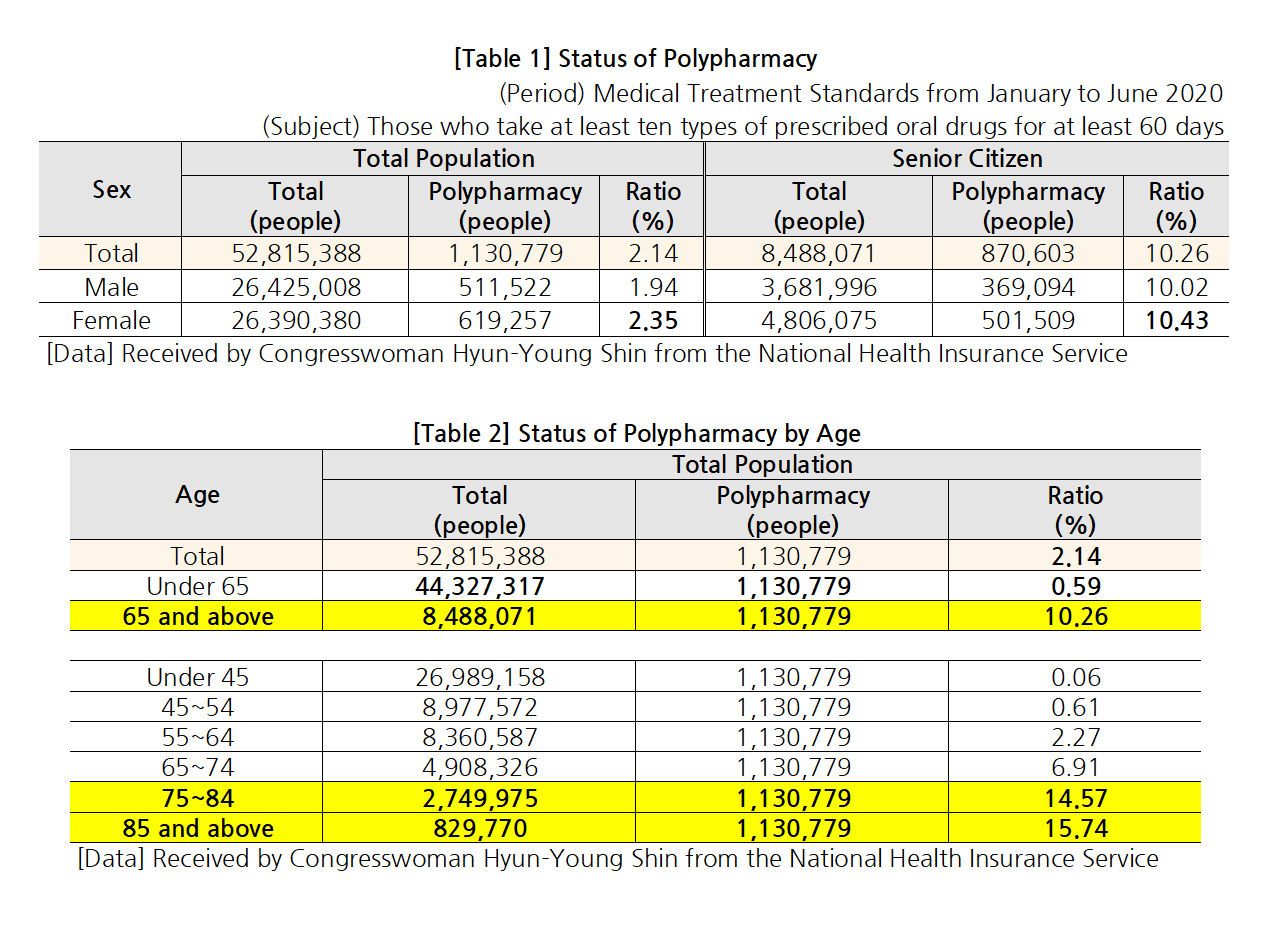
- Statistics showed that a high rate - 70.2% - of older adults (aged 75 or over) in Korea chronically take ‘more than 5 drugs for over 3 months.’ The average of 7 OECD countries other than Korea that submitted the same data was only 48%. In other words, concerns over the current polypharmacy status of elderly patients in Korea have been reaffirmed. On the 4th, NA member Hyung-young Shin of the Democratic Party of Korea announced the results above after analyzing OECD data. The medication rate of elderly patients in Korea has been globally high. According to the OECD’s data on the ‘rate of patients aged 75 or over who chronically take 5 or more drugs for over 3 months,’ the average of the 7 countries that submitted the data was 48.3%, compared to the much higher rate of 70.2% in Korea. However, Using an unnecessarily high amount of drugs in older adults can have a negative impact on their health. According to the National Health Insurance Service Ilsan Hospital's report, patients aged 65 or older who take 5 or more drugs have an 18% increased risk of hospitalization and 25% increased risk of death than those who take 4 or fewer drugs. According to the data that Shin received from the NHIS, 2.14% of the total population (1.13 million) in Korea takes 10 or more drugs. Among those, the elderly accounted for the largest proportion with 10.26%, and the polypharmacy rate was higher in women (2.35%) than men. The rate and number of patients using multiple drugs also increased with age. The polypharmacy rate was 10.26% for people over 65 but 15.74% for people over 85. By insurance premium quintile, polypharmacy rate was higher (12.52%) in medical aid beneficiaries than NHI policyholders. The polypharmacy rate in elderly medical aid beneficiaries was 22.57%, which roughly translates to one in 4 to 5 patients. Also, the proportion of the elderly was highest in the 1st and 10th insurance premium quintile (9.88%). Furthermore, the polypharmacy rate was higher in patients with underlying diseases such as diabetes, heart disease, cerebrovascular disease, asthma/COPD, chronic renal failure, pulmonary tuberculosis, etc. By population, the polypharmacy rate was highest in patients with chronic renal failure (18.38%), heart disease, (15.36%), cerebrovascular disease (13.86%). The order was the same in elderly patients but at a higher rate - chronic renal failure (23.80%), heart disease (20.97%), cerebrovascular disease (18.31%). Shin said, “As the rate of patients who take 10 or more drugs increases with age, we need to review whether the patients are taking unnecessary drugs due to over-prescription or redundant prescriptions. In other words, institutional support on the appropriate use of drugs is needed, and a system that assigns primary care physicians for the elderly should be introduced to manage the elderly’s use of multiple drugs, as well as provide customized support on the appropriate use of healthcare.”
- Policy
- The patient died due to the delay in Kymriah benefits
- by Lee, Jeong-Hwan Oct 06, 2021 06:06am
- Ko Eun-chan Korea leukemia patients organization launched a one-man protest, urging the first C-ART treatment Kymriah (Tisagencleucel)'s fast track. The Korea Leukemia Association held a press conference in front of the National Human Rights Commission of Korea at 10 a.m. on the 1st and announced that it submitted a petition to the National Human Rights Commission of Korea demanding Kymriah's health insurance registration and fast track for new drugs. Kymriah is the world's first chimera antigen receptor T-cell treatment that is effective in treating patients with recurrent or refractory B-cell acute lymphocytic leukemia and refractory giant B-cell lymphoma. Although patients are expected to have an effect of 82% cure rate even with one dose, the cost of one dose amounts to about 460 million won. Novartis applied for health insurance registration with the HIRA in March, but failed to pass the Cancer Drugs Benefit Application Committee. Lee Eun-young said, "Kymriah was not presented as an agenda at the 5th Cancer Drugs Benefit Appeal Committee in July and was not passed by the 6th Committee in September." She said, "If pts don't receive Kymriah treatment, they may die within three to six months." Lee Bo-yeon, the mother of Ko Eun-chan, who died in June while battling acute lymphocytic leukemia, also urged the introduction of fast track, saying that the government approved drugs to treat the disease, but they were useless due to the price of 500 million won. Mr. Lee said, "The government has not prepared a plan to allow high-priced drugs such as Kymriah and pay for them by dividing the amount or support the loan system for the use of new drugs." "This forced us to use loans from the second financial sector to raise drug prices," she said. "It's been nearly four months since my child died. "I thought health insurance would be applied soon because the effectiveness of the drug has already been proven and the number of people needed is limited, but I'm angry that the children are dying without any change," she said. "A malignant lymphocyte tumor progresses quickly. Through Kymriah's fast track, we need to make sure that there are no people in Korea who are dying because of lack of money like Eun-chan,"she said. Ahn Ki-jong, CEO of the Patient Association, said, "The Constitution prohibits the right to life and discrimination. Even though Korea is a citizen who pays taxes and health insurance premiums equally, people's lives should not be at stake depending on their economic capabilities." He then said, "After obtaining approval from the MFDS among the expensive new drugs, I only waited for health insurance registration. Eventually, this situation of death has been repeated over the past 15 years, at least patients who need new drugs directly related to life should temporarily apply health insurance at the same time as the MFDS approves to treat patients." Ahn also said, "Starting with Kymriah, we will not let any patients who cannot be treated because they do not have money at least in Korea." The patient association will hold a one-man relay protest in front of Novartis Korea's headquarters from the 1st to urge them to come up with active financial sharing measures. A national petition will be posted on Cheongwadae to convey the position of the patient association to the government and demand improvement.
- Policy
- Boryung's Dukarb Plus is about to be commercialized
- by Lee, Tak-Sun Oct 05, 2021 05:58am
- Dukarb, Tuvero, and Kanarb It was found that commercialization of the high blood pressure combination drugs including Boryung's Fimasartan is imminent. If this product is approved, a total of four products will form treatment options in the hypertension treatment lineup leading to Kanarb-Kanarb Plus-Dukarb. Through this, it is expected that the diversity of patient prescriptions can be secured. According to the industry on the 4th, Boryung recently submitted an application for permission for the tentatively named Dukarb Plus to the MFDS. Dukarb Plus is a complex in which a diuretic component, HCTZ, is bonded to Dukarb (Fimasartan-Amlodipine), a second complex. Already, Boryung has conducted phase 3 clinical trials in 250 hypertensive patients at 32 hospitals in Korea since May 2019 under the name of FAH. FAH is the first alphabet of Fimasartan, Amlodipine, and HCTZ. If Dukarb Plus is approved, it will be the seventh product containing Fimasartan since the launch of Kanarb in 2011. It is the fourth product to treat hypertension only after Kanarb (Fimasartan), Kanarb Plus (Fimasartan+HCTZ), and Dukarb (Fimasartan+Amlodipine). Patients who are not well controlled by Dukarb will be able to choose Dukarb Plus with diuretics added. Including Tuvero (Fimasartan + Rosuvastatin), Dukaro (Fimasartan + Rosuvastatin + Amlodipine), and Akarb (Fimasartan + Atorvastatin), it will be released up to the 7th drug. With Kanarb showing an annual performance of 49.2 billion won (as of UBIST 2020), combination drugs are also successfully settling in the market. Sales of Dukarb recorded 35.1 billion won last year, and Dukaro is also expected to become a blockbuster with 10 billion won this year. Dukarb Plus is expected to be released amid the imminent expiration of Kanarb patents. Material patent of Kanarb expires on February 1, 2023. Accordingly, pharmaceutical companies have started developing generics for Kanarb and Dukarb. The two drugs are so popular that many pharmaceutical companies are expected to release generics. In this situation, if complex with exclusive rights comes out, it is expected to boost the competitiveness of original products. This is because if Dukarb Plus is approved, it is likely that a six-year PMS (reexamination) will be granted.
