- LOGIN
- MemberShip
- 2026-07-29 05:40:23
- Domestic surgical robot development speeds up
- by Hwang, byoung woo | translator Hong, Ji Yeon | 2026-06-08 08:52:38

Numerous companies in the Korean domestic medical device industry are targeting the surgical robot market. Efforts to integrate robotic technology continue across diverse fields, including laparoscopic surgical robots, orthopedics, neurosurgery, endoscopy, and vascular intervention.
However, analysis suggests that, independent of increased market entry, core technological competitiveness remains limited compared to that of major countries. This is because competition in surgical robotics is shifting beyond the simple development of robotic arms or surgical instruments toward precision control, sensing, autonomous control, and data-driven surgical support technologies.
The success of surgical robotics is 'precision control'
According to the "Patent Trends Related to Precision Control of Surgical Robots" report published by the Korea Health Industry Development Institute (KHIDI), the global surgical robot market is projected to grow from approximately $9.2 billion in 2025 to around $38.4 billion by 2034. The compound annual growth rate (CAGR) is 17.2%.
Drivers behind this market expansion include rising demand for minimally invasive surgery (MIS), the need for enhanced surgical accuracy, and technological advancements in integrating imaging, sensor, and control systems.
In particular, recent surgical robots are evolving away from purely control-hardware systems toward intelligent platforms that combine imaging, sensors, artificial intelligence, and control algorithms.
The core competitiveness of surgical robots is shifting toward precision control technology.
Precision control is a technology that translates a clinician's manipulations into stable surgical motions through position·velocity control, force control, tremor compensation, and motion scaling. Because it directly influences surgical accuracy and safety, it is classified as a foundational technology that dictates product competitiveness.
Surgical robot precision control technologies are categorized into sensing-based feedback control, interaction-based control, and autonomous navigation control.
The importance of precision control is also confirmed in patent trends. According to the report, 4,097 patents related to detailed surgical robot precision control technologies were compiled from 2016 to 2025. Among these, interaction-based control accounted for 2,420 patents, representing 59.1%. Sensing feedback control accounted for 1,129 patents (27.6%), while autonomous navigation accounted for 548 patents (13.4%).
While interaction-based control still commands the largest share, technical trends are shifting. Analysis indicates that while the proportion of interaction-based control is declining, the shares of sensing-based feedback control and autonomous navigation are on the rise.
This means that surgical robots are moving beyond hardware that only transmits a clinician's movements, evolving into platforms that recognize and compensate for the real-time surgical environment.
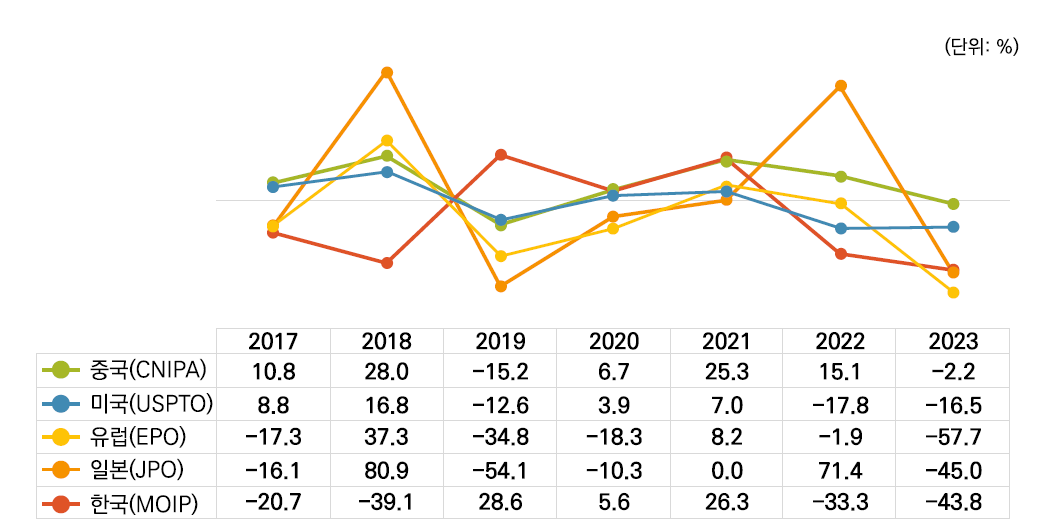
South Korea's patent applications stands at 4.5%...lowest among major nations
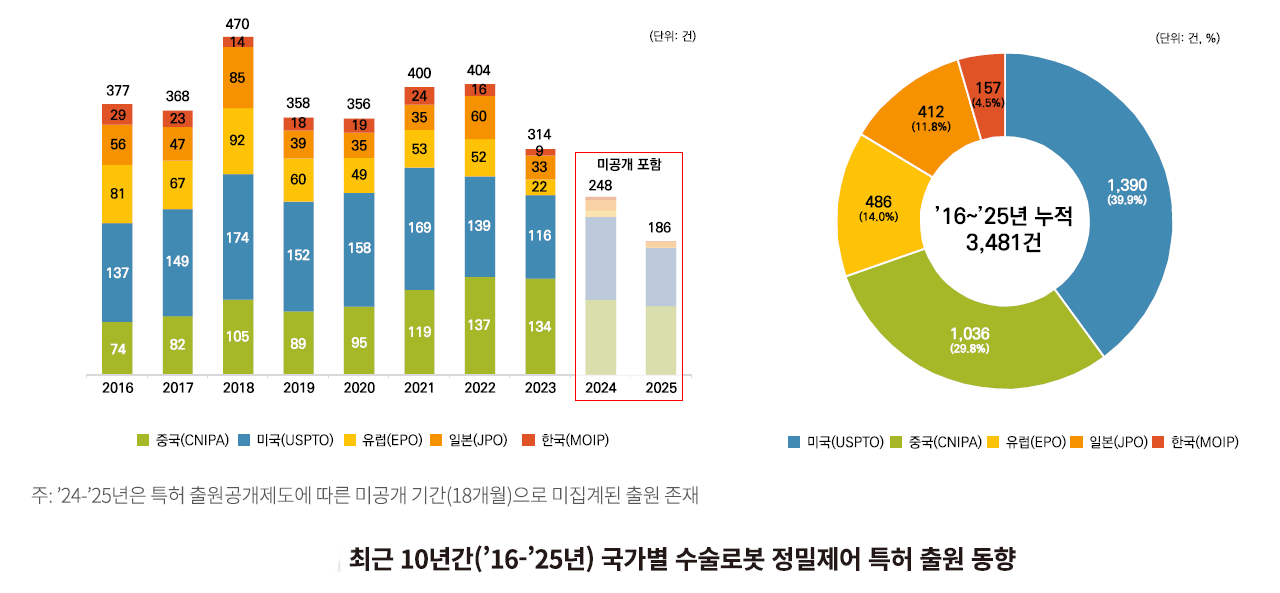
In terms of patent applications, a distinct competitive landscape emerged, centered heavily on the United States and China. From 2016 to 2025, a total of 3,481 surgical robot precision control patents were filed across the IP5 patent offices (South Korea, the United States, Japan, Europe, and China).
By country, the United States Patent and Trademark Office (USPTO) commanded the highest share of applications at 39.9%. China accounted for 29.8%, Europe for 14.0%, and Japan for 11.8%. South Korea recorded 4.5%, the lowest among major countries.
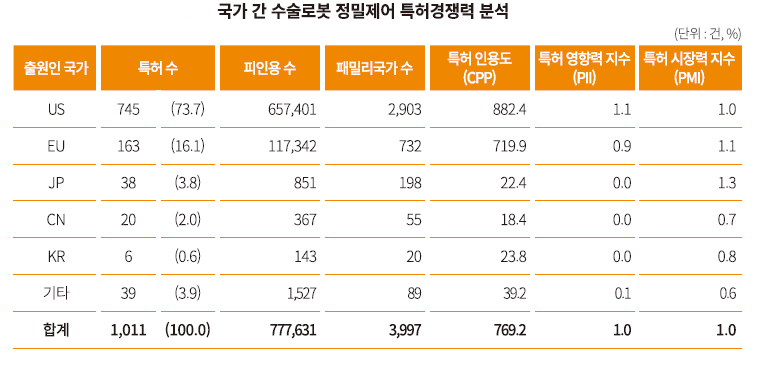
South Korea's position was also limited in terms of qualitative patent competitiveness. Among the 3,481 patents published over the past decade, a comparison of patent competitiveness among major nations, focusing on the 1,011 patents registered with the USPTO, revealed that US patents accounted for 745 patents (73.7%).
During the same period, Europe recorded 163 patents (16.1%), followed by ▲Japan with 38 ▲China with 20 ▲South Korea with 6.
South Korea was presented with a forward citation count of 143, a patent family country count of 20, a patent citation intensity of 23.8, a Patent Impact Index (PII) of 0.0, and a Patent Market Power Index (PMPI) of 0.8. Considering these metrics, the country's overall technological impact and global scalability are evaluated as limited.
Gaps across detailed technology segments were also substantial. In the patent competitiveness analysis for sensing feedback control, South Korea held 5 patents, accounting for 1.6% of the total. In interaction-based control, it held 1 patent (0.1%), and in navigation autonomous control, it remained at 2 patents (1.3%).
The United States showed a share exceeding 70% across all three sub-segments. It accounted for 238 patents (74.1%) in sensing-based feedback control, 547 patents (74.2%) in interaction-based control, and 118 patents (75.2%) in autonomous navigation control.
Patent concentration by specific corporate players was also high. The share of applications by the top 10 companies across each detailed technology exceeded 50%: 53.3% for sensing feedback control, 55.3% for interaction-based control, and 57.3% for navigation autonomous control. This indicates that the surgical robot market is unlikely to be reshaped by simply launching a product.
Technology accumulation is more critical than product launch
The prospects for Korean domestic surgical robot enterprises lie in technology accumulation rather than in market entry itself. Surgical robotics is a convergent industry integrating robotics, artificial intelligence, sensors, image processing, and control software.
Fabricating robotic arms or localizing surgical instrumentation alone is insufficient to close the gap with global market leaders. Precision control technology directly dictates intraoperative safety. Product competitiveness is determined by how accurately the system reflects minute movements at the surgical site, how reliably it compensates for clinician hand tremors, and how sophisticatedly it manages the forces generated during tissue contact.
Joint development with clinical sites is also vital. Precision control technology cannot secure commercial viability based purely on laboratory-level performance. Parameters such as operability, stability, and fatigue reduction that clinicians can actively sense must be validated within real-world surgical environments.
A global patent strategy must also be designed from the initial phases. Surgical robotics is an area where targeting only the domestic market is unsustainable. From early development, strategies are required to secure enforceable patents in major markets such as the United States and Europe while simultaneously deploying patent-circumvention tactics against competitors.
It is challenging for domestic firms to compete head-to-head with global leaders across all domains. A realistic approach involves a field-targeting strategy focusing on precision control technologies tailored to specific surgical specialties, particular techniques, or distinct hospital requirements.
An industry insider said, "As surgical robotics is a convergent industry combining robotics, artificial intelligence, sensors, image processing, and control software, securing global competitiveness is difficult through simple product development alone," and added, "The aim for domestic firms will be concurrently establishing real-world clinical validation and global patent strategies centered heavily around core precision control technologies."
-

- 0
댓글 운영방식은
댓글은 실명게재와 익명게재 방식이 있으며, 실명은 이름과 아이디가 노출됩니다. 익명은 필명으로 등록 가능하며, 대댓글은 익명으로 등록 가능합니다.
댓글 노출방식은
댓글 명예자문위원(팜-코니언-필기모양 아이콘)으로 위촉된 데일리팜 회원의 댓글은 ‘게시판형 보기’와 ’펼쳐보기형’ 리스트에서 항상 최상단에 노출됩니다. 새로운 댓글을 올리는 일반회원은 ‘게시판형’과 ‘펼쳐보기형’ 모두 팜코니언 회원이 쓴 댓글의 하단에 실시간 노출됩니다.
댓글의 삭제 기준은
다음의 경우 사전 통보없이 삭제하고 아이디 이용정지 또는 영구 가입제한이 될 수도 있습니다.
-
저작권·인격권 등 타인의 권리를 침해하는 경우
상용 프로그램의 등록과 게재, 배포를 안내하는 게시물
타인 또는 제3자의 저작권 및 기타 권리를 침해한 내용을 담은 게시물
-
근거 없는 비방·명예를 훼손하는 게시물
특정 이용자 및 개인에 대한 인신 공격적인 내용의 글 및 직접적인 욕설이 사용된 경우
특정 지역 및 종교간의 감정대립을 조장하는 내용
사실 확인이 안된 소문을 유포 시키는 경우
욕설과 비어, 속어를 담은 내용
정당법 및 공직선거법, 관계 법령에 저촉되는 경우(선관위 요청 시 즉시 삭제)
특정 지역이나 단체를 비하하는 경우
특정인의 명예를 훼손하여 해당인이 삭제를 요청하는 경우
특정인의 개인정보(주민등록번호, 전화, 상세주소 등)를 무단으로 게시하는 경우
타인의 ID 혹은 닉네임을 도용하는 경우
-
게시판 특성상 제한되는 내용
서비스 주제와 맞지 않는 내용의 글을 게재한 경우
동일 내용의 연속 게재 및 여러 기사에 중복 게재한 경우
부분적으로 변경하여 반복 게재하는 경우도 포함
제목과 관련 없는 내용의 게시물, 제목과 본문이 무관한 경우
돈벌기 및 직·간접 상업적 목적의 내용이 포함된 게시물
게시물 읽기 유도 등을 위해 내용과 무관한 제목을 사용한 경우
-
수사기관 등의 공식적인 요청이 있는 경우
-
기타사항
각 서비스의 필요성에 따라 미리 공지한 경우
기타 법률에 저촉되는 정보 게재를 목적으로 할 경우
기타 원만한 운영을 위해 운영자가 필요하다고 판단되는 내용
-
사실 관계 확인 후 삭제
저작권자로부터 허락받지 않은 내용을 무단 게재, 복제, 배포하는 경우
타인의 초상권을 침해하거나 개인정보를 유출하는 경우
당사에 제공한 이용자의 정보가 허위인 경우 (타인의 ID, 비밀번호 도용 등)
※이상의 내용중 일부 사항에 적용될 경우 이용약관 및 관련 법률에 의해 제재를 받으실 수도 있으며, 민·형사상 처벌을 받을 수도 있습니다.
※위에 명시되지 않은 내용이더라도 불법적인 내용으로 판단되거나 데일리팜 서비스에 바람직하지 않다고 판단되는 경우는 선 조치 이후 본 관리 기준을 수정 공시하겠습니다.
※기타 문의 사항은 데일리팜 운영자에게 연락주십시오. 메일 주소는 dailypharm@dailypharm.com입니다.
- “Drug pricing intervention contributes to the crisis in essential healthcare and shortage of drugs”
- Reporter's view | Lee, Jeong-Hwan