- LOGIN
- MemberShip
- 2026-09-11 00:49:08
- ‘Lower and Faster’…Dyslipidemia treatment strategy evolves
- by Son, Hyung Min | translator Alice Kang | 2026-04-21 07:33:04
Beyond the question of “how low to lower” LDL cholesterol, “how quickly to reach the target level” is emerging as a key variable in the treatment of dyslipidemia.
As the target has been tightened to below 55 mg/dL, an approach aimed at reaching the goal quickly through initial combination therapy is emerging as an alternative.
According to industry sources on the 21st, treatment strategies for dyslipidemia based on early combination therapy were presented as a major topic at the ACC Asia 2026 Together With KSC Spring Conference held recently in Gyeongju.
Cardiovascular disease is one of the major causes of death in Korea, and dyslipidemia is considered a representative risk factor that can be corrected through treatment.
Nevertheless, the 30-day and 1-year mortality rates of acute myocardial infarction patients in Korea still stand at approximately 9% and 16%, respectively, indicating that existing treatment strategies alone have not been sufficient to adequately reduce early mortality risk. This, together with the fact that the LDL cholesterol target attainment rate in very high-risk patients remains limited, suggests the need for a more aggressive treatment approach.
Against this backdrop, the need for a combination therapy that can overcome the limitations of statin monotherapy has been consistently raised. Notably, the IMPROVE-IT study reported that adding ezetimibe to statins resulted in an additional approximately 24% reduction in LDL-cholesterol, along with a 24% and 32% reduction in the risk of myocardial infarction and ischemic stroke, respectively.
With long-term safety and efficacy subsequently confirmed, ezetimibe has become established in major guidelines as a preferred combination and second-line treatment option.
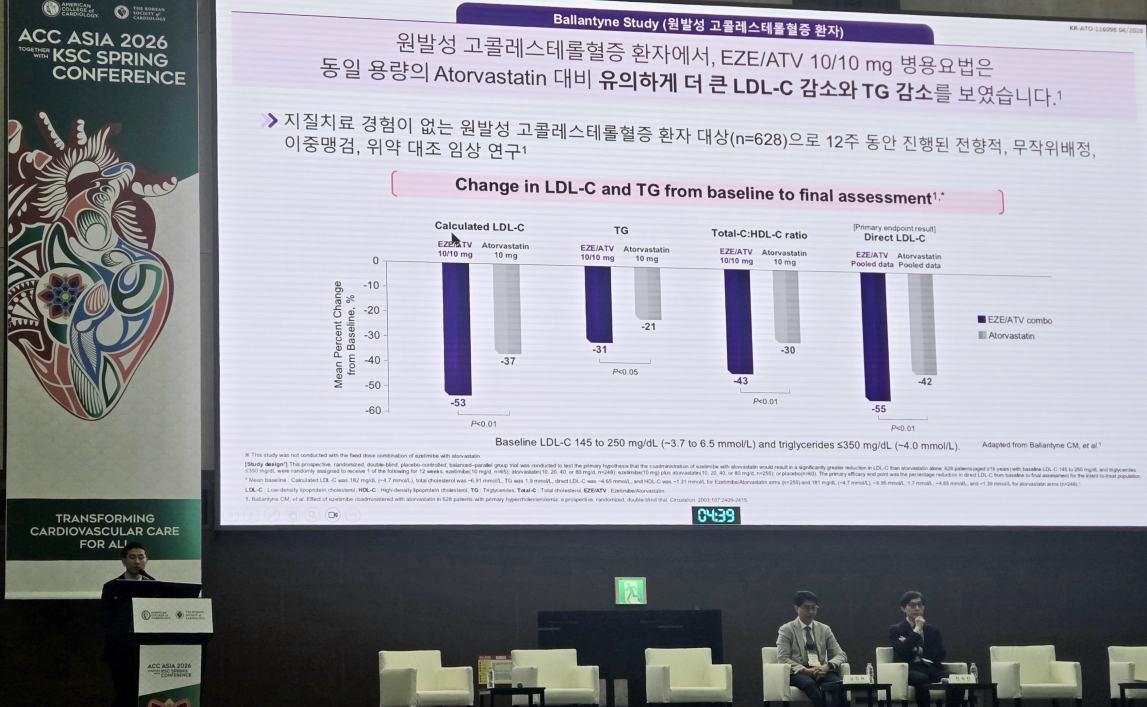
Professor Jin Wi of the Division of Cardiology at Gachon University Gil Medical Center said, “Dyslipidemia treatment is shifting from a high-intensity statin-centered approach to a more aggressive cholesterol-lowering strategy. It is important to reach LDL cholesterol targets quickly through early combination therapy.”
In particular, he emphasized the importance of dyslipidemia management from a CKM (Cardio-Kidney-Metabolic) perspective, where cardiovascular, kidney, and metabolic diseases are interconnected, saying, “In these patients especially, LDL cholesterol should be controlled aggressively at an early stage.”
He added, “Atorvastatin can be used in chronic kidney disease patients without dose adjustment, which gives it high clinical utility.”
Professor Suk Min Seo, Division of Cardiology at Eunpyeong St. Mary’s Hospital, also noted, “In actual clinical practice, it is difficult to fully implement stepwise therapy due to limitations in patient follow-up. Applying high-intensity statin and ezetimibe combination therapy from the outset is a realistic strategy in terms of achieving the target within a short period and managing risk.”
At the session that day, the ezetimibe/atorvastatin combination product ‘Atozet’ was also introduced as one of the initial combination therapy options.
Beyond ‘lower’ to ‘faster’… guidelines and clinical evidence align
Recent guidelines are demanding changes not only in treatment goals but also in the treatment approach itself.
The 2025 European Society of Cardiology / European Atherosclerosis Society (ESC/EAS) guidelines presented the LDL cholesterol goal for patients with atherosclerotic cardiovascular disease (ASCVD) as below 55 mg/dL and at least a 50% reduction from baseline, and in some very high-risk groups, recommended below 40 mg/dL.
Furthermore, for treatment-naïve ACS patients, the guidelines explicitly recommend considering combination therapy with high-intensity statins and ezetimibe from the outset, emphasizing aggressive intervention at the start of treatment.
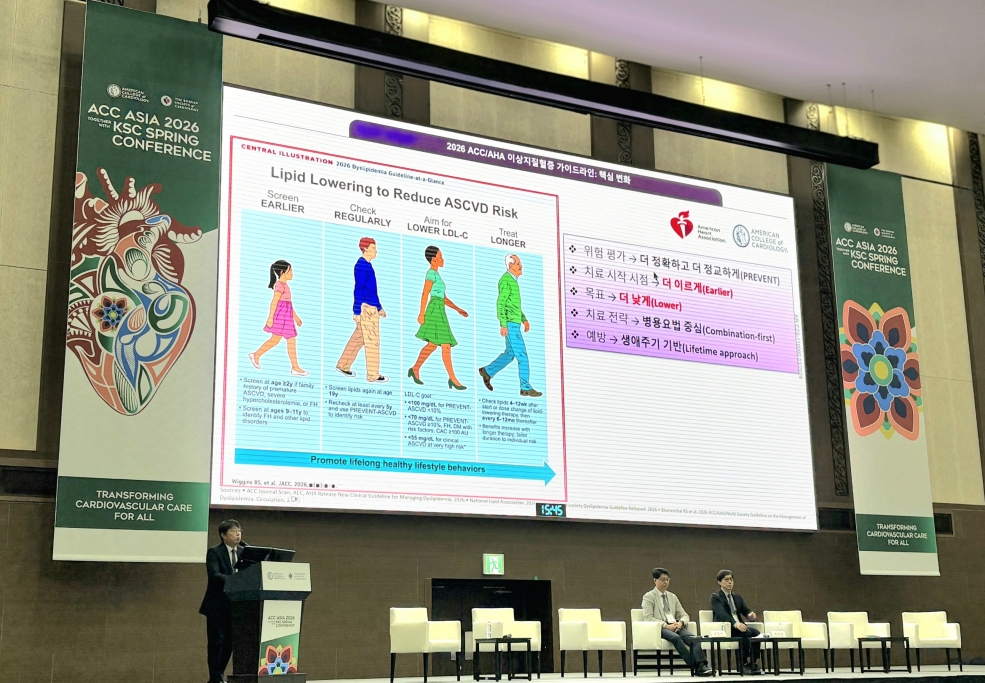
The 2026 American College of Cardiology / American Heart Association (ACC/AHA) guidelines likewise presented an LDL cholesterol goal of below 55 mg/dL for very high-risk patients in secondary prevention, and recommend early addition of non-statin agents when the target is difficult to achieve with statin monotherapy alone. Accordingly, the treatment paradigm appears to be shifting from the existing stepwise approach to an early combination-centered strategy.
This shift is supported by clinical research. The Ez-PAVE trial was a study designed to verify the clinical validity of lowering the LDL cholesterol target from the conventional 70 mg/dL to 55 mg/dL.
In this study, which enrolled 3,048 Korean ASCVD patients, the group targeting an LDL-cholesterol level below 55 mg/dL achieved a statistically significant reduction of approximately 33% in major adverse cardiovascular events (MACE) over three years compared to the group targeting below 70 mg/dL. This suggests that a strategy of controlling LDL cholesterol to a lower level can lead not only to numerical improvement but also to an actual reduction in clinical events.
Furthermore, the BETTER TRIAL study showed that early combination therapy resulted in significant improvements in both the magnitude of LDL-cholesterol reduction and the rate of target achievement compared to monotherapy. In this study of Korean patients with very high-risk ASCVD, early combination therapy with ezetimibe and atorvastatin, administered before reaching the maximum statin dose, demonstrated significant improvements in both the magnitude of LDL-cholesterol reduction and the rate of target achievement compared to monotherapy.
In particular, the rate of achieving LDL-cholesterol levels below 55 mg/dL was 46.2% versus 9.0% at 6 weeks and 55.0% versus 15.4% at 12 weeks, clearly demonstrating the efficacy of the early combination strategy.
Ultimately, the treatment of dyslipidemia is expanding beyond the question of “how low to lower” to include “how quickly to achieve” the target level. Considering changes in guidelines and clinical evidence, a strategy of applying aggressive combination therapy from the outset is expected to emerge as a key factor in improving patient outcomes.
-

- 0
댓글 운영방식은
댓글은 실명게재와 익명게재 방식이 있으며, 실명은 이름과 아이디가 노출됩니다. 익명은 필명으로 등록 가능하며, 대댓글은 익명으로 등록 가능합니다.
댓글 노출방식은
댓글 명예자문위원(팜-코니언-필기모양 아이콘)으로 위촉된 데일리팜 회원의 댓글은 ‘게시판형 보기’와 ’펼쳐보기형’ 리스트에서 항상 최상단에 노출됩니다. 새로운 댓글을 올리는 일반회원은 ‘게시판형’과 ‘펼쳐보기형’ 모두 팜코니언 회원이 쓴 댓글의 하단에 실시간 노출됩니다.
댓글의 삭제 기준은
다음의 경우 사전 통보없이 삭제하고 아이디 이용정지 또는 영구 가입제한이 될 수도 있습니다.
-
저작권·인격권 등 타인의 권리를 침해하는 경우
상용 프로그램의 등록과 게재, 배포를 안내하는 게시물
타인 또는 제3자의 저작권 및 기타 권리를 침해한 내용을 담은 게시물
-
근거 없는 비방·명예를 훼손하는 게시물
특정 이용자 및 개인에 대한 인신 공격적인 내용의 글 및 직접적인 욕설이 사용된 경우
특정 지역 및 종교간의 감정대립을 조장하는 내용
사실 확인이 안된 소문을 유포 시키는 경우
욕설과 비어, 속어를 담은 내용
정당법 및 공직선거법, 관계 법령에 저촉되는 경우(선관위 요청 시 즉시 삭제)
특정 지역이나 단체를 비하하는 경우
특정인의 명예를 훼손하여 해당인이 삭제를 요청하는 경우
특정인의 개인정보(주민등록번호, 전화, 상세주소 등)를 무단으로 게시하는 경우
타인의 ID 혹은 닉네임을 도용하는 경우
-
게시판 특성상 제한되는 내용
서비스 주제와 맞지 않는 내용의 글을 게재한 경우
동일 내용의 연속 게재 및 여러 기사에 중복 게재한 경우
부분적으로 변경하여 반복 게재하는 경우도 포함
제목과 관련 없는 내용의 게시물, 제목과 본문이 무관한 경우
돈벌기 및 직·간접 상업적 목적의 내용이 포함된 게시물
게시물 읽기 유도 등을 위해 내용과 무관한 제목을 사용한 경우
-
수사기관 등의 공식적인 요청이 있는 경우
-
기타사항
각 서비스의 필요성에 따라 미리 공지한 경우
기타 법률에 저촉되는 정보 게재를 목적으로 할 경우
기타 원만한 운영을 위해 운영자가 필요하다고 판단되는 내용
-
사실 관계 확인 후 삭제
저작권자로부터 허락받지 않은 내용을 무단 게재, 복제, 배포하는 경우
타인의 초상권을 침해하거나 개인정보를 유출하는 경우
당사에 제공한 이용자의 정보가 허위인 경우 (타인의 ID, 비밀번호 도용 등)
※이상의 내용중 일부 사항에 적용될 경우 이용약관 및 관련 법률에 의해 제재를 받으실 수도 있으며, 민·형사상 처벌을 받을 수도 있습니다.
※위에 명시되지 않은 내용이더라도 불법적인 내용으로 판단되거나 데일리팜 서비스에 바람직하지 않다고 판단되는 경우는 선 조치 이후 본 관리 기준을 수정 공시하겠습니다.
※기타 문의 사항은 데일리팜 운영자에게 연락주십시오. 메일 주소는 dailypharm@dailypharm.com입니다.